
Le Morne Cultural Landscape
By Cindy Carlsson
What is the Le Morne Cultural Landscape?
The Le Morne Cultural Landscape is located on Le Morne Brabant peninsula on the Indian Ocean island of Mauritius.
The site’s focus is the peninsula’s rugged Le Morne mountain, which served as a refuge for “maroons” (escaped slaves) in the 18th and early 19th centuries. The difficult-to-access mountaintop offered a nearly inaccessible, but relatively flat area for living, as well as nearby caves for hiding when necessary. Their descendants continued to live on and around the mountain into the 20th century.
Disclosure: This article contains affiliate links. Making a purchase through an affiliate link will mean a small commission for this website. This will not affect your price. Privacy policy.
Why is the Le Morne Cultural Landscape a UNESCO World Heritage site?
As a legendary maroon site that retains evidence of its settlement, Le Morne is important both historically and symbolically.
UNESCO explains: “The dramatic form of the mountain, the heroic nature of the resistance it sheltered, and the longevity of the oral traditions associated with the maroons, has made Le Morne a symbol of slavesʼ fight for freedom, their suffering, and their sacrifice, all of which have relevance beyond its geographical location, to the countries from which the slaves came – in particular the African mainland, Madagascar and India and South-east Asia.”
While the site harbors a number of rare plant species and the buffer area includes a unique underwater “waterfall,” the Le Morne World Heritage Site is purely a cultural site.
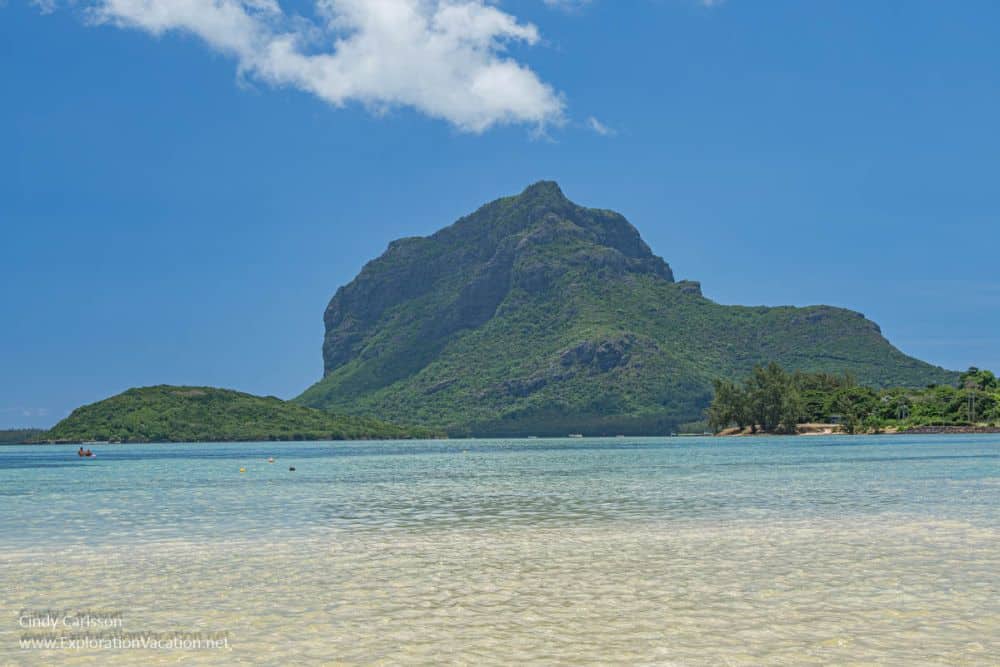
The mountain looms large in island history as the site of a mass suicide in 1835. The maroons on the mountain thought British authorities were coming to capture them. Rather than face bondage, many are said to have jumped from the cliffs to their deaths. But rather than recapturing them, the British were actually coming to announce that slavery had been abolished and they were now legally free people. It’s a particularly tragic ending to a brutal era.
What can you expect on a visit to the Le Morne?
Aside from viewing the mountain from the land or sea below it or from the air above, there are really only three options for actually visiting the Le Morne Cultural Landscape:
- Hike up the mountain.
- Visit the open air museum at the foot of the mountain trail (Currently closed for renovations).
- Visit a memorial garden at the base of the mountain.
Hike the trail: Le Morne was a refuge for maroons because the relatively flat top was only accessible via one very steep trail. That made the site suitable for settlement and easy to defend. None of that has changed. However, the trail has been improved somewhat, allowing hikers to go up the mountain along the same route used by the maroons. Along the way you are likely to see rare plants and spectacular vistas.
Visit Trou Chenille Open Air Museum, a re-creation of an early maroon settlement on a lower slope of the mountain. The museum provides insight into the life of the maroons who settled on and around the mountain through typical structures and activities in a village setting. However, as of 2026, the site is closed as it awaits and/or undergoes renovation. If UNESCO gives permission and all goes according to plan, the museum should reopen by early 2028, with better facilities and wheelchair accessibility.
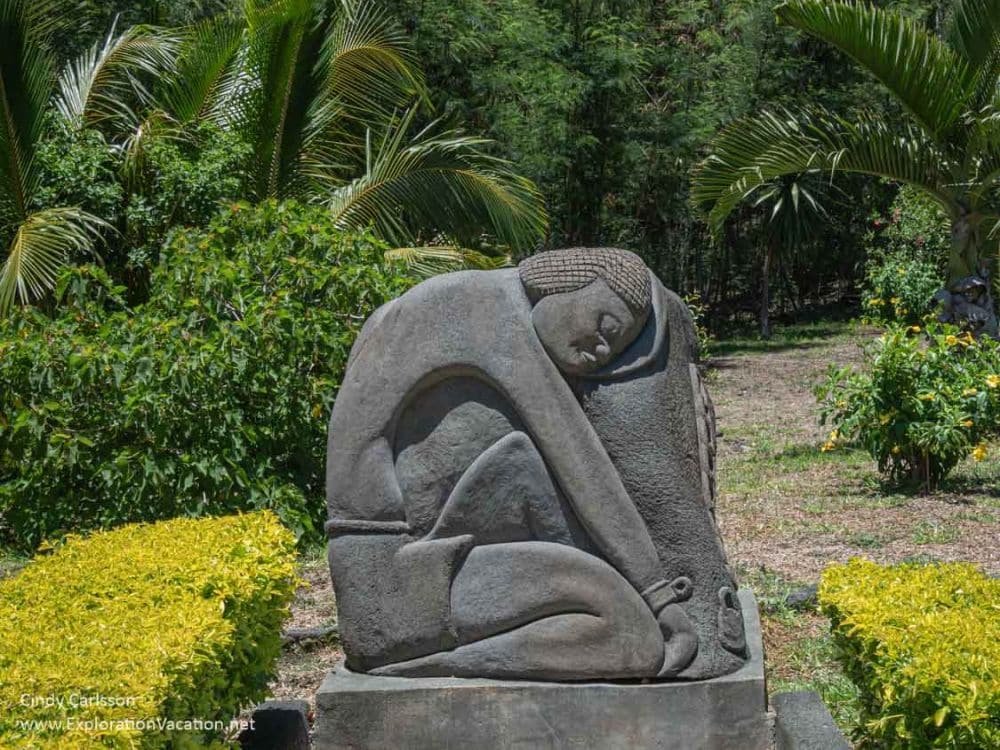
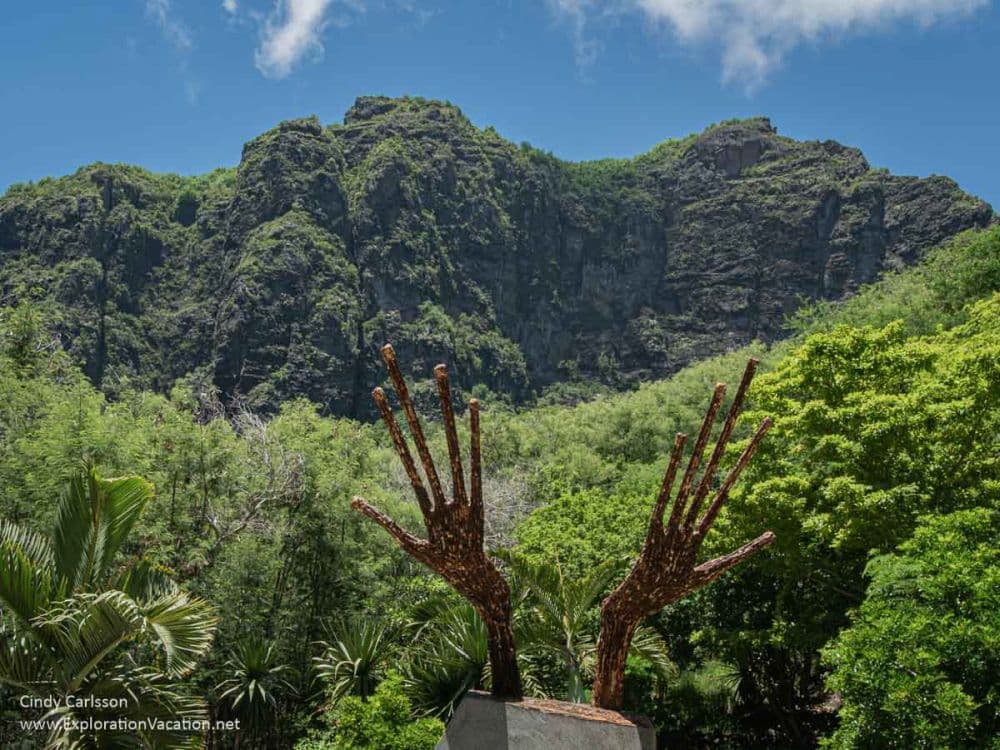
Visit the International Slave Route Monument to honor the resistance to slavery on Mauritius and beyond. This quiet garden/small park holds ten sculptures that reflect on slavery, escape, and freedom. The sculptures were created by artists from Mauritius, Reunion, Madagascar, Mozambique, China, Malaysia, Haiti, France, and Senegal. It’s part of a larger international Slave Route Project related to the transatlantic and Indian Ocean slave trade that honors the resistance and resilience of enslaved people.
And, of course, you can drive or bike to various locations that offer a view of the mountain. Take a boat out. Or take a seaplane ride or helicopter tour that gives you a view of the mountain and the underwater waterfall.
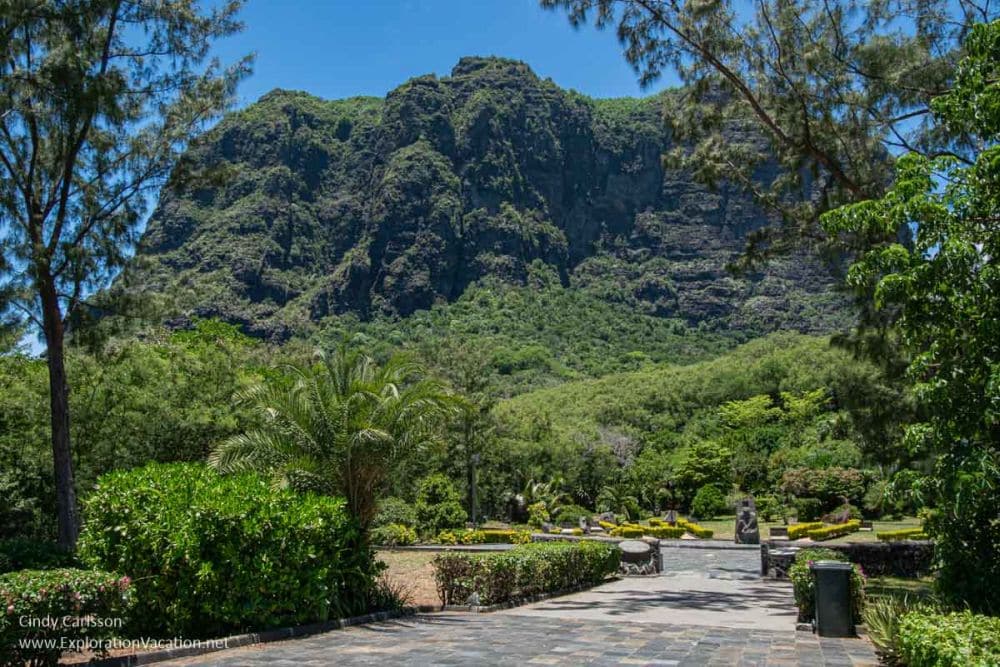
Of the three pieces of the UNESCO site, the only one I was actually able to visit was the slave memorial. It’s a peaceful spot with a great view of one side of the mountain and some very interesting sculptures.
Is Le Morne worth visiting?
Even if the open air museum is open, it doesn’t appear to be an extensive site. And Mauritius itself is a very long haul from most other spots in the world. For a lot of travelers, it probably doesn’t justify a special trip just for this and the island’s other small (but better interpreted) UNESCO World Heritage site, the Aapravasi Ghat immigration center.
However, if you are already planning a trip to Mauritius, it’s well worth heading to this part of the island and at least stopping at the slave memorial or heading up the mountain on a guided hike. This is a gorgeous area with plenty of beaches nearby, making it a nice day trip from pretty much anywhere on the island. And if you are looking to combine a beach vacation with a World Heritage site, spending a few days in this area offers both. It’s also an easy drive to the Aapravasi Ghat UNESCO site from this area.
What sorts of travelers would like Le Morne?
If you love challenging hikes with great views, this sounds like a good one. Combine it with other hikes on the island and those in the nearby Pitons, Cirques, and Remparts of Réunion Island UNESCO site. That gives you three World Heritage sites and a mix of stunning hikes and history.
Le Morne is a pilgrimage site of sorts for those with maroon ancestors from this part of the world. It’s one of the few places where you can literally follow the footsteps of people who escaped bondage to the exact site where they built lives as free people.
Tips for visiting the Le Morne Cultural Landscape
Sunscreen, water, and bug spray are essential even if you are just visiting the memorial garden. That’s especially true during the southern summer’s hot, humid cyclone season. Mosquitoes here can carry any of several serious diseases, so ALWAYS protect yourself from both the sun and mosquitoes!
Le Morne is best hiked early in the morning. Part of the trail is very steep and narrow, but this area can be bypassed by only taking section 1 – the historical trail – and avoiding the steeper and more dangerous section 2. Hiking tours are available and provide historic and cultural information along with your hike.
Book your accommodations on Mauritius here.
If you plan to visit the open air museum, check around locally to see when/if it is open. Since not all drivers seem to know where the museum is located (and will take you to the slavery memorial instead), tell your driver to take you to the spot where the mountain hiking trail begins instead. Everyone knows where that is, and the museum is right there.
You’ll find the best views of the mountain from beaches along the peninsula. Some of these are behind resorts and are hard to access. (All beaches are public, but you can’t cross non-beach private property to get to them.) The beach by the mangrove forest near the sea plane base is a good spot and all drivers know it. It’s also quite near the entrance to the museum and hiking trail.
Compare rental car prices on Mauritius.
You MAY be able to get information on the rest of the UNESCO site at the slave memorial. There is a small park office there and it was open when I visited. However, I couldn’t actually find anyone on the site! There was someone there, but I never found them.
English is the official language of government in Mauritius and everyone will usually understand it. They will probably also understand French, as well as Mauritian Creole and one or more Asian or Indian languages.
Roads are generally paved and in good condition, but often narrow and always a little chaotic. Signage is generally in French and English. However, because you drive on the left side of the road here, many Western travelers hire drivers, use taxis, or book tours to get around the island. When you find a driver you like, ask if you can hire him directly for the rest of your trip.
Where is the Le Morne Cultural Landscape?
The Le Morne Cultural Landscape UNESCO Site is on the southwesternmost point of the island of Mauritius, in the Indian Ocean east of Madagascar.
Direct flights to Mauritius are available from Europe, Africa, India, the Middle East, Indonesia, and several other Indian Ocean islands. Flying time from Europe is around 12 hours. There are no direct flights from North America.
- From Sir Seewoosagur Ramgoolam International Airport (MRU), Le Morne is about an hour’s drive almost directly west.
- From Port Louis, Le Morne is at least an hour’s drive south. (Travel times for Port Louis are almost impossible to predict, due to traffic.)
- It will take another half-hour from Grand Baie, north of Port Louis – depending on traffic around Port Louis.
There are a few locations from which you can explore or at least easily view the site:
- The Le Morne hiking trail and the Trou Chenille Open Air Museum are on the south side of the central part of the peninsula. There is a sign along the route. The GPS is -20.4600, 57.3273. Parking should be free.
- The International Slave Route Monument is located at -20.4518, 57.3144. It’s right across from the Le Morne Public Beach, which has a large paid parking area.
- The mountain vista from the beach along the mangrove forest is at around -20.4630, 57.3382. We stopped without paying, but check when you arrive, as I think there is a fee.
If you’re willing to walk a bit, you should be able to reach these sites via bus 5, which you may have to connect to from another bus from wherever you’re staying. Check route details at your lodging.
For more information about the Le Morne Cultural Landscape, its opening hours and admission fees, see its official website. Hiking info is located here in the form of a PDF.
Have you been to Mauritius and visited Le Morne? If so, do you have any additional information or advice about this UNESCO World Heritage site? Please add your comments below!