
Tashkent Modernist Architecture. Modernity and Tradition in Central Asia
By Rachel Heller
What is Tashkent Modernist Architecture UNESCO site?
This UNESCO group of buildings were all constructed between the 1960s and the beginning of the 1990s. Uzbekistan was, at the time, part of the Soviet Union. A devastating earthquake in 1966 destroyed much of the capital, Tashkent, and these buildings were all part of the reconstruction, which completely reshaped the city center into a “modern socialist metropolis,” according to UNESCO.
Disclosure: This article contains affiliate links. Making a purchase through an affiliate link will mean a small commission for this website. This will not affect your price. Privacy policy.
The ten buildings in the group are all very different from each other, but have certain traits in common that fall under the general category of Soviet modernist architecture. They were chosen as example of many more buildings that were part of the same reshaping of the city, and each represents a different category of public building.
The ten buildings are:
- Zhemchug Residential Building (Zhemchug, the “Pearl”)
- The State Museum of History (former Lenin Museum)
- Central Exhibition Hall of the Academy of Arts (former Exhibition Hall of the Union of Artists)
- Kosmonavtlar Metro Station (Cosmonauts Avenue Metro Station)
- Big Solar Furnace (Sun Heliocomplex)
- Peoples’ Friendship Palace
- State Museum of Arts
- State Circus
- Chorsu Market (Chorsu Bazaar)
- Alisher Navoi Cinema Palace (Palace of Arts, Panoramic Cinema)
Why are these examples of Soviet modernist architecture a UNESCO World Heritage site?
In this “post-thaw” period, these particular structures were all intended to be landmarks in this new, model Soviet city. What is unusual about them – and the many other buildings they represent – is how they “combined modernist themes and aspirations with reinterpreted local motifs and building patterns,” according to UNESCO. The group “exemplifies the combination of Soviet standardisation and site-specific designs” as part of a movement of “localised modernism” across the USSR.
In other words, while modernism was a global movement in architecture, Tashkent’s versions combine ideals of Soviet socialism – standardization of materials, but also a certain glorification of the state – with local visual themes such as mosaics and latticework screens, for example.
What can you expect if you visit these examples of Soviet modernism in Tashkent?
Nine of the buildings are within the center of this very modern city. That is not to say that they’re close together, because the post-earthquake urban area is very spread out, with many parks and wide avenues. The tenth building in the list is quite a long way away on the edge of the city. I managed to see the nine central ones, though I didn’t see inside very many of them.
This is not the modernist architecture, i.e. Bauhaus, that developed earlier, in the 1920s and 1930s. Yet as I visited them one at a time, I could recognize certain common features, and even recognized other buildings that were clearly from the same period.
Zhemchug Residential Building
Architect: Ofelia Aidinova. Built: 1985.
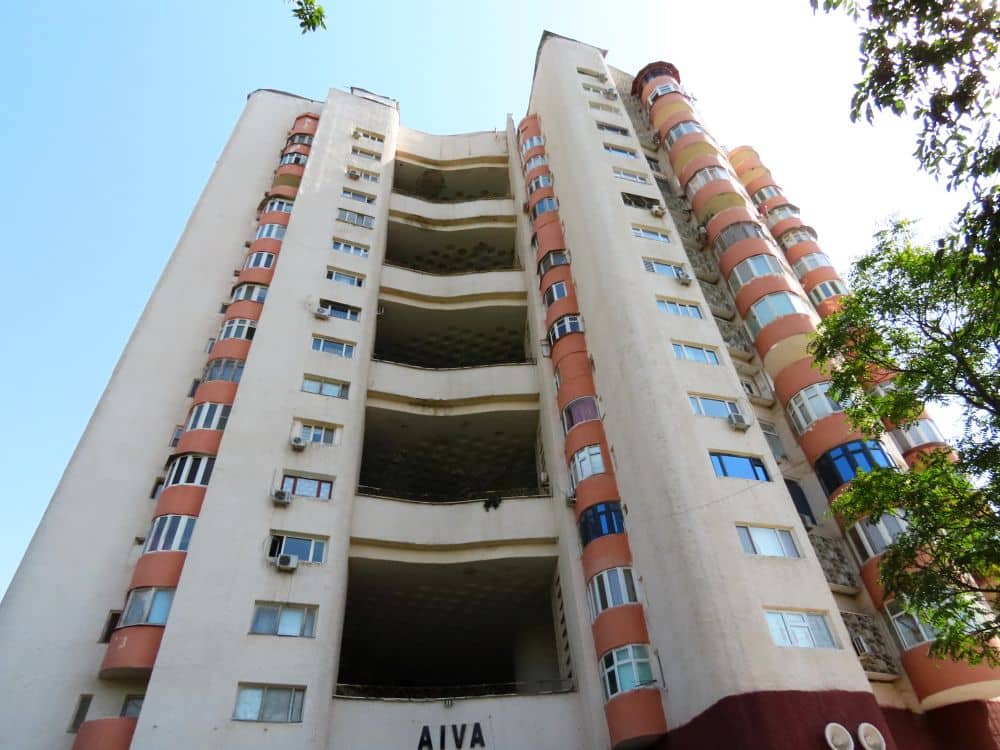
This tall apartment building stands out for two unusual features. First, the balconies are round, forming vertical cylinders up the buildings. These days many of the balconies have been closed in with windows, but the form is intact.
Secondly, the architect, Ofelia Aidinova, tried to create a village atmosphere by including an atrium every three stories. These spaces are open to the outside and the apartment entrances face into them, which makes each one a sort of plaza for residents to sit with their neighbors and for their children to play.
The State Museum of the History of Uzbekistan
Architects: Yevgeny Rozanov and Vsevolod Shestopalov. Built: 1970.
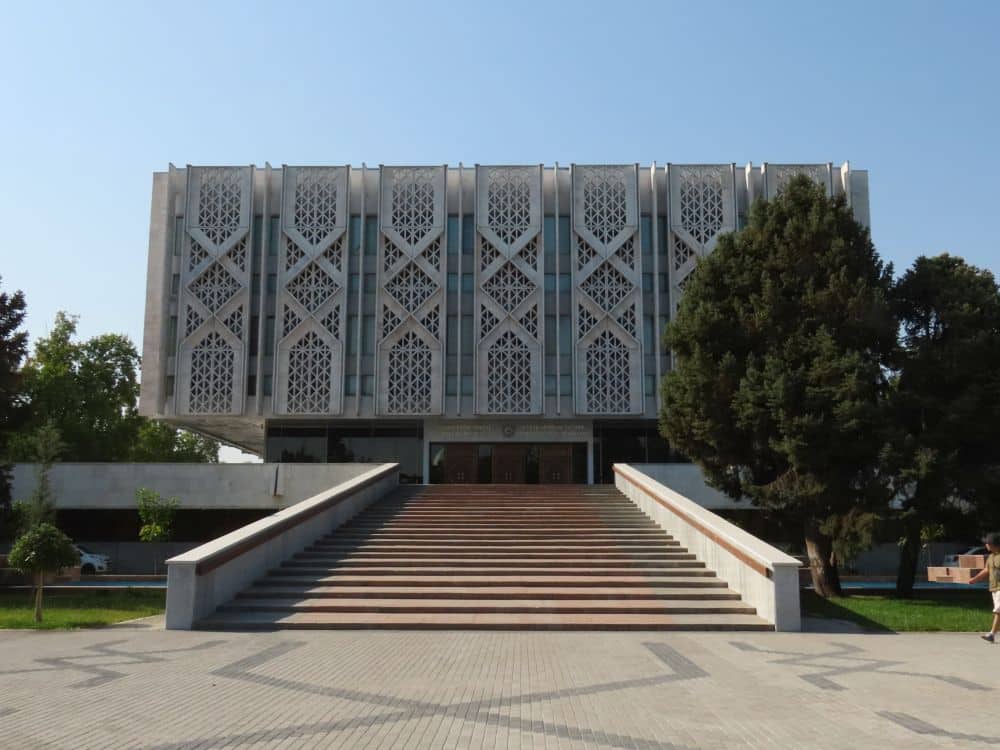
The original concept of the museum revolved around Lenin and how his ideals were supposedly realized in Central Asia. The entrance inside had a six-meter-tall statue of Lenin and a mosaic depicting workers, peasants and intellectuals making his ideals a reality, though both were removed after Uzbekistan’s independence.
Today this interesting structure houses an excellent history museum. It is well worth visiting if you want to get an overview of Uzbekistan’s history before visiting the more famous destinations like Bukhara and Khiva. The presentation is a combination of historical objects, photographs and films, all presented chronologically with explanations in Uzbek, Russian and English.
As for the building, on the outside you can see a traditional Central Asian motif. A very long, grand staircase leads up to the entrance, and inside you’ll enter the museum up an elegant marble stairway. The building struck me as being in much better shape than many of the others.
Central Exhibition Hall of the Academy of Arts
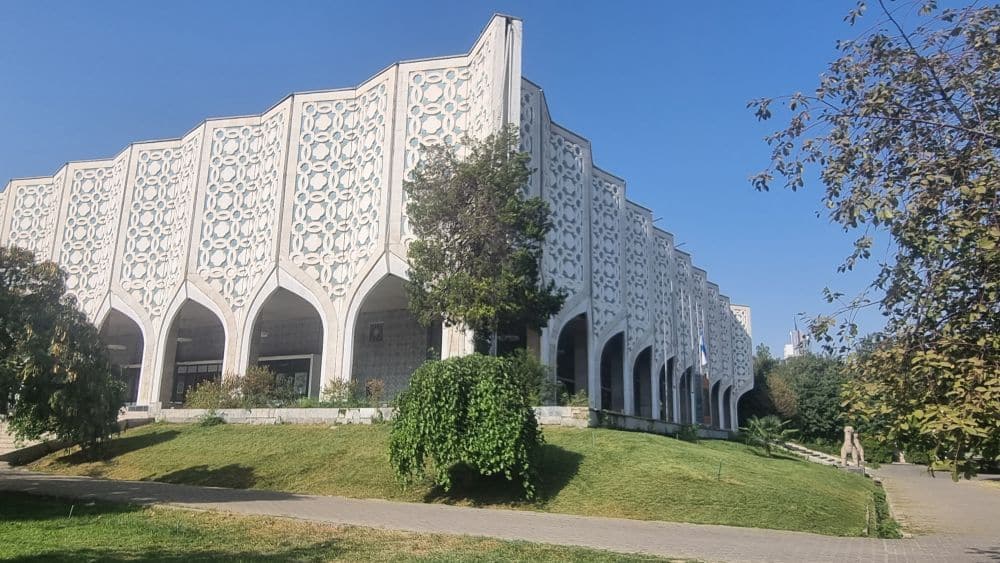
Architects: Rafael Khairutdinov and Farhad Tursunov. Built: 1974.
I did not get to see the inside of this one, but if there’s an exhibition going on, you might be able to. Like the history museum, it repeats some traditional geometric motifs on its exterior. The arches at the ground floor and skylights on the roof allow indirect light to enter.
Kosmonavtlar Metro Station
Architects: Sergo Sutyagin, Sergei Sokolov. Built: 1984.
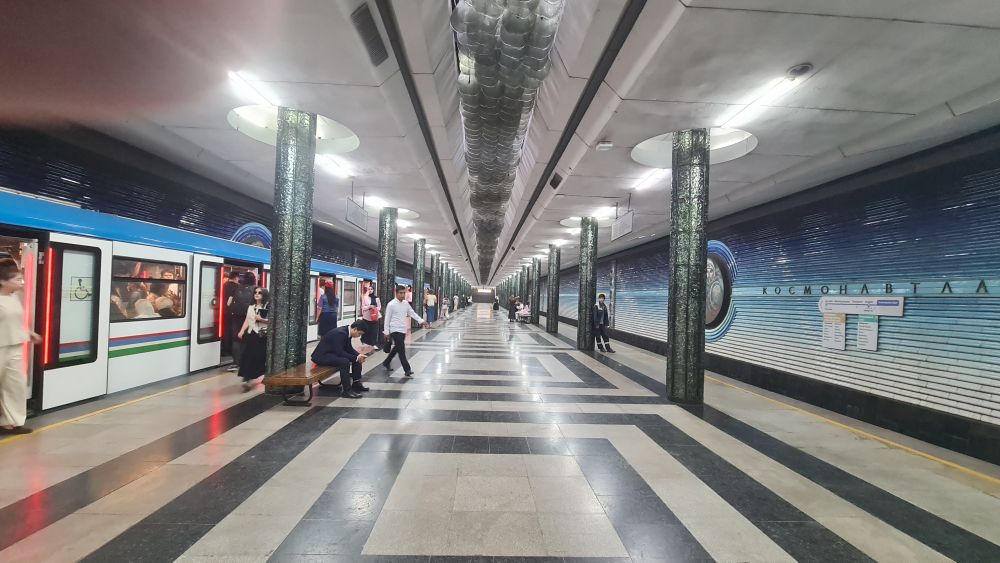
This metro station represents Tashkent’s entire metro system, each of which is decorated with a different theme. The metro is the easiest way to get around in Tashkent, and the stations are definitely worth a look.
Unlike the metro stations in Moscow, these do not extol the USSR, with heroic statues of workers, peasants and so on. Instead, each theme has something to do with Uzbekistan and/or its history.
Kosmonavtlar Metro Station is dedicated to the cosmonauts of the Soviet space program. The dominant color is blue, and the images along the platform illustrate cosmonauts or events from the history of the space program. Gagarin, for example, is pictured, as is Valentina Tereshkova, the first female cosmonaut. The gradual white to dark blue color scheme is meant to suggest the darkness of space.
It’s worth going out of this metro station to see a beautiful statue in honor of Uzbekistan’s cosmonauts. It has rather dreamlike images of Icarus, Ulugbek (astronomer), cosmonaut Vladimir Dzhanibekov, and various other figures I can’t identify.
Peoples’ Friendship Palace
Architects: E. Rozanov, V. Shestopalov, E. Shumov, E. Sukhanova, and L. Berezovskaya. Built: 1977–1981.
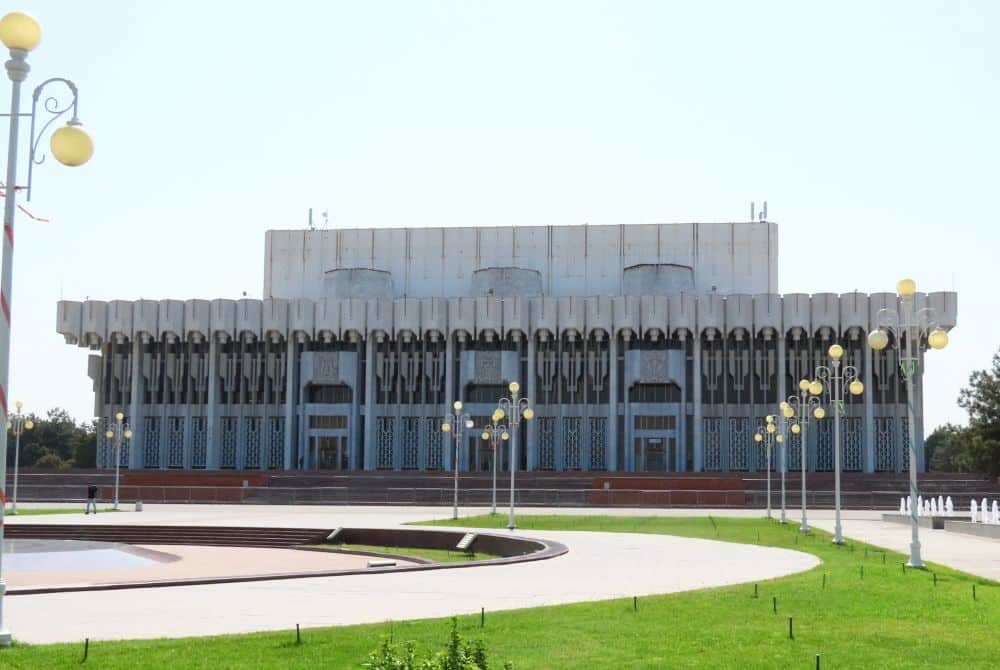
The Peoples’ Friendship Palace certainly looks like a palace. It was meant for both Communist Party congresses and concerts, with room for a 4,100-seat congress hall. The external elements like those between the columns under the portico and the screens on the facade are references to local traditional elements. It is still used as an event space. Apparently the lobby is very grand, with its original chandeliers and artworks. Unfortunately, you can’t go in unless you are attending an event there.
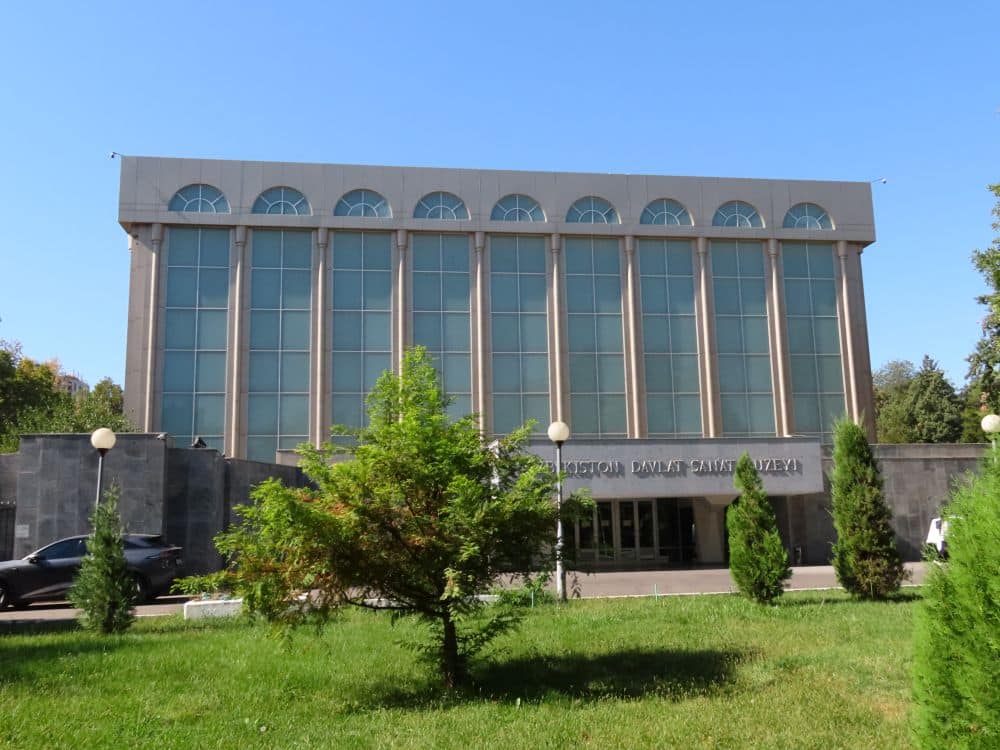
State Museum of Arts of Uzbekistan
Architects: Savely Rosenblum, Iskander Abdulov, and Anatoly Nikiforov. Built: 1974.
This one struck me as the least modernist, with so many glass windows and vaguely classical columns. That’s because the exterior as it now stands is not the original. Rather than repair the original exterior – a grid of square translucent panels that filtered the light inside – a new exterior, added in the 1990s, is distinctly at odds with the original plan. The interior, however, is still original.
As of this writing, the museum is closed for renovation, which should restore it to its original design. It is reputed to have a wonderful art collection and to be well worth visiting once it opens again. I can’t find any information, though, on when that is expected to happen.
State Circus
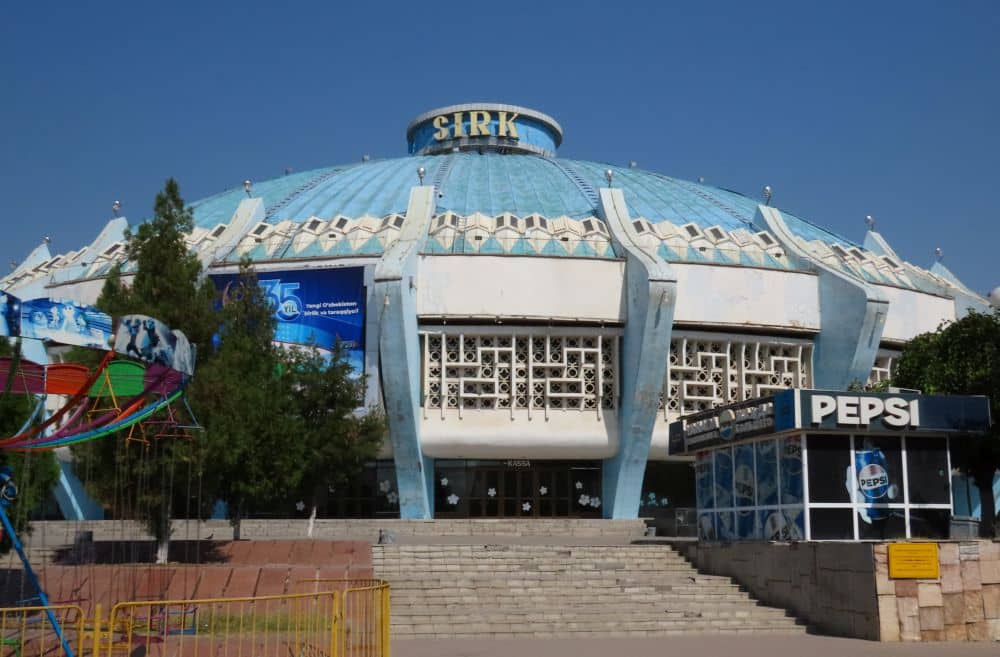
Architects: G. Aleksandrovich and G. Masjagin. Built: 1962–1976.
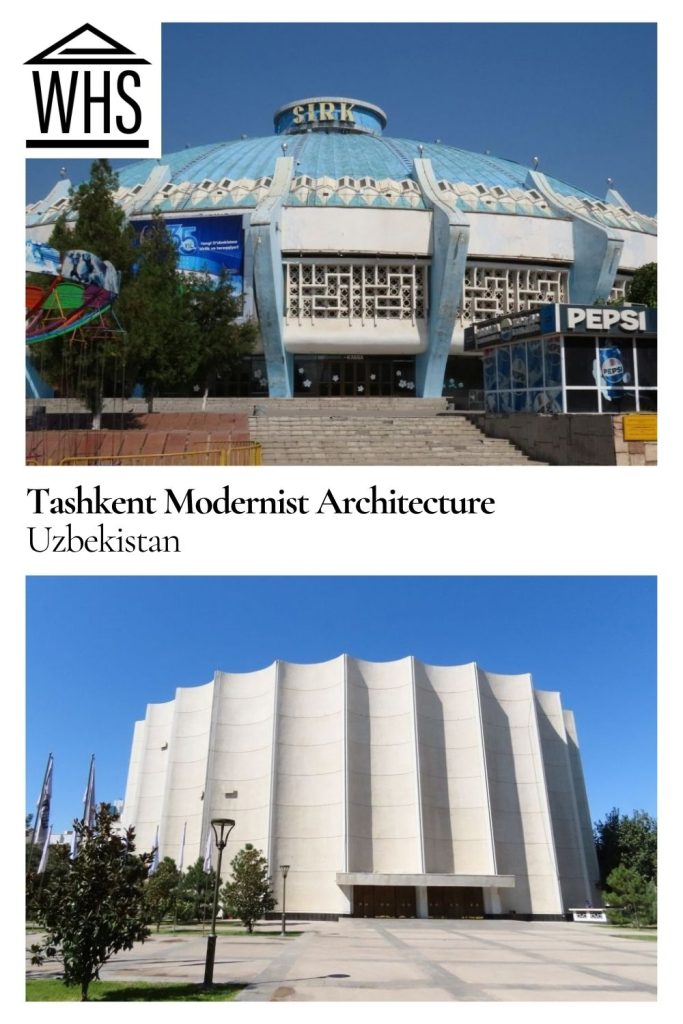
The performance space of the State Circus building is entirely round and covered by a dome. it offers seating for 3,000 people, and has a two-level foyer around its edges. The lower level of the foyer is recessed and glass-sided. The upper level, not recessed, is shaded by a concrete screen: again, a nod to traditional Central Asian motifs. The building appears to be in quite bad shape, judging from the outside, but still hosts performances by the Tashkent Circus.
The plaza in front of it gave a very forlorn impression when I was there; the fountain was empty and also looked badly in need of repair.
Chorsu Market (Chorsu Bozor)
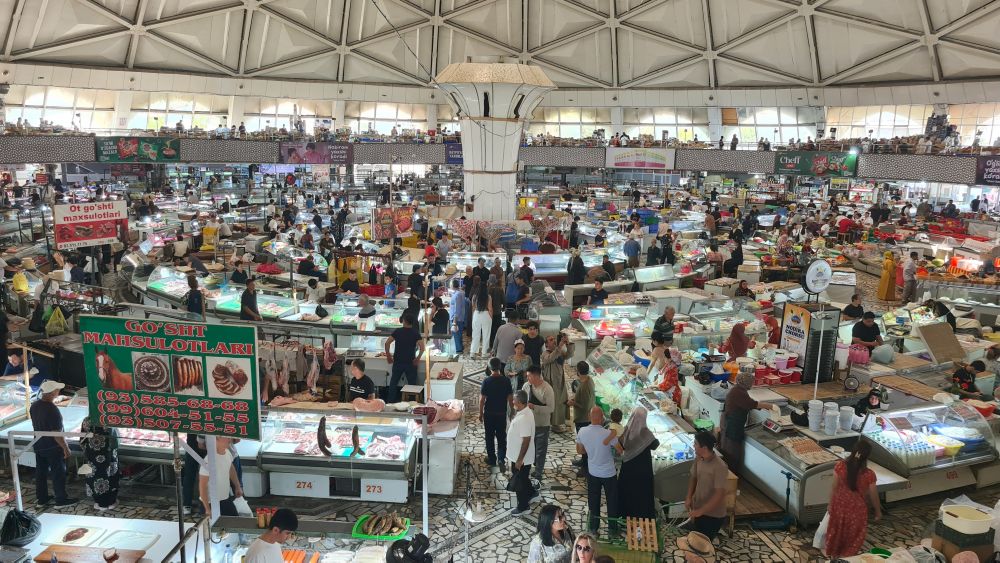
Architects: Vladimir Azimov and Sabir Adylov. Built: 1985–1990.
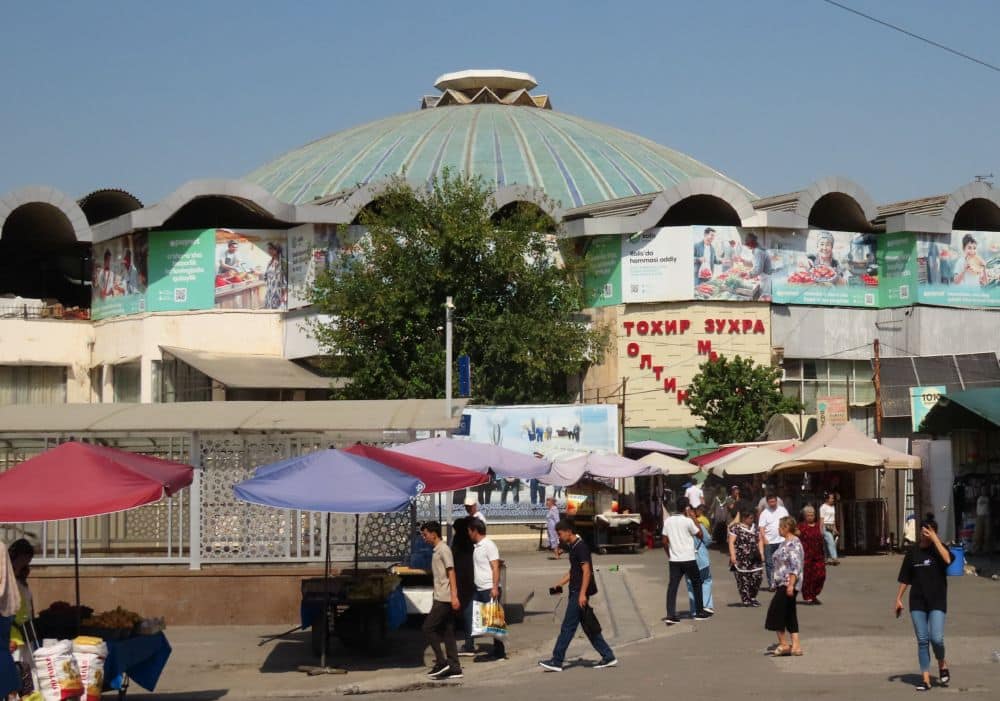
Like the circus, this municipal market building is round, but far bigger. The market teems with people and stalls covering its floor, but also covering lots more territory around it. Vendors sell food of all sorts, but also everything else you can imagine. Clearly some of the vendors focus on wholesale; others on retail.
Around the walls inside the UNESCO dome is a second story: a balcony that is dwarfed by the size and height of the dome. It is also busy with stalls and vendors, but it’s worth climbing the stairs to take a look over the railing at the expanse of the bazaar below. Light comes in through the windows around the upper level as well as through the opening at the center of the dome.
Alisher Navoi Cinema Palace
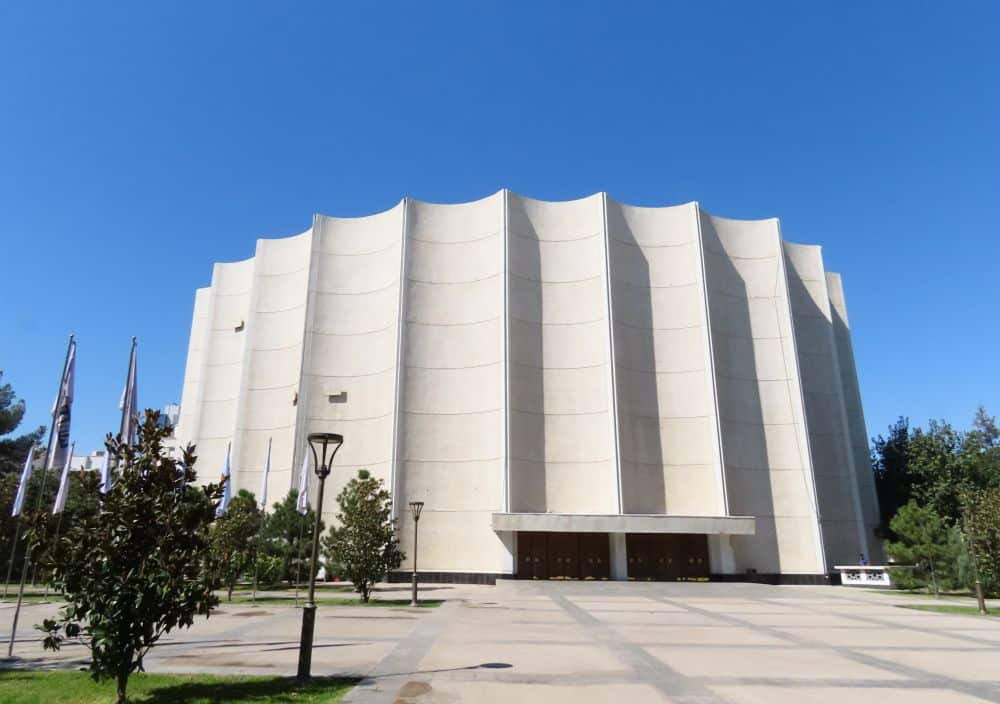
Architects: Sergo Sutyagin, Vladimir Beryozin, Yuri Khaldeyev, Dmitry Shuvaev, with Olga Legostaeva. Built: 1964.
I found the fluted, windowless form of this cinema quite pretty. Originally intended to serve as a cinema, a concert hall and a meeting hall for party congresses, today the building – and the extension next door – is still a cinema. I didn’t have time to stay for a movie, but presumably you could get a look inside.
Big Solar Furnace (Sun Heliocomplex)
Architect: Viktor Zakharov. Built: 1981–1987.
This is the only one I didn’t visit. Apparently it was used for experimenting with the effects of extreme heat on substances. Mirrors on a hill reflect sunlight to a parabolic surface which in turn focuses the light to a single point: a sun furnace. Other buildings in the complex house labs and offices, though apparently the facility is outdated so it’s no longer used for purpose.
Is the Tashkent Modernist Architecture group worth visiting?
If you’re an architecture geek, it’s worth visiting. Otherwise, not so much. On the other hand, Tashkent is a pleasant city, with manicured, shady parks and lots of good museums. If you are on your way to or from the more well-known Silk Road sites like Samarkand, Bukhara or Khiva, you’re likely to at least pass through Tashkent. Depending on how many museums you want to visit, you should give it at least a day, but we had two and didn’t get to see everything we wanted to see.
If 20th-century architecture is your thing, or more specifically Modernism, make sure to plan trips to other UNESCO sites built around architecture:
Tips for visiting Soviet modernist architecture in Tashkent
Check ahead of time online to find out if there are any events at the People’s Palace and if there are any films you want to see (and that are in a language you understand) at the Alisher Navoi Cinema Palace. Also check if the State Museum of Art has reopened; it has an excellent collection.
Find your accommodations in Tashkent.
If Soviet modernist architecture is of particular interest to you, you’ll probably spot quite a few other buildings that would fall under this heading. Take a look at the Tashkent Modernism website by the Uzbekistan Art and Culture Development Foundation. There, you’ll find more detail about the ten that make up this UNESCO group, but also quite a few more interesting examples.
Take a picture of a metro map and you should be able to find your way around easily enough. You’ll still end up doing a lot of walking, so wear comfortable shoes. The sidewalks are generally in good shape, but watch your step because here and there you’ll come upon a pothole or steps. I also noticed that staircases in Tashkent very often have one step that’s a different size: usually the top or bottom step is smaller than the rest.
Another option is to sign up for a Tashkent tour.
Tashkent does not seem to be very wheelchair-accessible in general, with steps up or down on sidewalks and inside public buildings. I didn’t spot any elevators in the metro stations. Some have escalators, but you still end up walking long staircases. Your best bet is to hire a taxi.
And speaking of taxis, make sure to download the Yandex Go app before you leave home for Central Asia. If you can get it to accept a payment method, it makes things much easier. You order the taxi just like an Uber. The app sets the price, and you pay through the app: no haggling with the taxi driver. I set it up at home by using a VPN which I set to Kazakhstan, so presumably the app thought I was there. It worked equally well in Kyrgyzstan and Uzbekistan as in Kazakhstan. You’ll need data to use it, of course, so set up an e-sim ahead of time.
Where are the elements of the Tashkent Modernist Architecture UNESCO site?
Here is a map of all of the elements of this group:
And here are the addresses, the nearest metro station to each one, and a website, if it has one:
- Zhemchug Residential Building: Buyuk Turon Street, 77, Tashkent. Metro: Kosmonavtlar.
- The State Museum of History: Sharaf Rashidov Avenue 3, Tashkent. Metro: Mustakillik maydoni. Website.
- Central Exhibition Hall of the Academy of Arts: Sharaf Rashidov Avenue 40, 100085, Tashkent. Metro: Kosmonavtlar or Mustakillik maydoni. Website.
- Kosmonavtlar Metro Station: Corner of Afrosiab and Sharaf Rashidov Avenue. Website.
- Peoples’ Friendship Palace: Furkat Street 3, 100003, Tashkent. Metro: Xalqlar Do’stligi.
- State Museum of Arts: Amir Temur Avenue 16, 100060, Tashkent. Metro: Ming O’rik. Website.
- State Circus: Zarkaynar Street 1, 100011, Tashkent. Metro: Gafur Gulom. Instagram.
- Chorsu Market: Tafakkur ko’chasi 57, Tashkent. Metro: Chorsu.
- Alisher Navoi Cinema Palace: Navoi Avenue 15, Tashkent. Metro: Alisher Navoi.
- Big Solar Furnace (Sun Heliocomplex): in Parkent, 30 km outside Tashkent. No metro anywhere nearby. Your best bet is to use a Yandex taxi.
For more information about Tashkent Modernist Architecture, see the Tashkent Modernism website by the Uzbekistan Art and Culture Development Foundation.
Have you been to Tashkent and visited any of its modernist architecture? If so, do you have any additional information or advice about this UNESCO World Heritage site? Please add your comments below!
- About the author
- Posts by this author

Rachel Heller blogs at Rachel’s Ruminations, a website focusing on historical and cultural sights/sites for independent travelers. She is also the owner of this World Heritage Travel website.