
Samarkand – Crossroads of Culture
By Rachel Heller
What is Samarkand – Crossroads of Culture?
Samarkand in Uzbekistan was an important city on the Silk Road that connected China to Europe, at its height in the Temurid period (14th-15th centuries). However, it was a place of intercultural contact long before that. Its ancient city, Afrosiab, was founded in the 7th century BCE and lasted until Genghis Khan destroyed it in the 13th century CE. It was already important in terms of trade.
The city’s history spans three parts of the modern city:
- The site of Afrosiab is now an archeological park.
- The medieval Timurid city contains the structures that appeal most to tourists because of their distinctly Islamic architecture: mausoleums, madrassahs and mosques. In the residential streets of the old town, the historical patterns continue: narrow streets lined with traditional houses, often still built of mud bricks and with enclosed courtyards.
- And the more modern part of the city to the west, while containing much more modern structures, still reflects traditional forms, particularly in terms of housing with courtyards.
Disclosure: This article contains affiliate links. Making a purchase through an affiliate link will mean a small commission for this website. This will not affect your price. Privacy policy.
Why is Samarkand a UNESCO World Heritage site?
The architecture in Samarkand, particularly the Temurid-era architecture, represents “masterpieces of Islamic cultural creativity,” according to UNESCO. The urban planning and architecture of this period influenced town planning and Islamic architecture throughout Central Asia: UNESCO mentions the Safavids in Persia, the Moghuls in India and the Ottomans in Turkey. This diffusion of styles was possible because of the city’s location along more than one Silk Road route.
What can you expect when you visit Samarkand?
The most visited sights in Samarkand are the ones from the Temurid period: the mosques, madrasahs and mausoleums are in varied degrees of repair, but the beauty of the tilework and decorative brickwork is undeniable. Take your time as you visit each one: the detail is wonderful.
Registan
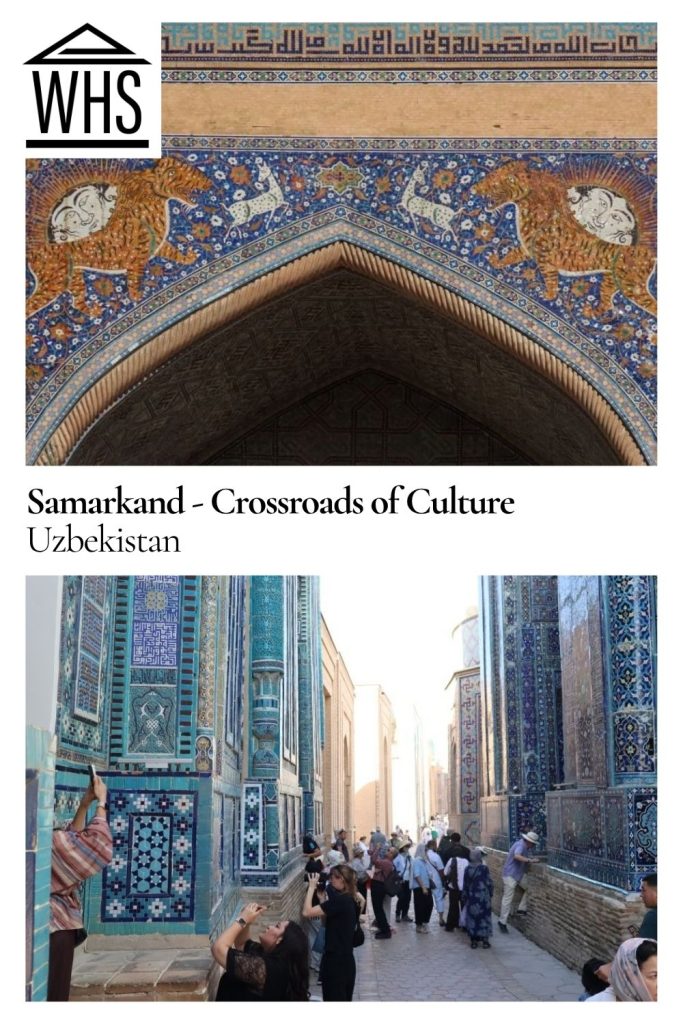
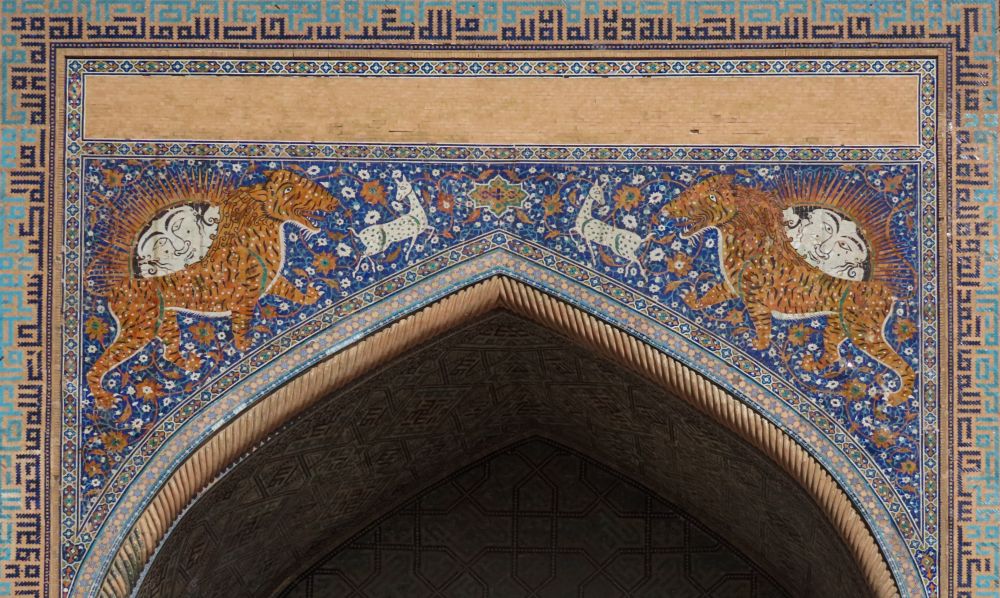
Registan is probably the most famous and most photographed sight in Samarkand. Its three madrassahs stand facing each other on three sides of an open square, and they are magnificent. The one on the left, as you stand on the platform overlooking the open side of the square, is the oldest, dating to the 15th century. The other two are from the 17th century. Inside them are big open courtyards with shady trees in the center. The small rooms around the courtyard, once used as classrooms and sleeping quarters, are now mostly given over to small shops selling locally-produced clothing and other hand-crafted items.
Bibi-Khanum Mausoleum
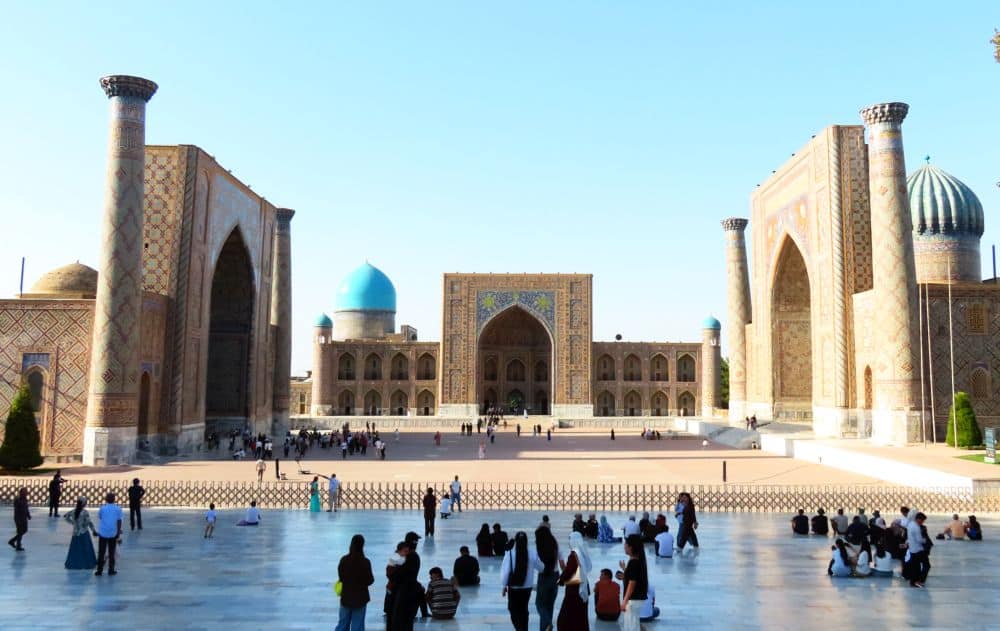
Bibi-Khanum Mausoleum is much simpler on the outside: just a small square building with a simple blue dome. Inside, while the tomb itself is not interesting – and covered with a cloth anyway – take a look at the decorations in the arches. The detailed tile and paintwork is lovely.
Bibi-Khanum Mosque
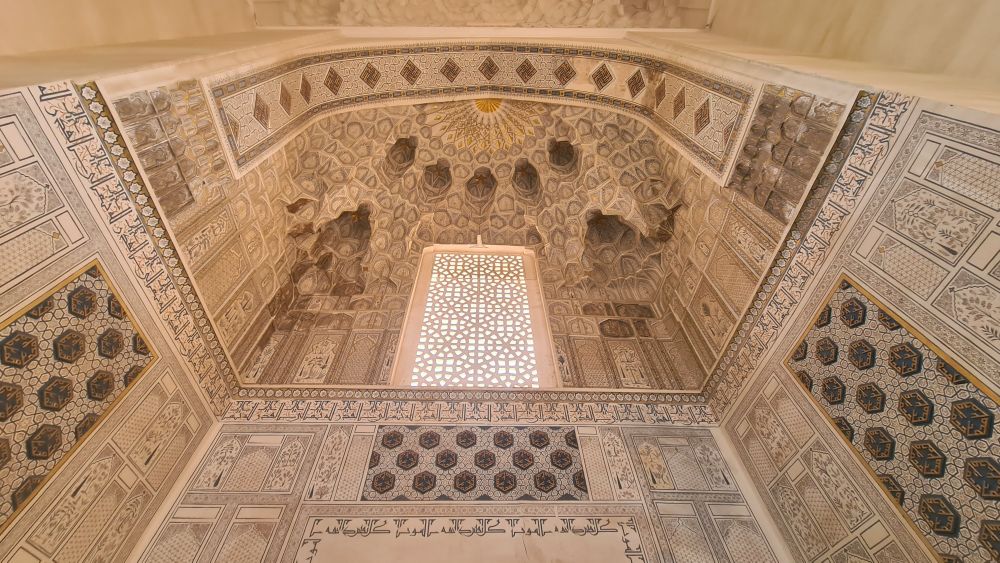
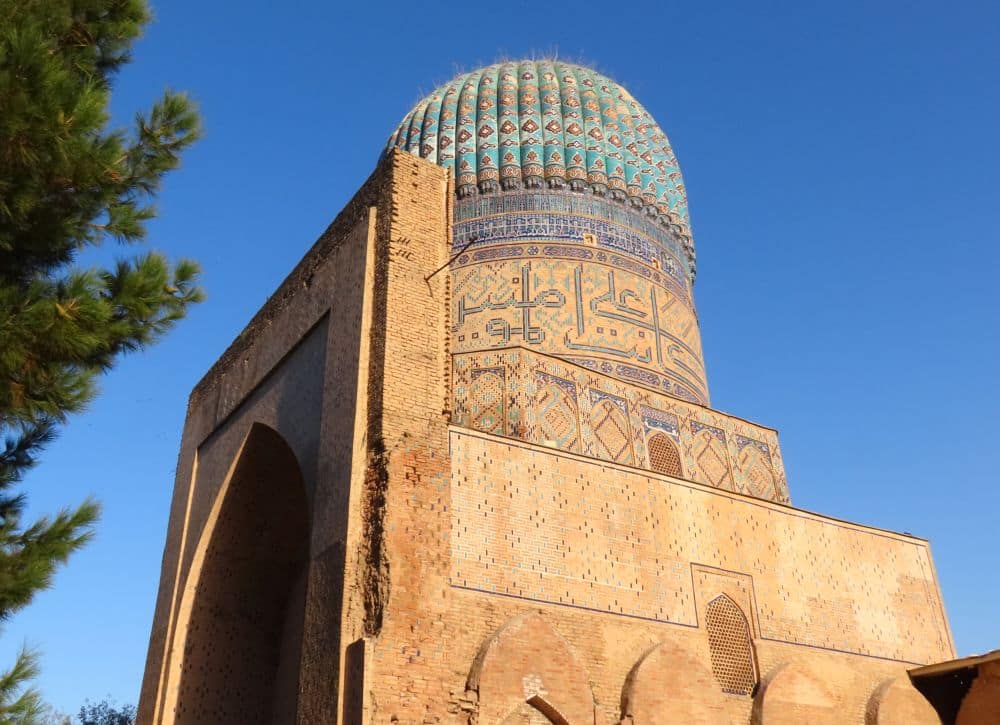
This complex has several parts: you enter through an entrance gateway that is enormous but whose tilework is not in great shape. Then you see two domed buildings, one on either sides. Their domes are absolutely stunning: fluted and brightly tiled. The one on the left is equally beautiful inside, with both painted and tiled surfaces, while the one on the right is in poor repair. Ahead of you, as you enter the gateway, is another mosque with a larger dome and a massive archway framing its entrance, but it’s in even worse shape. In fact, when we visited, it was locked, and we could only peer in through the bars at the interior. It had few tiles left so that the underlying brick was exposed, and we could see cracks where the building is falling apart.
The Shakhi-Zinda complex
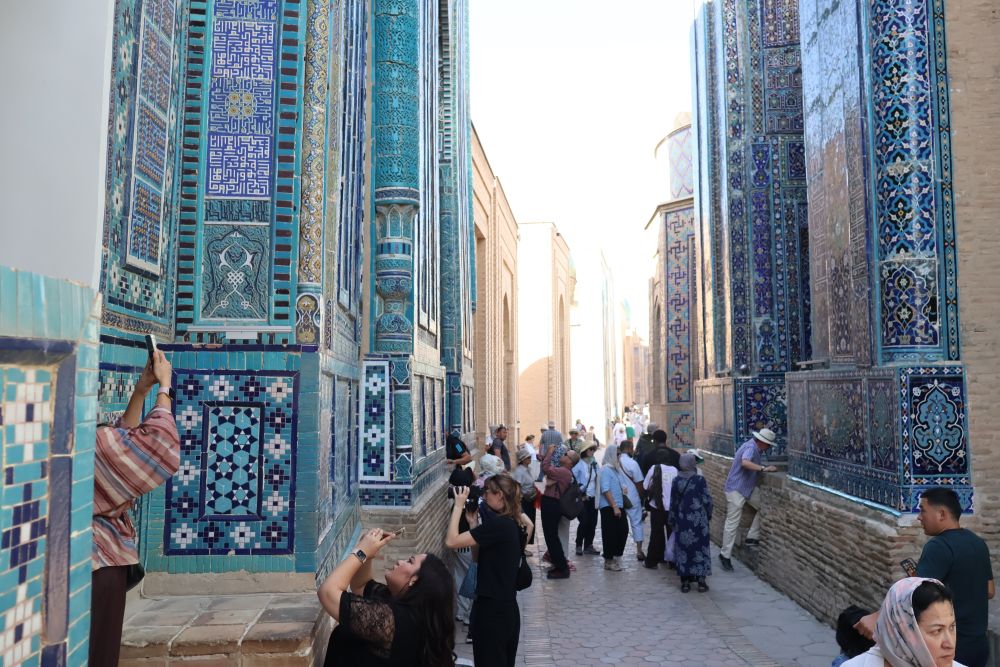
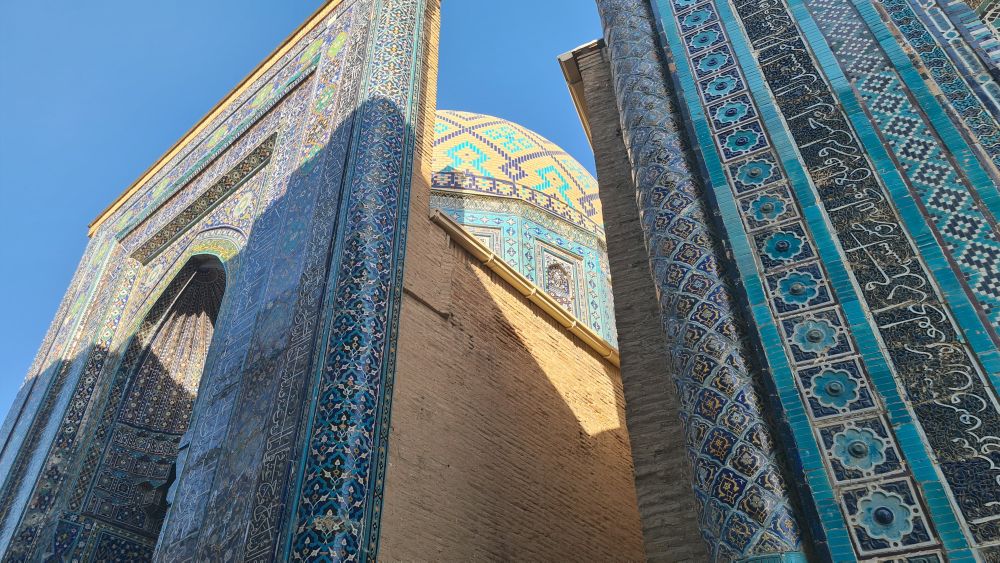
This is the most awe-inspiring of the many sights in Samarkand. Ranged up the side of a hill, you may at first think you’re just visiting a mosque. Climb the stairs, though, and you’ll come to a narrow lane with tall, very ornate mausoleums lining both sides, each more stunning than the last. The exteriors are hard to see because the lane isn’t very wide, and the facades are tall and tiled in great detail. You can enter most of them, and they vary quite a bit. Some are quite plain inside, with white-painted walls and a simple tomb in the middle. Others are as highly decorated inside as out. A sign outside the door explains a bit about who lies in each mausoleum.
Gur-Emir
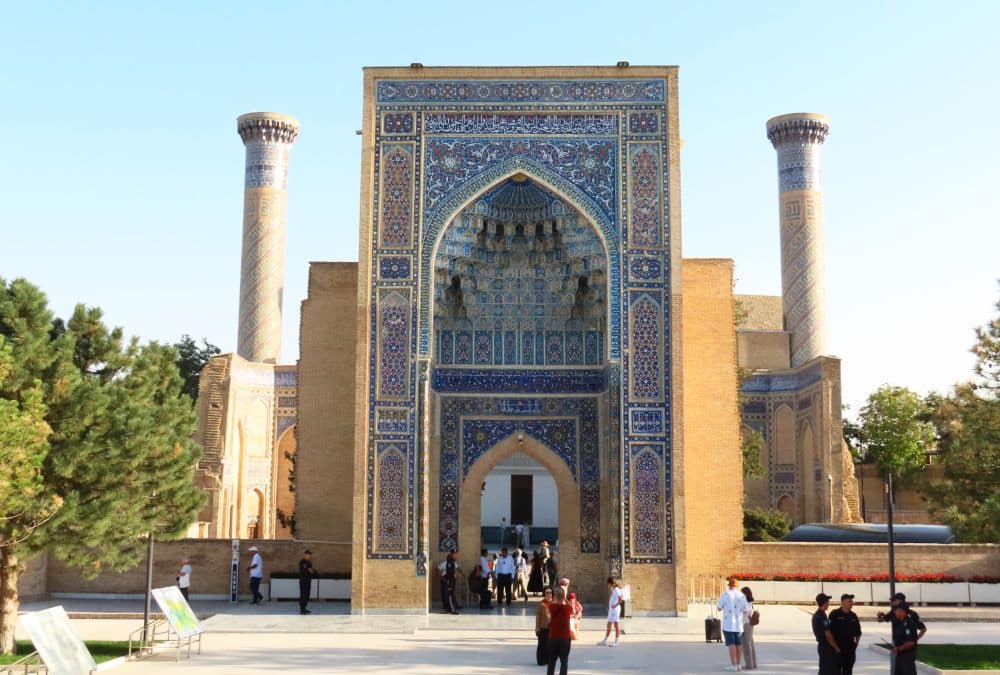
A beautifully-restored archway leads into this complex. Beyond that is a mausoleum, just as grand and beautifully adorned. Amir Timur’s tomb is here, and despite the grandeur of the buildings, the tomb is quite simple and humble. Timur – known in the west as Tamerlane – was the founder of the Timurid dynasty and conquered large swaths of Central Asia.
Other sights
There are quite a few other sights to see in Samarkand, though they are overshadowed by the ones I’ve listed above. Here are a few.
The Ulugbek Observatory
The Ulugbek Observatory is worth a visit if astronomy interests you. Like at the Jantar Mantar in Jaipur, India, also a UNESCO site, a member of a ruling dynasty who took an interest in mathematics and the stars built the site. The difference, though, is that Ulugh Beg lived in the 1400s, while Jai Singh was raja in the 1700s. There’s not much to see there, though, except for a small museum inside the former observatory and an excavated section of the quadrant he built. (Ulugbek also built the oldest of the madrassahs at Registan.)
The Hazrat Khizr mosque
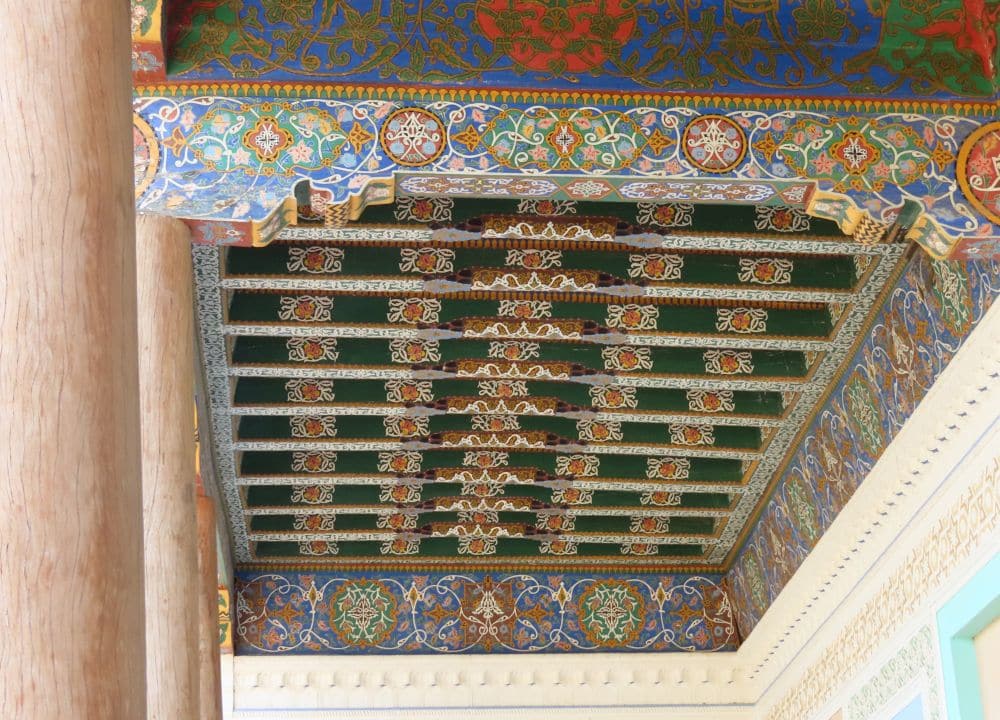
If you visit the Bibi-Khanum Mosque, you might as well cross the bridge over the highway and go see the Hazrat Khizr Mosque as well. It has a wide portico with a wood beam ceiling held up by wooden pillars, as do many smaller mosques in this region. What’s special about this one is how the ceiling has been painted in very colorful detail using traditional Muslim motifs.
Afrosiab
The area where the older city once stood is on a flat-topped hill that once had several concentric walls around it. They’re now so eroded you can’t really tell hill from wall. On the hill is a museum that is very well worth a visit to get an overview of the city’s history. It’s small and will only take a half-hour or so, but it covers pre-history until when Genghis Khan destroyed it. One room includes frescoes found among the ruins in what was likely a palace.
Admission to the museum also covers entrance to the ruins themselves. However, there’s not much to see. The land is pockmarked with holes where excavations took place – more than 20 locations – but nothing seems to remain. You can identify a few building walls edging the excavations here and there, but that’s about all. On the other hand, the hill offers views over the rest of the city.
All the sights listed above are marked on the map below, plus some other minor sights. A warning: they are not as close together as the map makes them seem. It’s a big, spread-out city.
Is Samarkand worth visiting?
Absolutely it is, if only just for the beauty of Registan and the Shakhi-Zinda complex. If you’re very pressed for time, though, I thought Bukhara was even better. It has similar mosques, madrassahs and such from the same period, but also a more intact and authentic old town. See both, if possible, but if you have to choose, I’d suggest Bukhara. Itchan Kala, the walled old city of Khiva, is another old city in Uzbekistan with similar Islamic architecture, but mostly from a century or two later.
To see all three Silk Road cities – Samarkand, Bukhara and Khiva – consider signing up for a private or group multi-day tour.
Who would most enjoy visiting Samarkand?
Any history geek like me would enjoy learning more about the Silk Road and its major stopping points like Samarkand. And if you love Islamic architecture with exquisite tilework, you would like Samarkand. It’s also a wonderful place to shop for authentic local crafts, especially tiles and embroidered textiles.
Tips for visiting Samarkand
If you only have a day here, prioritize seeing Registan and the Shakhi-Zinda complex.
At Registan you have to pay an entrance fee to approach any of the three madrassahs. However, the viewing platform is free, and a free sound and light show takes place every evening.
Most of the sights charge admission fees, except that mosques are usually free. For foreigners the fees are higher than for locals, and some accept cards, but some don’t. Have some cash ready in case they don’t.
The general rule is if there is carpeting, take off your shoes before entering. This is usually the case for mosques. If there’s no carpeting, you can keep your shoes on, which is usually the case for mausoleums.
For visiting mosques, make sure your clothing covers your knees (both men and women), and women must have your shoulders and head covered. Many mosques will have a supply of shawls on hand for tourists who are dressed inappropriately.
Use Yandex Go to hire taxis. Otherwise, you may very well get overcharged. Download the app before you leave home and set up a payment method within the app so that it’ll work like Uber and you won’t have to haggle. You might have to set your VPN to Uzbekistan to get the app to accept your credit card.
Using Yandex Go also means you need to have data outside of the Wifi in your hotel. I’ve been using an e-sim from either Gigsky or Holafly, depending on what deal works best for me. Again, set it up beforehand.
And speaking of credit cards, make sure you have a Visa card that is not blocked for use in Uzbekistan. No one accepts Amex and I suspect many won’t accept Mastercard either.
Don’t visit in the summer, when it gets unbearably hot. Even when I was there in mid-September, the temperature reached about 35°C each day (95°F). The best months temperature-wise are October and May. If you must travel when it’s very hot, plan to do your sightseeing the morning or evening and retreat to your hotel – hopefully with air conditioning – in the middle of the day.
Book your accommodations in Samarkand here.
Where is Samarkand?
Samarkand is in southeastern Uzbekistan, not far from the border with Tajikistan. It is easy to reach by bus or train from Tashkent, the capital of Uzbekistan, in about four hours. It’ll take an hour or more longer by car because of traffic. I booked my transportation through 12Go.
For more information about Samarkand – Crossroads of Culture, see the Uzbekistan Tourism website.
Have you been to Samarkand? If so, do you have any additional information or advice about this UNESCO World Heritage site? Please add your comments below!
- About the author
- Posts by this author

Rachel Heller blogs at Rachel’s Ruminations, a website focusing on historical and cultural sights/sites for independent travelers. She is also the owner of this World Heritage Travel website.