
Royal Palace at Caserta
By Rachel Heller
What is the Palace at Caserta?
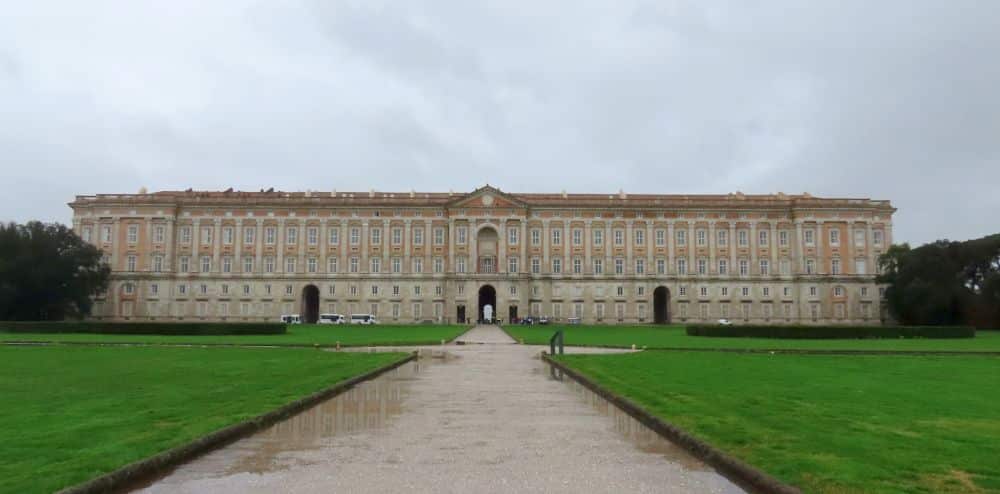
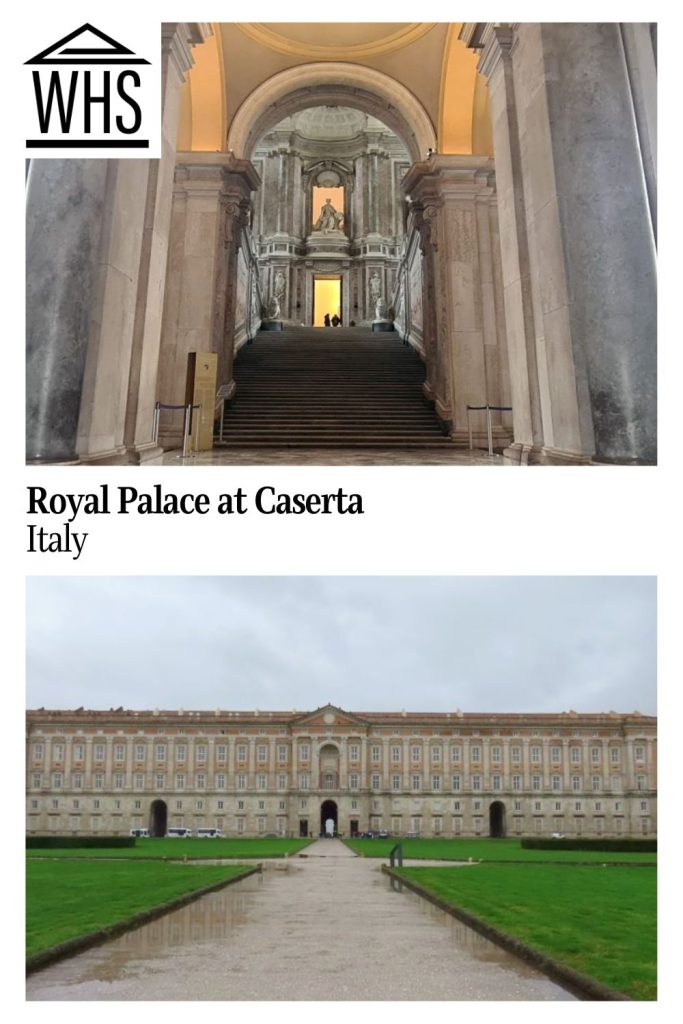
The Palace of Caserta (Reggia di Caserta in Italian) is a massive palace dating from the 18th century, when the Bourbon King Charles III decided he needed a palace and park to rival Versailles. Designed on a symmetrical rectangular floor plan around four courtyards, it contains 1,200 rooms, 138,000 square meters of floor space (1.5 million square feet) over five stories, with 34 stairways. All of it centers around a grand staircase in its center, a masterpiece of Baroque art and architecture.
Disclosure: This article contains affiliate links. Making a purchase through an affiliate link will mean a small commission for this website. This will not affect your price. Privacy policy.
There’s more to this UNESCO site than the palace, however, even though the palace gets most of the attention. Its official name as a UNESCO site is “18th-century Royal Palace at Caserta with the Park, the Aqueduct of Vanvitelli, and the San Leucio Complex.”
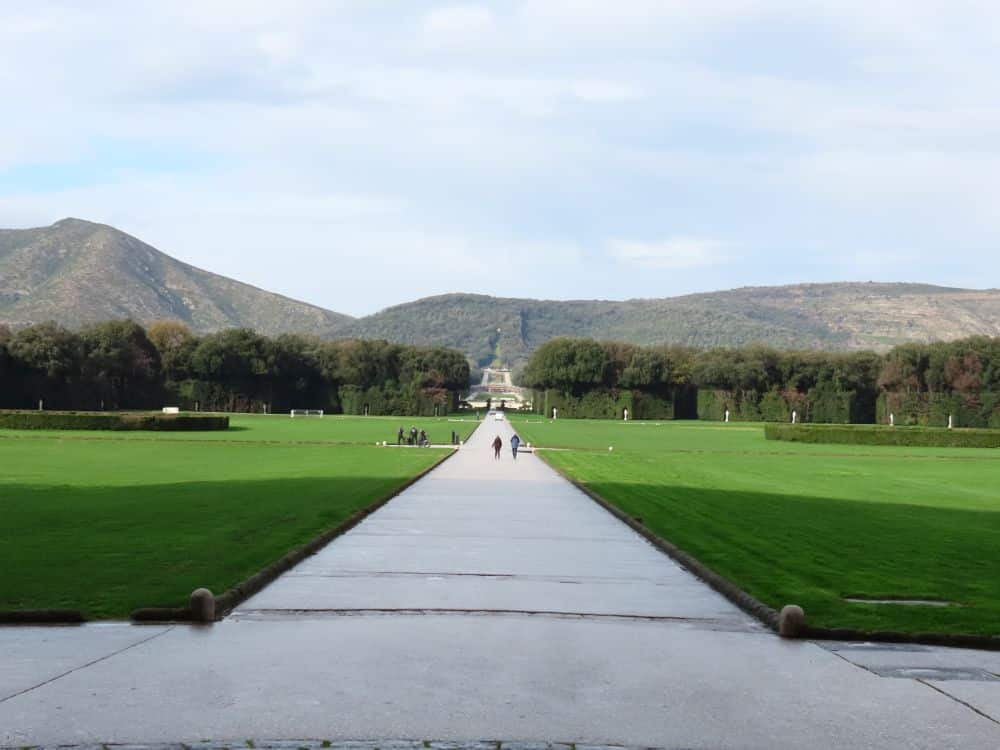
The park referred to in the title is the long formal stretch of park behind the palace, which climbs a hill in the distance, culminating in a waterfall. The park covers 120 hectares (300 acres), and includes statues and fountains that hearken back to classical themes. Near the end point of the park is an English Garden as well.
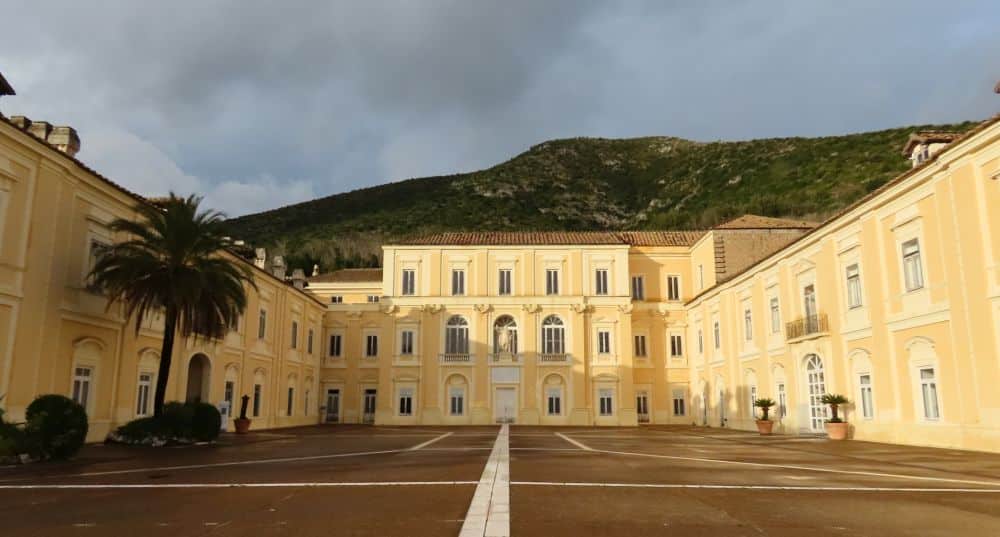
The San Leucio Complex is about five kilometers away. Originally a hunting lodge dating to the 16th century, it was part of a far-reaching plan by Charles III’s son, Ferdinand IV. His intention was to develop a new city which would include the town of Caserta and also San Leucio village. He bought the Casini di Belvedere hunting lodge and converted it into a place for raising silkworms and manufacturing silk, along with providing schooling and housing for the silk factory’s workers.
Ferdinand’s idealistic plans, based on Enlightenment ideals, were very radical at the time. The planned Colony of San Leucio would, for example, include equal rights for men and women, the abolition of dowry, housing and medical care for all workers, and be set up in such a way as to create a model community of equality. Only a small part of what was planned ever came to fruition.
The Aqueduct of Vanvitelli – also called Aqueduct Carolino – was necessary partly to supply water to the palace and the extensive water features of the park. The ultimate intention was that it would supply water to the Colony and the mills and other manufacturers. It carried water from 38 kilometers away (24 miles).
Why is the Palace of Caserta a UNESCO World Heritage site?
The estate represents, according to UNESCO, “the spirit of the Enlightenment.” The various parts of the site are “important evidence of the interchange of human values, thanks to the broad scale of its original project for an ambitious new town.” At the same time, the parts of the plan that were realized combine to present “an outstanding example of urban planning implemented by the Bourbon dynasty, according to Vitruvian principles of solidity, functionality and beauty in line with the neoclassical culture in vogue at the time.”
What can you expect on a visit to Caserta?
The Royal Palace of Caserta
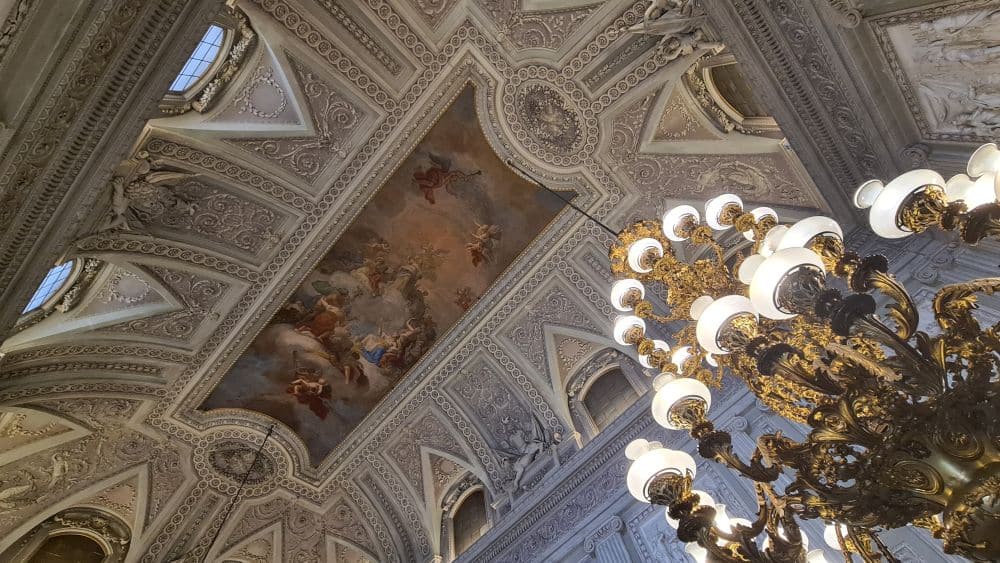
The main attractions here are the palace and its garden. Not all of the palace is open to the public, but many rooms on the first floor can be viewed, complete with well-restored baroque walls, ceilings and furniture. It’s only a fraction of the building’s space, but will still take several hours to view.
Entering in the center archway, you’ll see a courtyard on either side, separated by massive pillars. Straight ahead, you’ll see the whole length of the garden to where it ends in a waterfall far in the distance up a hill.
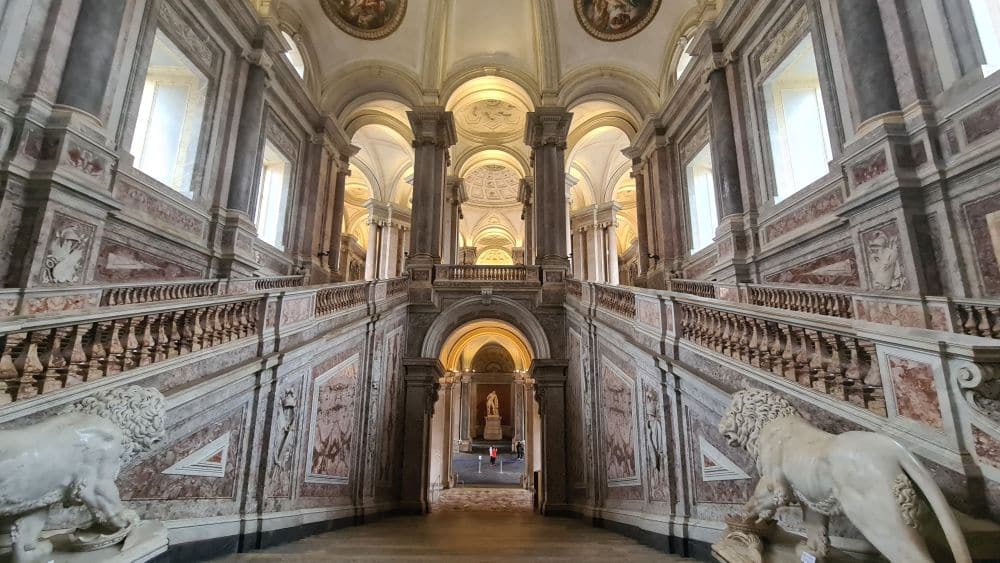
To see the rooms, you’ll climb the Grand Staircase. For us, at least, this was a definite “wow moment” just for its sheer size and the elegance of its Baroque decoration: marble panels, ornate statues, and colorful baroque-style painting in the high round dome. Halfway up, the wide stairway divides into two – on on each side, and they take you to the central hub of the building, the Upper Vestibule. From here, corridors lead to all parts of the palace.
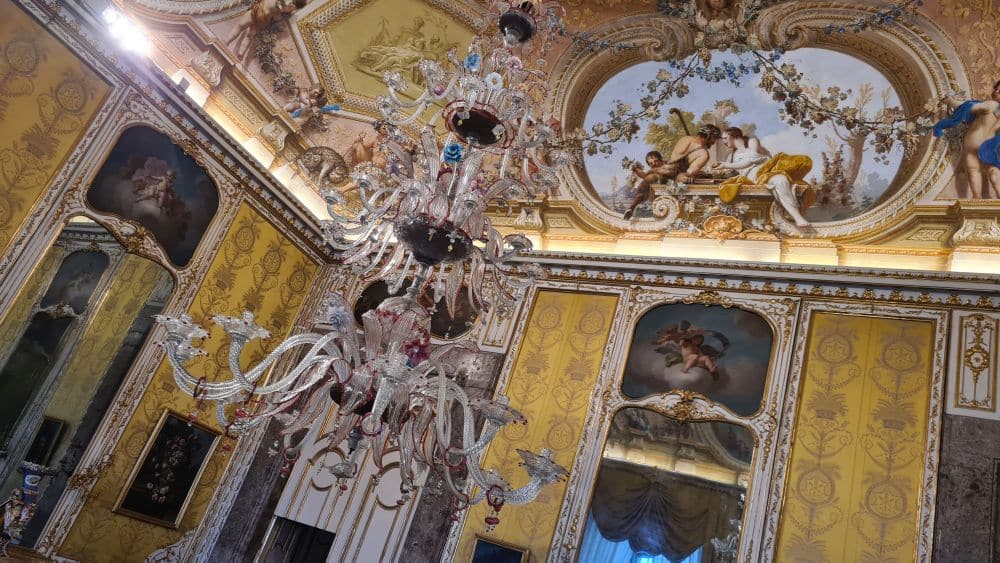
Following the route set out for visitors will take you through the huge public rooms first: the throne room, for example, and various meeting halls and ballrooms. Each carries a theme of some sort in its design: a particular color or a particular Greek god, for example. The walls carry statues or other three-dimensional decorations, wallpaper or frescos, and each ceiling sports ornate baroque paintings.
The route also takes you through the private rooms, no less grand, but a bit smaller. These also vary a lot in terms of their décor. Some have similar baroque ceilings as the grand public rooms, but because the ceilings aren’t so high, you can see the paintings better. The walls of many of these rooms are not carved, but rather painted in a way to look three-dimensional: trompe l’oeil style.
Also notice the furniture. It’s not clear to me how much of this is original to the palace and how much is just from the same period, but some of it is just stunning. The inlay, for example, on some of the wooden chests and cabinets is gorgeous.
The gardens
If the weather cooperates – it didn’t for us – the garden is worth time as well. On the way down the length of the park you’ll pass a series of Baroque statues set around the edges of the garden. The real highlights, though, are the six ornate and complicated fountains, including the magnificent Fountain of Dolphins at the end of the long pool and, further up, the Fountain of Venus and Adonis and the fascinating Fountain of Diana and Actaeon. Beyond the last fountain is the waterfall, fed by the aqueduct, and dropping 82 meters.
The English Garden is meant to look natural and “romantic,” unlike the much more symmetrical and formal Italian garden you’ll pass through first. It is dotted with “follies”: structures meant to look like ruins.
San Leucio Belvedere
We did not get to see the inside of this complex. Today it houses a museum about the silk factory, with the machinery used at the time, as well as former royal apartments, embellished like the palace’s royal apartments in ornate Baroque style. These were used by King Ferdinand when he came here on hunting trips. That was before he hit on the idea of setting up a school for village children to learn silk-making here, establishing the silk factory at the same time. The royal gardens at the complex have been restored to period, and there’s also a refurbished weaver’s house.
The Aqueduct of Vanvitelli
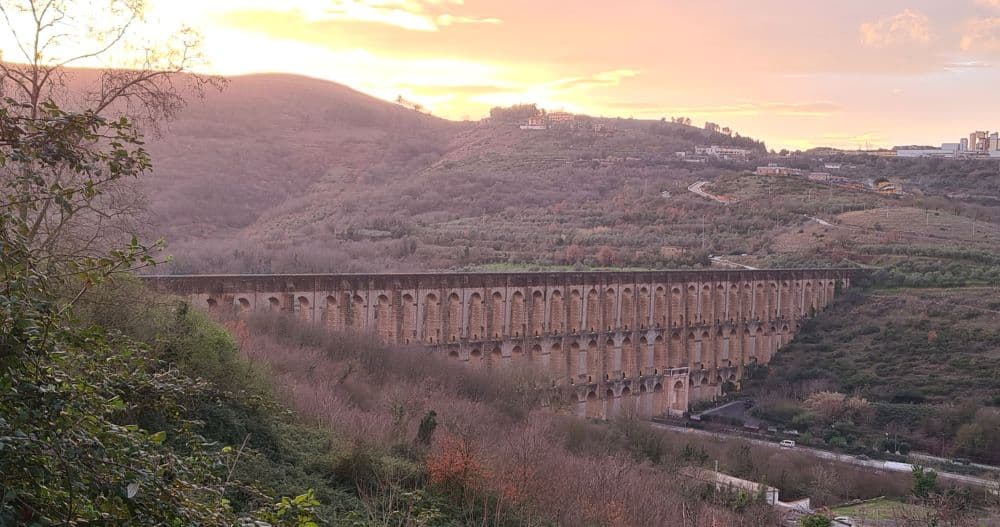
The aqueduct is apparently still in use to this day. It’s quite a sight, especially when you consider that it’s been standing there on those massive supports for hundreds of years. You can drive out to see it, about 10 kilometers from the palace, but you can’t walk on it. A busy road passes under it, but you can pull onto a nearby side road to see it from below, or drive up the hill on either side to see it from a higher vantage point.
Is the Royal Palace at Caserta worth visiting?
Charles III meant this palace to rival Versailles, and it does. If you like Baroque art and architecture or have an interest in historical garden design, you’ll love this place.
Children might very well enjoy the palace just because of the sheer grandeur of it, though it might not hold their attention for long. At least for a time, you could keep them busy picking details out of the frescoes. They might like seeing so many naked statues too! The garden, of course, is where they could run relatively free, but make sure they don’t climb on any statues.
We visited in February, so I can’t be sure, but I suspect that Caserta doesn’t get nearly as crowded as Versailles. I would say it’s worth a detour if you’re going to be anywhere near Naples.
Tips for visiting the palace and gardens
Good shoes are a must; even though you only see a fraction of the palace, you’ll get in a lot of steps.
The best times to visit would be spring and fall. In the summer it gets very hot in this region. In spring or fall, the garden and the forest surrounding it will be lovely, and it won’t be so hot. It also won’t be as crowded as in the peak summer tourist season.
Buy your entrance ticket here.
It’s definitely worth getting a guide. Hire a tour guide ahead of time, or you can rent an audio guide at the palace. Otherwise, make sure you have internet on your phone so you can consult the official website. It has lots of detailed information on the Palazzo Reale (Royal Palace), the Parco Reale (Royal Garden) and the Giardino Inglese (English Garden).
Book a small-group tour of the palace and garden or a tour of just the palace.
Book accommodations in Caserta.
Somewhere in the palace is an elevator for wheelchair access. Consult the palace’s website for specific instructions about how to access the building. Make sure to buy your tickets ahead of time so you can skip the inaccessible ticket office.
If you visit Caserta, you’re not far from other UNESCO sites worth visiting. The Historical Center of Naples, Herculaneum and Pompeii, and the Amalfi Coast are all nearby.
Where are the palace and the other elements of this UNESCO site?
The palace: Piazza Carlo di Borbone in Caserta. By car, this is about a half-hour’s drive from Naples. By train, it’ll take about 45 minutes from the Napoli Centrale station, and the palace is about a 10-minute walk from Caserta train station. From the port of Naples you can take a direct bus to Caserta.
San Leucio Belvedere: Via del Setifiicio 5 in Caserta. You really need a car to get to this one. It’s about 40 minutes from Naples, or about 15 minutes from the palace. However, watch out for the ZTL signs, meaning a traffic zone you have to have a permit to enter. If you can work your way around those, there is a parking garage right next to the site.
The Aqueduct is about 40 minutes by car from Naples or 20 minutes from the palace. It’s not easily reachable any other way.
For more information about the Royal Palace at Caserta, its opening hours and admission fees, see its official website. You can read about San Leucio Belvedere at its official website (only in Italian). There’s information about it on the palace’s website too, where you can also read about the aqueduct.
Have you been to the Royal Palace at Caserta, the San Leucio complex or the aqueduct? If so, do you have any additional information or advice about this UNESCO World Heritage site? Please add your comments below!
- About the author
- Posts by this author

Rachel Heller blogs at Rachel’s Ruminations, a website focusing on historical and cultural sights/sites for independent travelers. She is also the owner of this World Heritage Travel website.