
Historic Centre of Urbino
by Rachel Heller
What is the Historic Center of Urbino?
Urbino is a small and very pretty medieval city on a hilltop in Italy. Founded as a Roman town about 200-300 BC, it grew from there, but stayed within the original Roman walls until the 11th century AD, when it was necessary to build new walls because the town had grown.
The 15th century, though, was the most important period for Urbino, especially in the period when Duke Federico da Montefeltro ruled (1444-1482). The city expanded to a second hill nearby, and Renaissance walls surrounded all of the city. Under Montefeltro’s influence, the city attracted the great thinkers of the time – humanists, mathematicians, architects, and artists – and their aesthetic ideals affected how the additions to city developed. The importance of the city in the Renaissance didn’t last long after Montefeltro’s lifetime. By 1519, it was part of the Papal States and went into a slow decline.
Disclosure: This article contains affiliate links. Making a purchase through an affiliate link will mean a small commission for this website. This will not affect your price. Privacy policy.
Because of its general loss of importance, though, the city, or at least the old city within the walls, remained essentially intact. Although some changes happened later, in the 19th and 20th century, the city still has the atmosphere and appearance of a late medieval city. At the same time, it’s not a sleepy town due to the presence of a large university.
Why is Urbino a UNESCO World Heritage site?
It may have been a short period, but in those few decades, Urbino attracted many Renaissance thinkers. They set their ideas into action in creating, according to UNESCO, “an exceptional urban complex of remarkable homogeneity, the influence of which was carried far into the rest of Europe.” UNESCO goes on to say that “Urbino represents a pinnacle of Renaissance art and architecture, harmoniously adapted to its physical site and to its medieval precursor in an exceptional manner.”
What can you expect on a visit to the Historic Centre of Urbino?
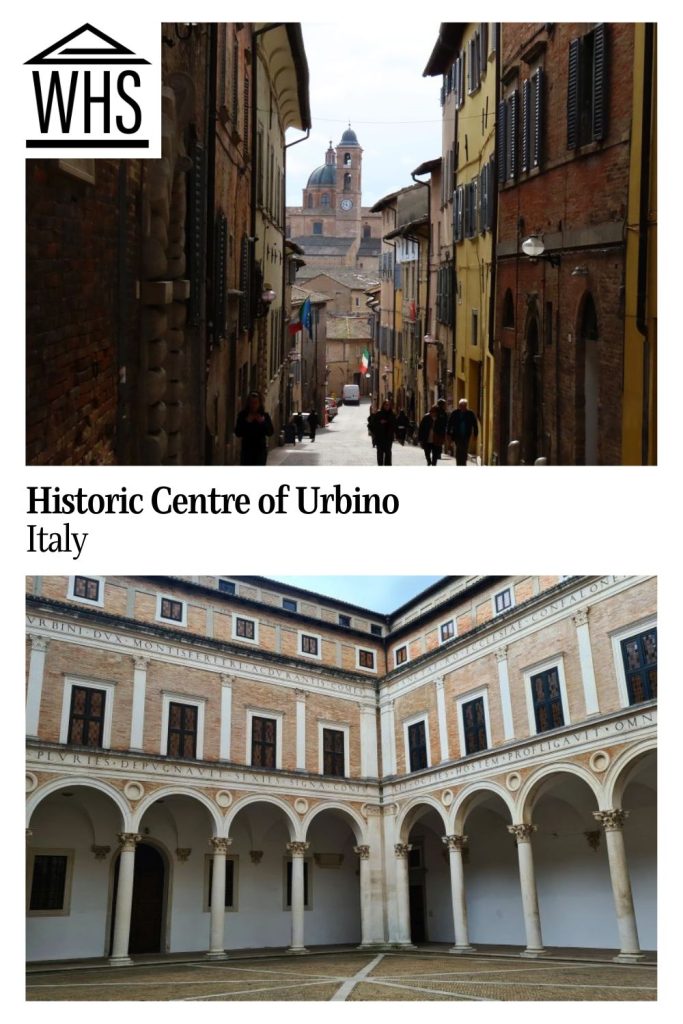
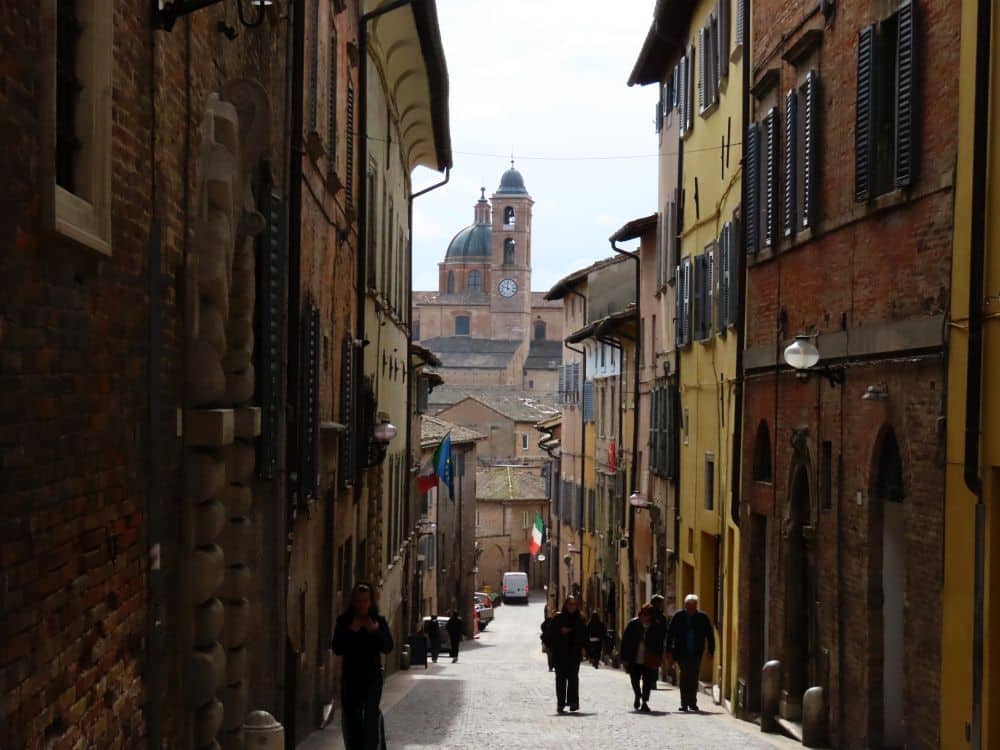
UNESCO’s description is very apt. As you walk the streets of the old center, you’ll see that, while the buildings around you are not all the same, they somehow go together in a pleasing way.
At the same time, there are certain structures that deserve particular attention:
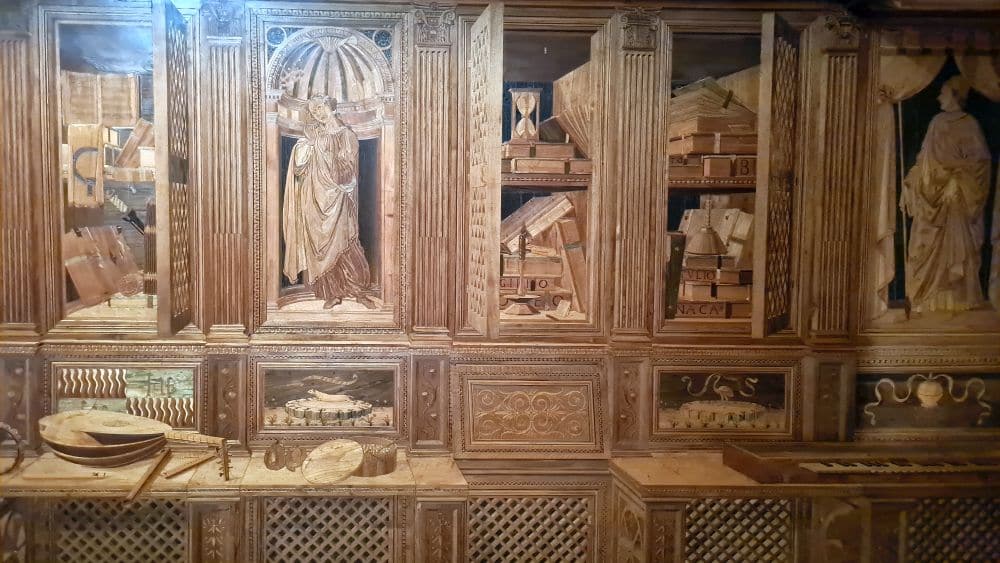
The Palazzo Ducale (Ducal Palace) is now the home of an art gallery called Galleria Nazionale delle Marche with an outstanding collection of Renaissance art. While they are no longer furnished as they would have been under Montefeltro or his successors – the Duchy ended in 1631 – some of ceiling and wall decorations are still intact. You’ll see frescoes, plaster bas-reliefs, and trompe l’oeil frescoes that are remarkable. The cellar is interesting too; the stables and kitchens and other work spaces were below ground.
Raphael’s house is where the artist grew up. It can be toured.
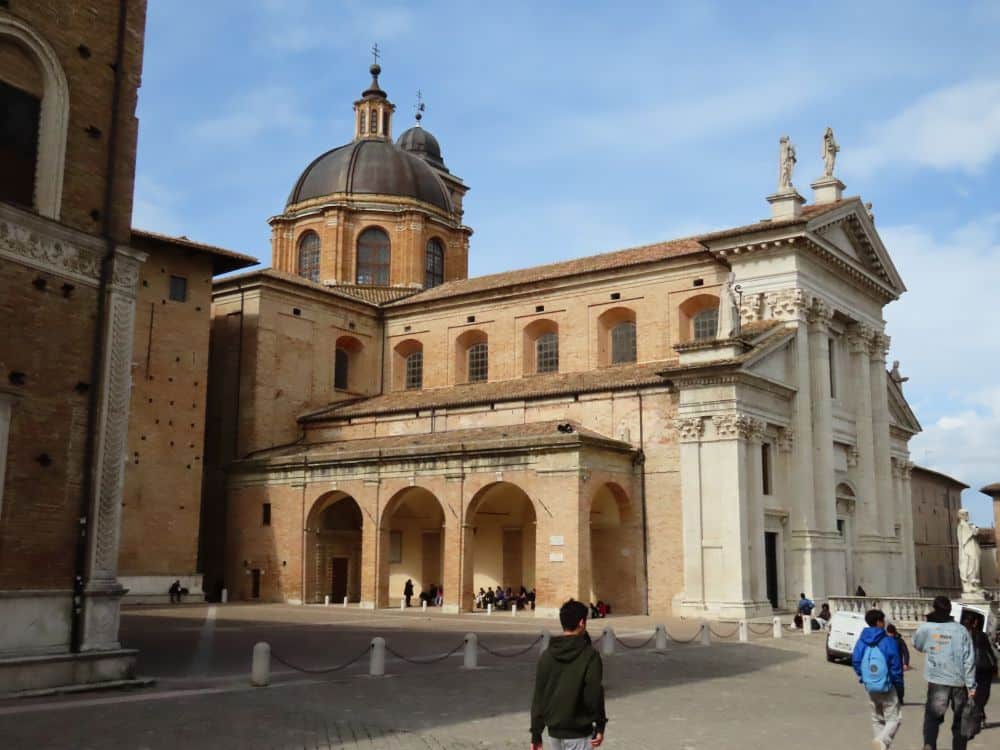
The Duomo is the main cathedral in Urbino and dates to the 11th century. You’d never guess that, though, since it’s been rebuilt twice since then: in Federico da Montefeltro’s day, and then again after an earthquake in 1789. What you see now is in the neoclassical style popular in the 18th century.
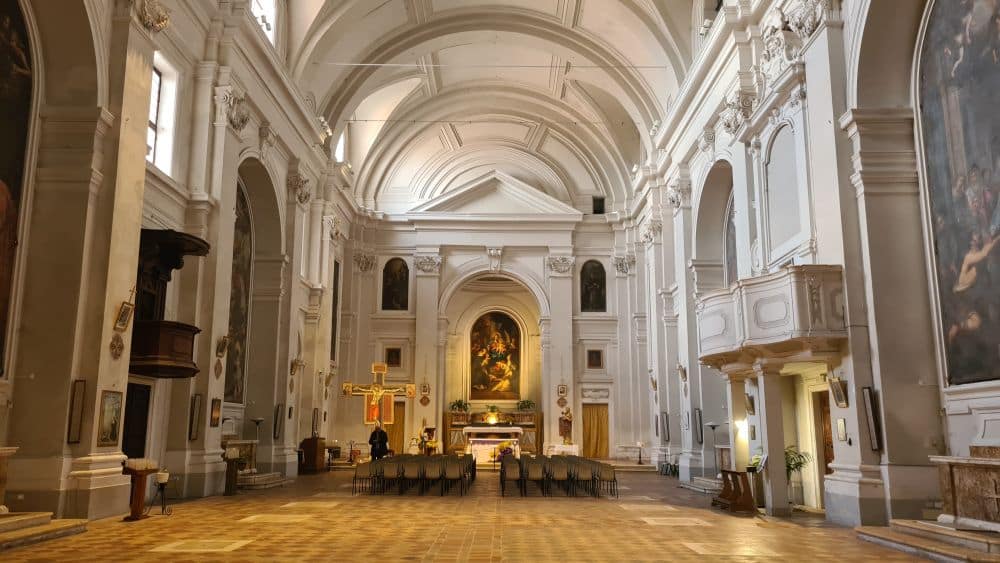
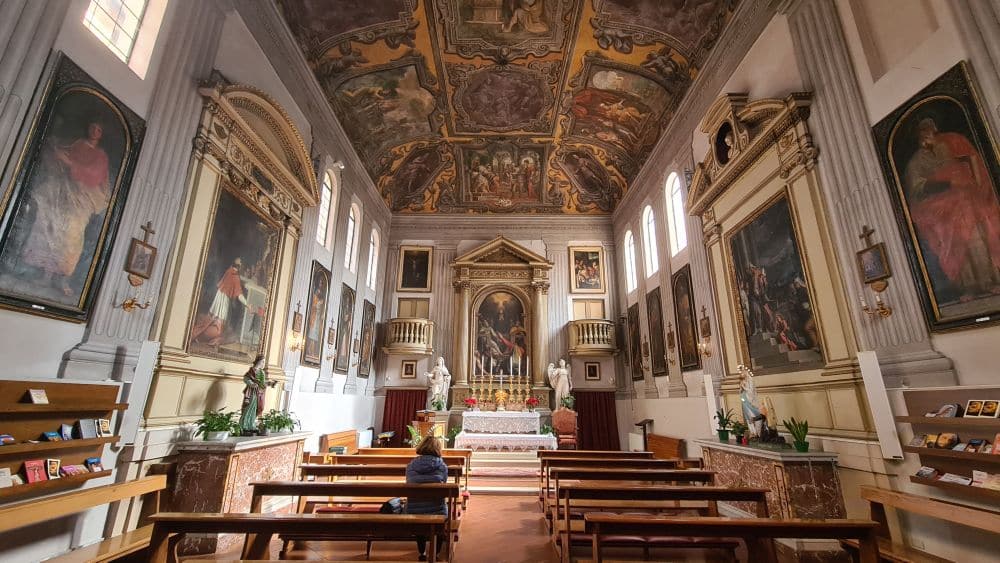
Other churches are worth a stop as well, many in Neoclassical style because of that earthquake in 1789. Right across the plaza from the Duomo is the Church of San Domenica, for example. Dating to the end of the 13th century, it looks Romanesque on the outside, but an extensive renovation in the 18th century gave it a purely Neoclassical interior. The little Church of Santo Spirito (late 16th century) retains its late Renaissance style with an ornately-painted Baroque ceiling.
Is the Historic Centre of Urbino worth visiting?
Urbino is small and quite pretty, partly because of the Renaissance-era architecture, but also partly because of its setting on a hill, overlooking the countryside beyond. Whether that makes it worth visiting depends on your interests. If you enjoy Renaissance architecture, it’s certainly worth a stop and a stroll through the picturesque streets. If Renaissance art is something you enjoy, you could spend many hours in the galleries of the Ducal Palace, and many of the churches still contain religious paintings by some of the most renowned artists of the time.
Tips for visiting Urbino
If you happen to be in Urbino, even if this period of art and architecture does not interest you, at least go to the Ducal Palace, particularly to see the smaller rooms of the ducal apartments. The trompe-l’oeil “furniture” is amazing.
The roads are steep at times and cobbled, so be careful and wear solid shoes.
Consider taking a walking tour of all the Urbino highlights.
We didn’t stay in Urbino because we needed a place with parking, so we stayed at a hotel in between Urbino and San Marino, which was comfortable and had a spa (for an extra charge) and a gorgeous countryside view. If you don’t need parking or don’t mind paying for parking, I’d suggest staying in the historic center. It must be lovely up there on the hill in the evenings. Book accommodations in the historic center.
If you want to see more Renaissance-era cities, make sure to plan in a visit to Pienza, Ferrara, Mantua and Sabbioneta. For Baroque art, visit the palaces in Genoa and the Royal Palace at Caserta.
Urbino is located a few hours away from several cities with UNESCO-listed historic centers: Bologna (specifically, its porticoes), Siena, Florence, and San Gimignano. Ravenna, on the list for its early Christian monuments, is also not far away.
Where is the Historic Center of Urbino?
Urbino is south of the independent state of San Marino, also a UNESCO site.
If you’re traveling by car, it’s about a 3-hour drive from Florence, 2.5 hours from Siena, or 2 hours from Bologna. Keep in mind that Urbino has a ZTL zone (limited traffic zone), as most cities do in Italy. If you see a ZTL sign at an intersection, choose another way. If you enter this zone, you’ll get a big fine. Instead, park in a paid parking lot outside the historic center and walk up.
By public transportation, reaching Urbino is more complicated because it has no train station. Instead, you can take a train to the coastal city of Pesaro, but from there you will have to take the LV bus the rest of the way. It runs frequently and takes about 45 minutes.
To get to Pesaro by train will take 2.5-3 hours from Florence (with a change in Bologna), about 5 hours from Siena (also with a change in Bologna), or about 1.5 hours from Bologna.
For more information about Urbino, see its tourism board website.
Have you been to Urbino? If so, do you have any additional information or advice about this UNESCO World Heritage site? Please add your comments below!
- About the author
- Posts by this author

Rachel Heller blogs at Rachel’s Ruminations, a website focusing on historical and cultural sights/sites for independent travelers. She is also the owner of this World Heritage Travel website.