
White City of Tel-Aviv – the Modern Movement

By Rachel Heller
What is the White City of Tel-Aviv?
The UNESCO designation called “White City of Tel-Aviv – the Modern Movement” – is not about the city as a whole. It’s about the modernist architecture within the city, also known as Bauhaus or International Style.
In the period before the Second World War, many Jews emigrated from Europe to Israel – then called Palestine under the British Mandate. Some of those emigrants were architects, trained in Europe, steeped in the Modern movement ideas of the Bauhaus school. They fled when the Bauhaus School closed in 1933; Hitler considered the architecture “degenerate.”
Disclosure: This article contains affiliate links. Making a purchase through an affiliate link will mean a small commission for this website. This will not affect your price. Privacy policy.
At the same time, Tel Aviv was a new city, founded in 1909 near the old city of Jaffa, and it was growing fast. This gave these architects an opportunity to apply their ideas on a large scale. Sir Patrick Geddes designed the plan for the city, but the individual buildings came from many different architects. Their construction dates from the early 1930s until the state of Israel was established in 1948.
The White City UNESCO site is made up of three clusters, with a single buffer zone surrounding them all.
Why is White City of Tel Aviv a UNESCO World Heritage site?
While there are lots of examples of Modernist architecture around the world, this serial site is larger in scale, just in terms of the number of buildings involved: about 4,000 of them. UNESCO calls it “a synthesis of outstanding significance of the various trends of the Modern Movement in architecture and town planning in the early part of the 20th century.” It also mentions how the architecture was adapted to suit the cultural context as well as the climate.
What can you expect on a visit to the White City of Tel-Aviv UNESCO site?
When you first see these Modernist structures, you might not even notice them at all. They are plain, unadorned, with white surfaces. I had been to Tel Aviv before and had never noticed them. To me, they just seemed very utilitarian: blockish, filling the lot they occupied, each with several apartments.
When I learned a bit about the precepts of Bauhaus architecture, though, I could identify more characteristics of it on the buildings I saw: both the ones in the UNESCO grouping, and newer ones that borrowed elements of the same style.
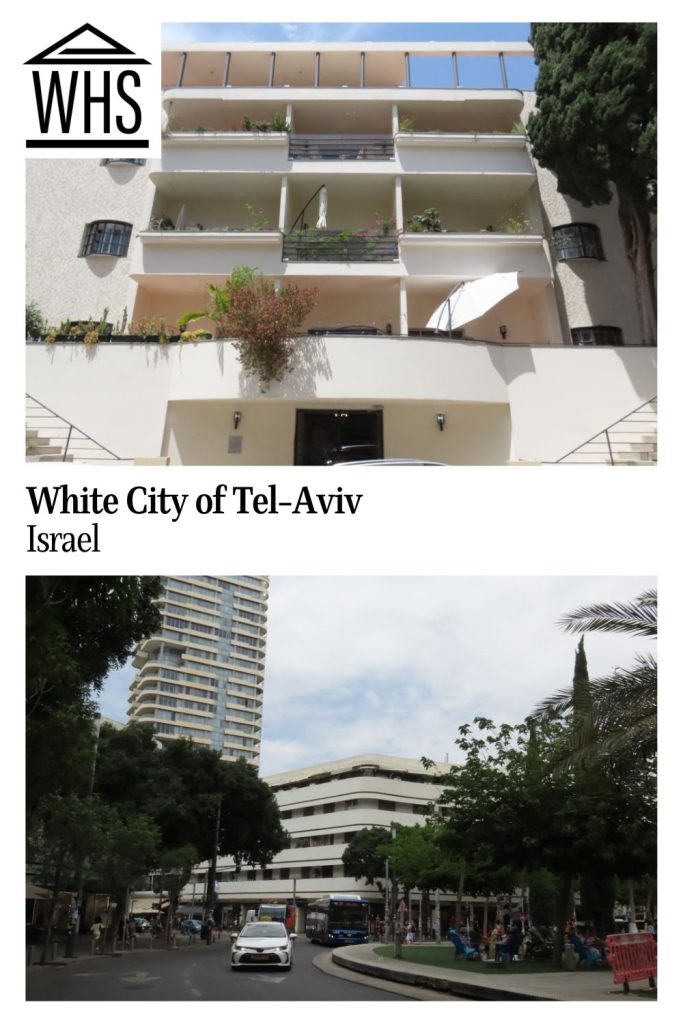
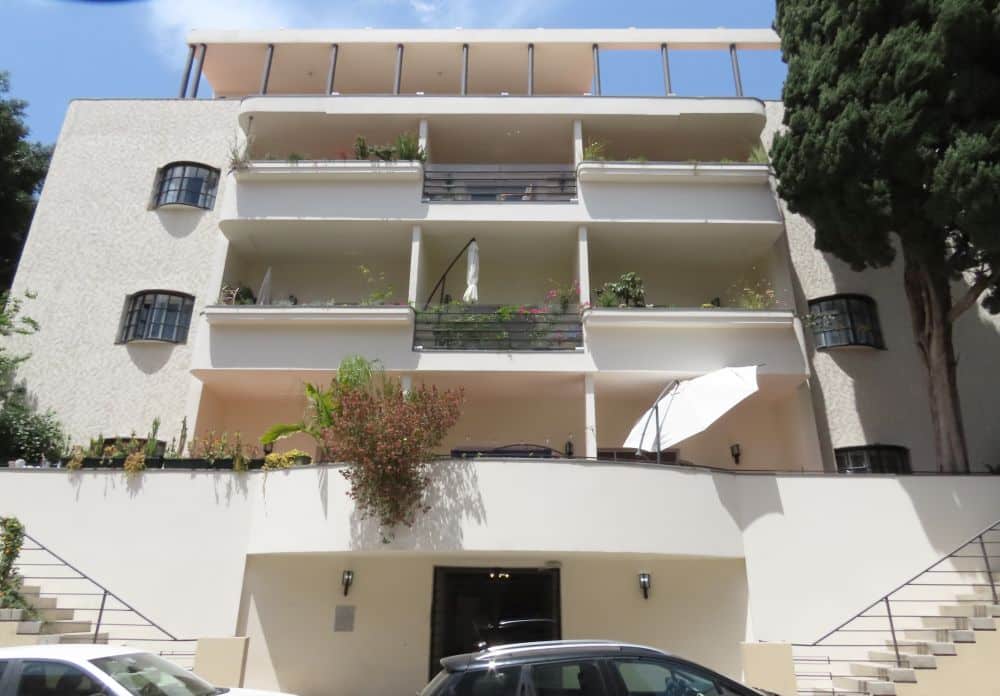
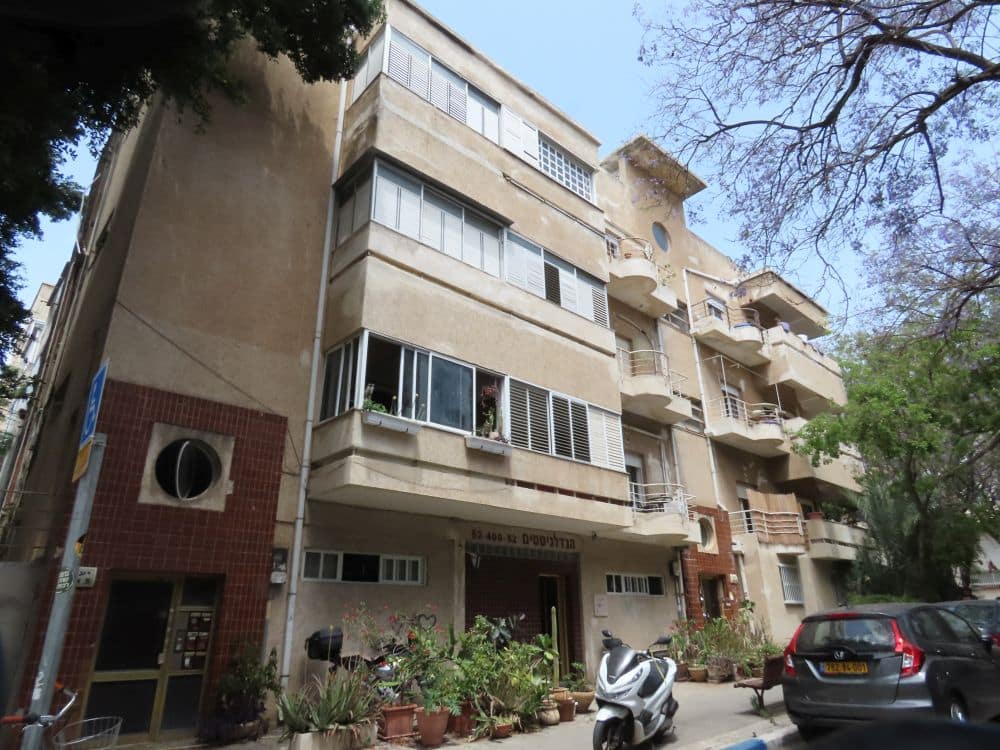
The focus is on functionality and simplicity, with any decorative elements in the structure itself rather than as added adornment. So, for example, a common element is round windows: just a few, here and there. Many followed one or more of Corbusier’s “five points:”
- A raised ground floor on concrete pillars, allowing an outdoor ground plan.
- Free design of the facade. In other words, the weight of the building is carried on beams and columns so the outside walls are not supporting the bulk of it. This allows things like extending floors out to form balconies or using wider windows.
- Flexibility in the interior design. The beam and concrete frame allows more options about interior wall placement, and enables open floor plans too.
- Horizontal “ribbon” windows let a lot of light in. Again, they’re possible because the shell of the building is not the frame.
- A flat roof with communal space: a roof garden and/or laundry.
You’ll see some selection of these elements on most of the buildings:
- Horizontal ribbon windows and/or balconies.
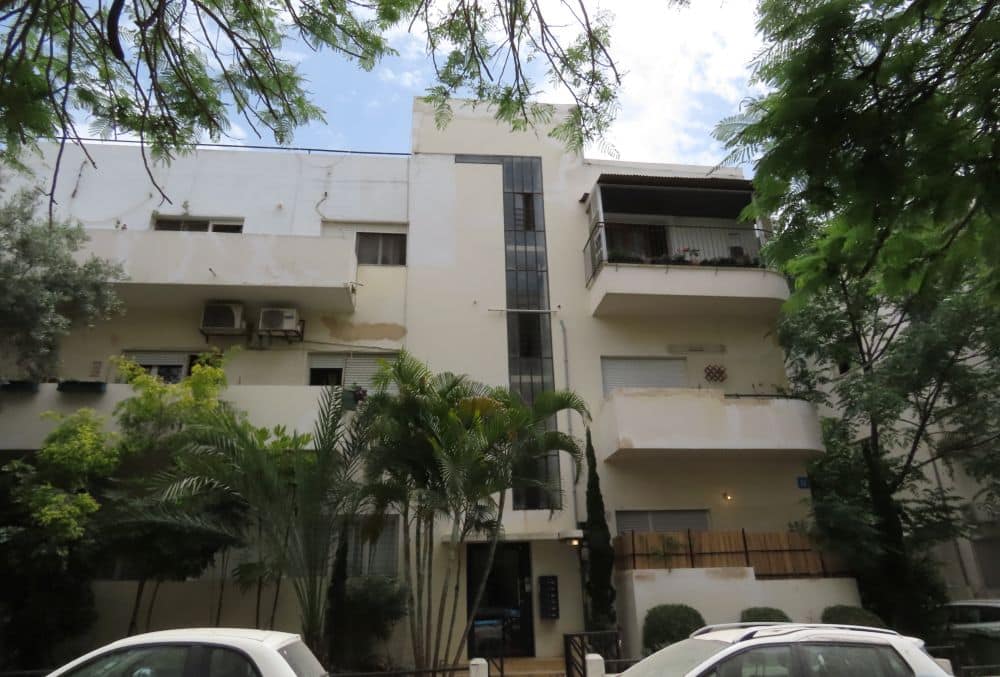
- Vertical strips of glass on the stairwells.
- Ledges (“eyebrows”) extend out over balconies to provide a bit of shade.
- Cantilevered out from the building, the balconies often have rounded corners.
- Sometimes the building itself has rounded corners.
- Some buildings stand on columns, shading outdoor garden spaces.
- Rooftops are flat, with gardens and/or laundry facilities. These outdoor spaces were meant to contribute to a sense of community, since the buildings were mostly apartment houses.
- Most Modernist buildings in the collection are asymmetrical.
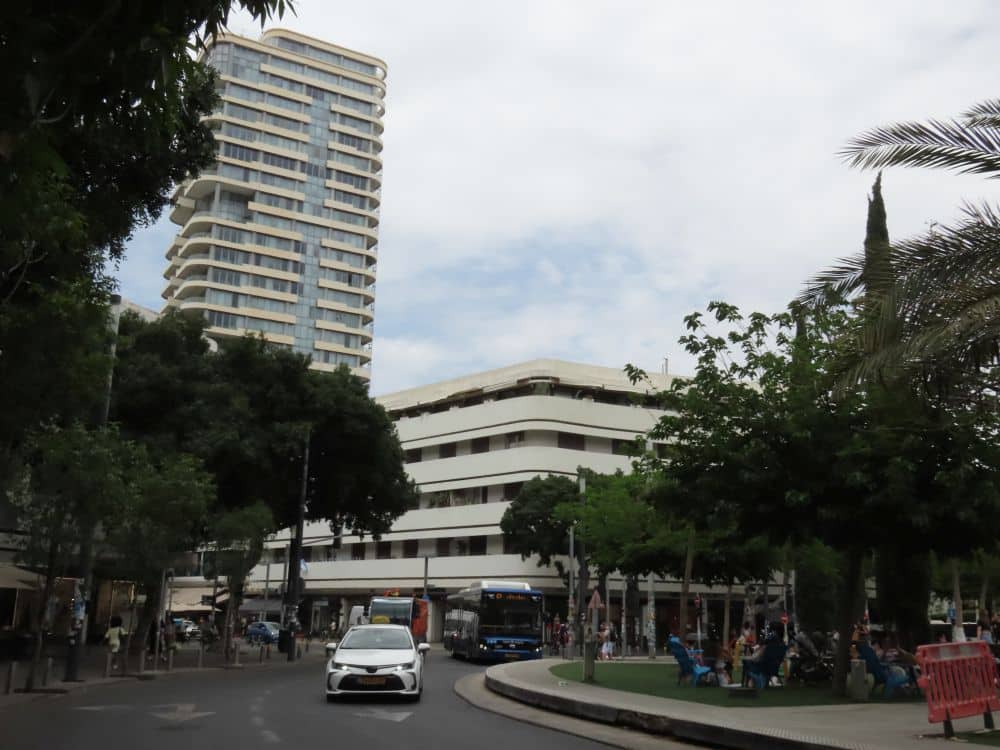
The cluster of Modernist architecture that is most well-known is at Dizengoff Square (really a circle). The buildings around it are all part of the UNESCO designation. One used to be a cinema and is now the Cinema Hotel. Most of the 4,000-odd structures, though, are small apartment buildings.
Some buildings within the UNESCO area are not actually Modernist, but rather the “Eclectic” style that preceded it. That means more decorative elements: plaster figures on the facade, decorative railings on the balconies, and more ornate details inside as well, such as murals. Because the walls carry the building’s bulk, the windows are more limited in size and narrower.
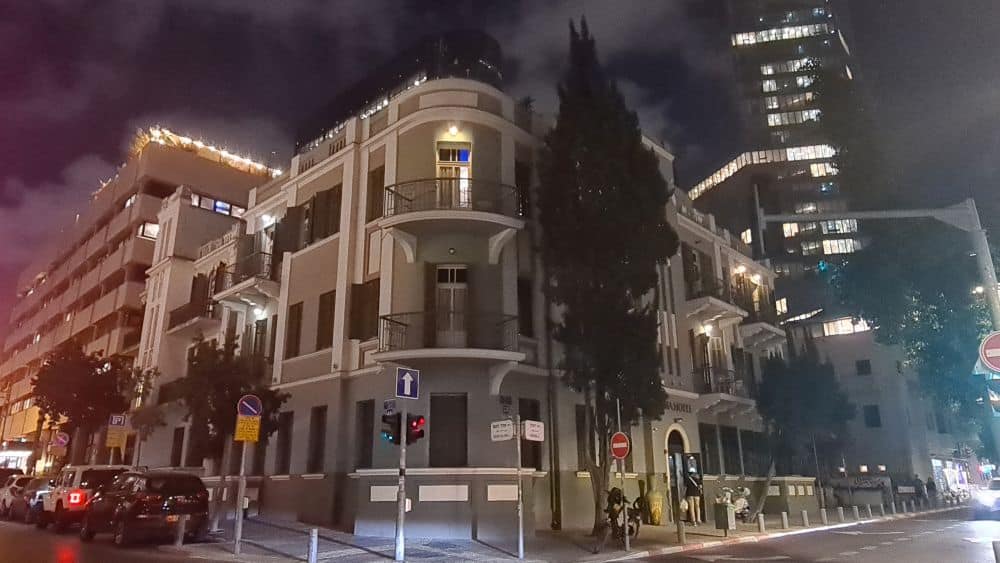
I was surprised when I toured the area (May 2025) to see that some of the buildings were not in great shape while their neighboring buildings were clearly newly renovated. Apparently this is because anyone renting an apartment before about 1970 qualified for strict, permanent rent control. Rents are capped at 2-5% of the market value, so we’re talking about extremely low rent. They can also pass the right to the same low rent to their spouse or children when they die. As a consequence, the owners don’t earn enough from the rent to carry out the needed repairs. Nevertheless, I did see many in the process of renovation, and many more will be renovated in future by Tel Aviv’s city government.
Is Tel Aviv worth visiting?
Tel Aviv in general is worth visiting, if nothing else than as an antidote to the more conservative, more religious, and more touristy Jerusalem. It’s very hip, has a great gastro scene, and a long stretch of Mediterranean beach. There are also dozens of museums on all sorts of topics.
As far as the Modernist architecture is concerned, it’s worth visiting if you have an interest in 20th-century architecture. If you don’t, skip it.
Tips for visiting Tel Aviv
If you’re not already quite knowledgeable about Modernist architecture, start your visit in one of two places: either Liebling Haus or at Bauhaus Center.
Liebling Haus
Liebling Haus (29 Idelson St.) is one of the Modernist buildings in the collection and houses the White City Center. It dates to the mid-1930s, designed by Dov Karmi to be an apartment building. Nowadays it has an exhibition that’s mostly just text and photos about this architecture and a timeline telling the story of the growth of the city as a whole. It’s very useful for getting a sense of what you’ll be looking at before you go out and see the neighborhoods.
Liebling Haus has various other permanent and temporary exhibitions too. Even if the topics don’t interest you, they allow you a look around what used to be several residential apartments. You can also take a look at the neighborhood from the roof.
The Bauhaus Center
The Bauhaus Center (77 Dizengoff St.) offers tours of the White City in both guided form (Friday and Sunday mornings) and in self-guided audio form. I took the audio tour. First you watch a short film introducing the topic, then you rent the audio guide. It comes in a general version or an extended version meant for professional architects. Using a printed map and the audio guide, you go look at some of the buildings at your own pace. That suited me well, since it also allowed me to stop for lunch.
The audio guide won’t cover all 4,000 buildings, of course, but points out the main elements of the architecture using some key examples, and tells a bit about their architects and uses. I found it very interesting and enjoyed the walk.
The Bauhaus Foundation
The Bauhaus Foundation (21 Bialik St.) is another organization worth visiting, but it was closed for renovation when I was there. Housed in a 1934 Modernist building designed by Shlomo Gepstein, the Foundation hosts temporary exhibits about topics related to Bauhaus. It seems to focus particularly on interior design.
Other tips
Especially if you’re taking a walking tour, make sure to bring some water along. When you look at the Dizengoff Square cluster, you’ll find plenty of shops where you can pick up a bottle. Wear sun lotion, a hat, and comfortable shoes. Unlike in Jerusalem, no one will give you the side-eye for skimpy clothing; if it’s hot, it’s fine to wear shorts and a sleeveless shirt or crop top in Tel Aviv.
I stayed at a very chic little adults-only hostel called Isla Tel Aviv, but in a private room with bathroom. It was comfortable and quiet, though with only a tiny window. Their coffee shop on the street was a very pleasant place to sit and get some work done. Other accommodations in Tel Aviv.
Tel Aviv has a newish metro system, a light rail, and a rather creaky bus system as well. You’ll need a Rav-Kav card, which you can buy from a tourist info center, a train station or at the airport. Then you add money to it by using the HopOn app or the Rav-Kav app. Make sure to set one of those up ahead of your trip.
Keep an eye on the news and book refundable accommodations. While Tel Aviv has suffered little from recent hostilities, things can change from day to day. Wherever you stay in the city, make sure you know where the hotel’s shelter is in case sirens notify you of incoming rockets. It’s usually in the basement. If you’re out and about and hear a siren, follow the lead of the locals around you – they’ll lead you to a shelter.
If you plan to see more of Israel than just Tel Aviv and Jerusalem – the sights around the Sea of Galilea, for example – it might be worth renting a car for at least the parts of your trip outside of these two cities.
Read about other UNESCO sites in Israel: Jerusalem, Acre and Masada.
Where is the White City of Tel-Aviv?
Tel Aviv is on the Mediterranean coast north of the Gaza Strip and south of Haifa, and the White City buildings are in the center of the city. Buy a map at the Bauhaus Center for more detailed locations.
Ben Gurion Airport, where you’ll likely arrive in Israel, is southeast of Tel Aviv and halfway between Tel Aviv and Jerusalem. You can take a train from there to Tel Aviv. If you’re likely to arrive tired, book a service like Welcome Pickups to meet your flight and take you right to your hotel.
For more information about the components of the White City UNESCO designation, see the websites of the Liebling Haus or the Bauhaus Center.
Have you been to Tel Aviv? If so, do you have any additional information or advice about this UNESCO World Heritage site? Please add your comments below!
- About the author
- Posts by this author

Rachel Heller blogs at Rachel’s Ruminations, a website focusing on historical and cultural sights/sites for independent travelers. She is also the owner of this World Heritage Travel website.