
Churches of Moldavia
By Rachel Heller
What are the Churches of Moldavia?
The Churches of Moldavia is a serial UNESCO site comprising eight different churches in the northeastern part of Romania. They all date from the 15th or 16th century. What makes them unusual is that Byzantine-style frescoes completely cover their outer walls, illustrating stories on religious themes. In many of paintings, which mostly date to the mid-1500s, the images are still bright and are presented as a series of boxes, much like modern graphic novels. Most have similar images covering the inside walls as well.
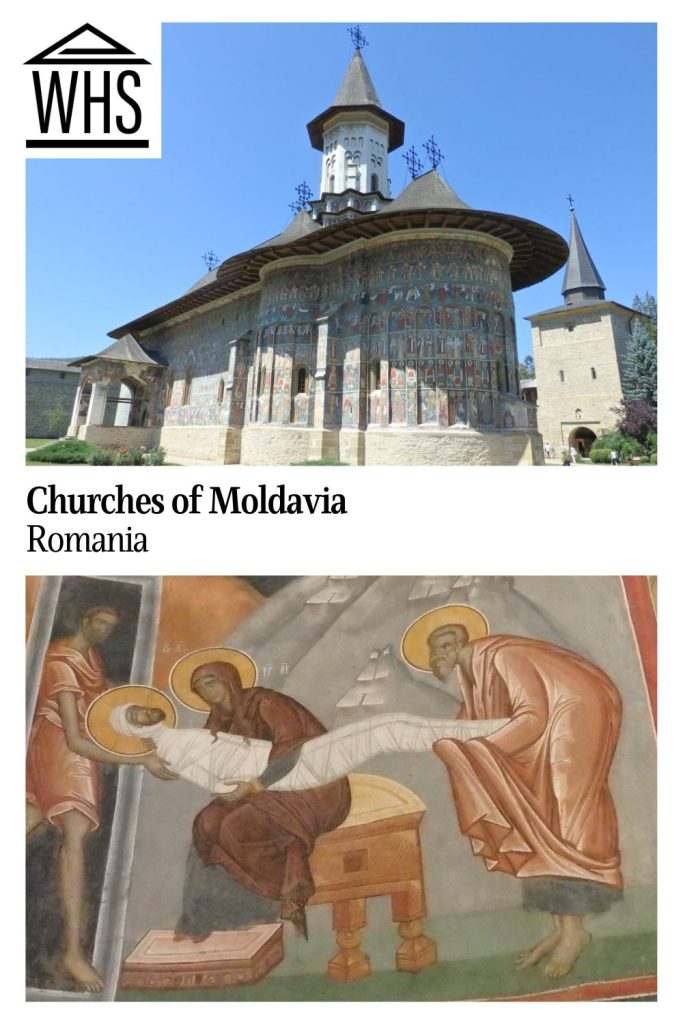
The eight towns and their churches in the group are:
- Arbore: Church of the Beheading of St John the Baptist
- Humor: Church of the Assumption of the Virgin
- Moldaviţa: Church of the Annunciation
- Pătrăuţi: Church of the Holy Rood
- Probota: Church of St Nicholas and the Catholicon
- Suceava: Church of St George
- Suceviţa: Church of the Resurrection
- Voroneţ: Church of St George the Martyr
Disclosure: This article contains affiliate links. Making a purchase through an affiliate link will mean a small commission for this website. This will not affect your price. Privacy policy.
Why are the Churches of Moldavia a UNESCO World Heritage site?
The main reason these painted churches are on the list, according to UNESCO, is that they “embody a unique and homogeneous artistic phenomenon, directly inspired by Byzantine art.” It praises them as “masterpieces of mural painting.”
In addition, covering the exterior of churches in this way is unique to the region of Moldavia and “illustrates the cultural and religious context of the Balkans from the late 15th century to the late 16th century.”
What can you expect on a visit to the Painted Churches in Moldavia?
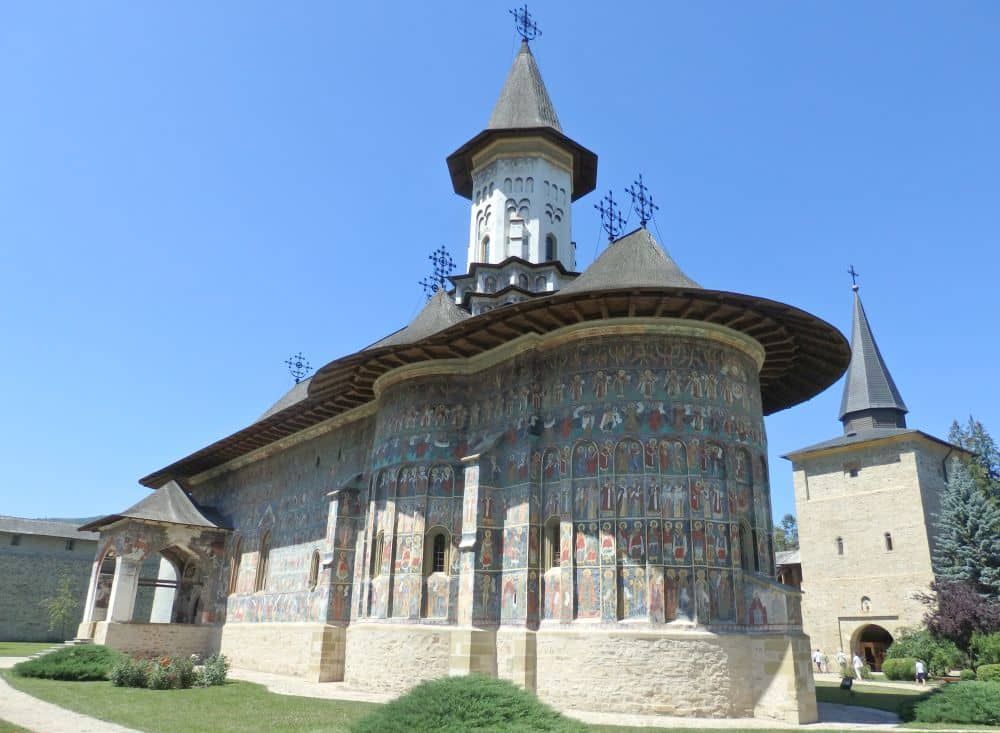
These are small rural churches, not particularly grand in terms of architecture. They aren’t very busy, probably because of their distance from the more popular tourist destinations in Romania like Bucharest and Bran Castle in Transylvania.
From ground level to right up at the edge of the roof, paintings cover the walls, mostly as a series of squares with consecutive scenes shown from left to right or top to bottom. On some churches, you’ll also notice purely decorative elements along the borders that divide the scenes.
The paintings are in a typically medieval style in that the posture of the figures is awkward, with halos behind the saints’ heads, and perspective is not always respected. Yet they are detailed and sometimes masterful. You’ll find yourself trying to identify the various stories and to follow the logic of the panels.
On the exterior walls, the condition of the paintings varies. On one side they’ll be faded and hard to make out, while they’re still bright and clear on the opposite side. Paintings that are sheltered by the eaves of the roof tend to be brighter than those lower down. Inside, though, the paintings are in much better shape, and much brighter.
As far as I know, only two of the churches – Moldoviţa and Humor – depict a non-religious theme: the Seige of Constantinople in 628 AD. At Moldoviţa, it shows the enemy as Turks rather than Persians. At the time it was painted, Moldavia was being threatened by the Ottoman Empire; hence the Turks in the image.
Voroneţ’s church has a huge image of the Last Judgement covering an entire outer wall, with much detail of both heaven and hell.
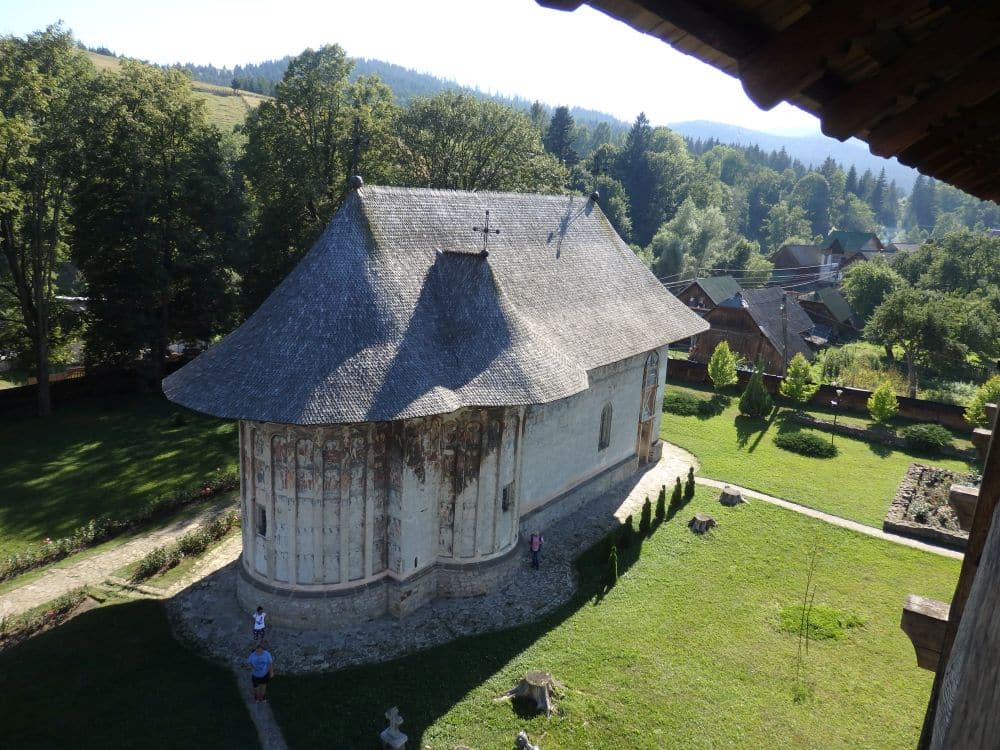
The church in Pătrăuţi has the most accomplished of the interior paintings, in my opinion, but the artist is unknown. The outside is not completely painted.
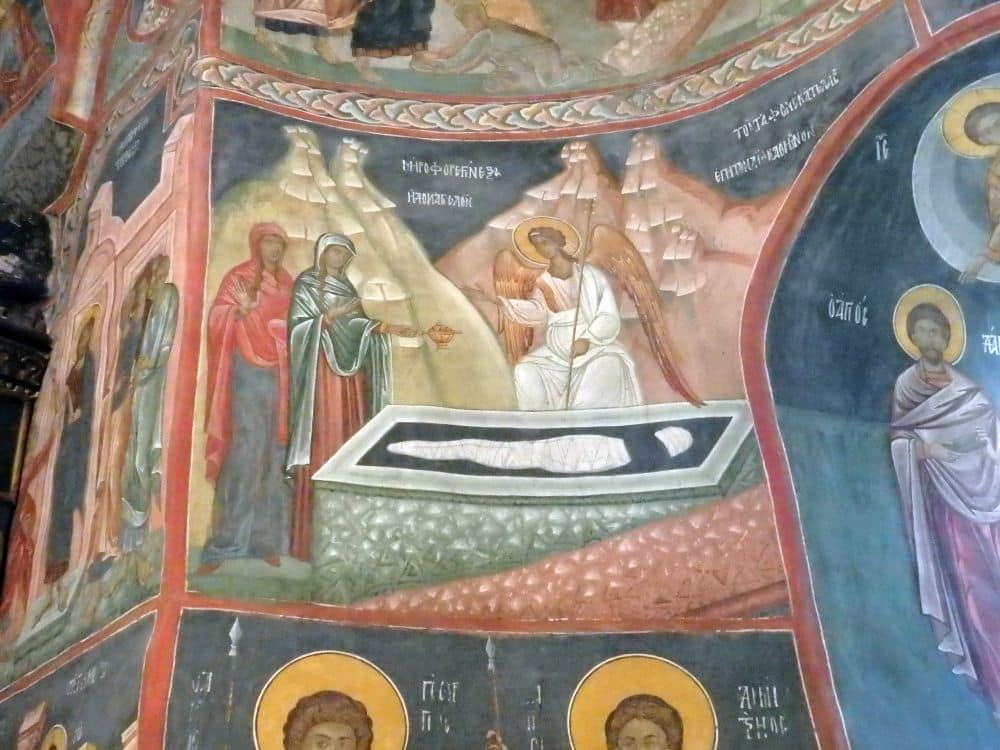
Arbore is the smallest church in the group.
At Suceviţa you’ll see a huge image of the “Ladder to Paradise,” showing a diagonal ladder up to heaven with neat rows of angels. Sinners fall from the ladder to the devils in hell below.
Are the Churches of Moldavia worth visiting?
It depends. If medieval-period vernacular religious art is something that interests you, this is a wonderful gallery of such art, so to speak. It’s very off-the-beaten-track, however, and takes some effort to get to. On the other hand, the landscape in this part of Romania is lovely. We visited on a road trip around the country, so we had the time to go take a look. Once we’d seen one, it made us want to see some others. I would say that if the pictures in this article don’t speak to you, it’s probably not for you.
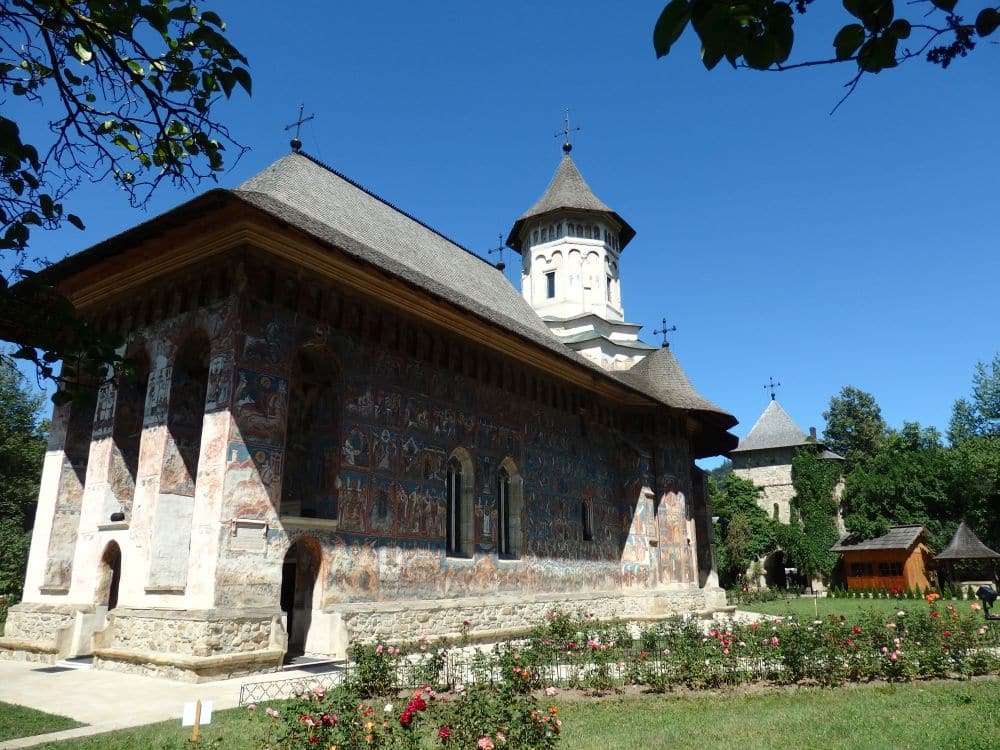
If you enjoy this kind of vernacular religious architecture and you’re traveling in Romania by car, you’d likely also enjoy the Wooden Churches of Maramureş UNESCO group of churches in the remote north of the country, as well as the UNESCO group of Fortified Churches in Transylvania.
Tips for visiting the Churches of Moldavia
Don’t confuse Moldova with Moldavia. Moldova is the country bordering Romania on the east; its capital is Chișinău. Moldavia is a region of Romania.
Make sure to see the inside as well as the outside of any church you visit because while UNESCO mostly focuses on the exteriors, the interiors are just as richly painted.
Take your time. The longer you look at a series of images, the more you’ll notice in them.
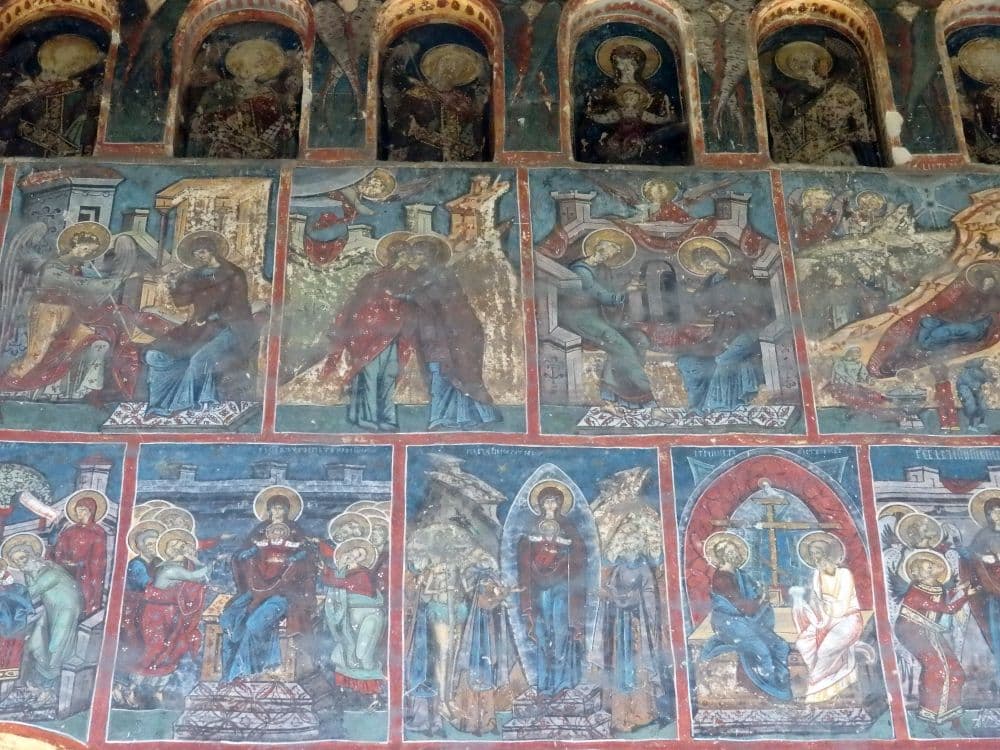
Suceava and Gura Humorului are the largest towns in the area. Book accommodations in Suceava. Or use the map below, centered on Gura Humorului, to find a place. Zoom out to find accommodations in other villages as well.
The churches are open every day, and some charge a small fee. Some do not allow photography inside, while some charge an extra fee for taking pictures.
The churches in Humor, Modovita, Probota, Voroneţ and Suceviţa are all within monastery complexes.
Dress modestly.
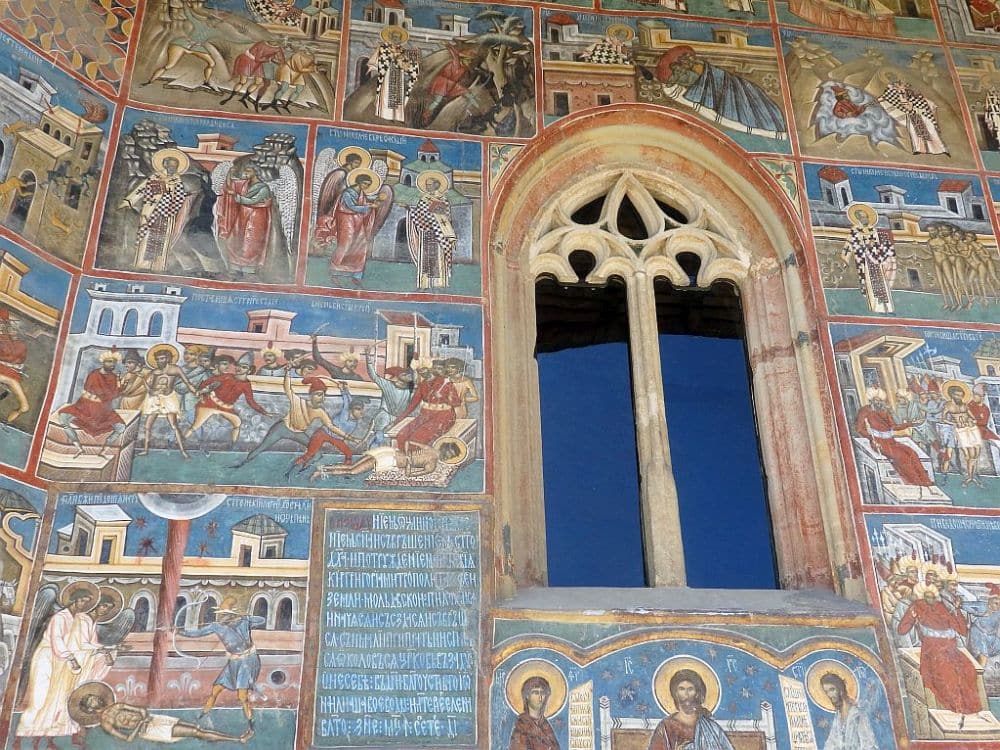
Where are the Painted Churches of Modavia?
The churches are all in the far northeast of Romania in the region of Bukovina, more than 5 hours’ drive from Bucharest, or about a one-hour flight from Bucharest Airport (OTP) to Suceava (SCV).
All eight churches are in villages within one hour’s drive of the town of Suceava. By far the easiest way to travel in this region is by car. Rent one on arrival in Bucharest or take a train or flight to Suceava and rent one there.
Alternatively, take a one-day tour from Suceava or Gura Humoruliu that visits four of the churches.
Each of the churches is marked on the map below, as well as the towns of Suceava and Gura Humoruliu:
You can get to Suceava and Gura Humoruliu by train, but from either of them you’ll need to take a local bus to get to any of the churches.
- Arbore: DN2K 732. The nearest larger town is Suceava, 39 km (24 mi) away.
- Humor Monastery: Mănăstirea Humorului village, which is 6.4 km (4 mi) from Gura Humorului and 40 km (25 mi) from Suceava.
- Moldovița Monastery: Vatra Moldoviţei village. 72 km (45 mi) from Suceava or 32 km (20 mi) from Gura Humorului. Vatra Moldoviței has a train station.
- Pătrăuți Church: DJ208V 214, in Pătrăuți village, 8 km (5 mi) from Suceava.
- Probota Monastery: DJ208S 58, in Probota village, 50 km (31 mi) from Suceava.
- Suceava: Saint George’s Church: Strada Ion Vodă Viteazul 2 in Suceava.
- Sucevița Monastery: DN17A 169 in Suceviţa village, 51 km (32 mi) from Suceava and 51 km (32 mi) from Gura Humorului.
- Voroneţ Monastery: Strada Voroneţ 166 in Gura Humorului, 6.4 km (4 mi) from the town of Gura Humorului and 48 km (30 mi) from Suceava.
For more information about the Churches of Moldavia, their opening hours and admission fees, see Romania Tourism’s website.
Have you been to any of the Churches of Moldavia? If so, do you have any additional information or advice about this UNESCO World Heritage site? Please add your comments below!
- About the author
- Posts by this author

Rachel Heller blogs at Rachel’s Ruminations, a website focusing on historical and cultural sights/sites for independent travelers. She is also the owner of this World Heritage Travel website.