
Early Christian Monuments of Ravenna
By Rachel Heller
What are the Early Christian Monuments of Ravenna?
In the Italian city of Ravenna, eight monuments are preserved that date to the fifth and sixth centuries. Despite their age, they are all intact, or at least parts of them are, and all but one contain magnificent mosaics rich in early Christian symbolism.
This was an important period in the early history of Christianity in the region, but at the same time, it was an unstable time. Ravenna was the capital of the Western Roman Empire, but when the empire fell in 540 AD, the Byzantines took control. These different artistic traditions – Eastern and Western – are visible in the mosaic artworks.
Disclosure: This article contains affiliate links. Making a purchase through an affiliate link will mean a small commission for this website. This will not affect your price. Privacy policy.
Why are Ravenna’s Christian monuments a UNESCO World Heritage site?
The main reason that this group is a UNESCO site is because of the “supreme artistry of the mosaic art they contain,” according to UNESCO. They are the best surviving examples of mosaic artwork from this period, which was so important in the history of Christianity in Europe. UNESCO points out, in particular, how the artists who created these mosaics blended different traditions: “a wonderful blend of Greco-Roman tradition, Christian iconography and oriental and western styles typifying the culture of the later Roman Empire.”
What can you expect on a visit to Ravenna?
Ravenna is a very pleasant city for a stroll, and most of the monuments are in the center of the old city, within walking distance of each other. The exception is the Basilica of Sant’Apollinare in Classe, which is a bit outside the city.
Because these monuments come from a very early period in the history of Christianity, they contain elements that we might associate today with Eastern Orthodox churches, as well as elements that would today be connected with the Catholic Church. Christianity hadn’t settled into consistent symbolism or rituals yet, and different Christian sects interpreted the Bible differently.
One part of that process was the debate over the relationship between God and Jesus. A Christian belief system called Arianism, based on the ideas of Arius, competed with the more mainstream (Nicene or Catholic) Christianity. The Arian church doctrine emphasized Jesus’s humanity. He was created from God, so he was separate from and even subordinate to God, not part of a trinity. The First Council of Nicaea declared Arianism a heretical doctrine in 325 AD.
Several Roman emperors, however, were pro-Arian, and Arianism spread across Europe over the next couple of centuries. This ended when the Byzantine Emperor Justinian issued a new codification of law in 529-565 AD which included an edict declaring the Bishop in Rome to be the head of all Christian churches. In Ravenna, both Arian and Nicene strands were present until the Justinian edict. While all of the monuments in this UNESCO group became Catholic places of worship over the following centuries, some were originally Arian.
The eight monuments are as follows, in no particular order:
The Mausoleum of Galla Placidia
Galla Placidia was briefly the Empress of the Western Roman Empire and served later as regent for her son Valentinian. While she was a Christian and contributed to building several of these monuments, she probably was never actually entombed in this mausoleum.
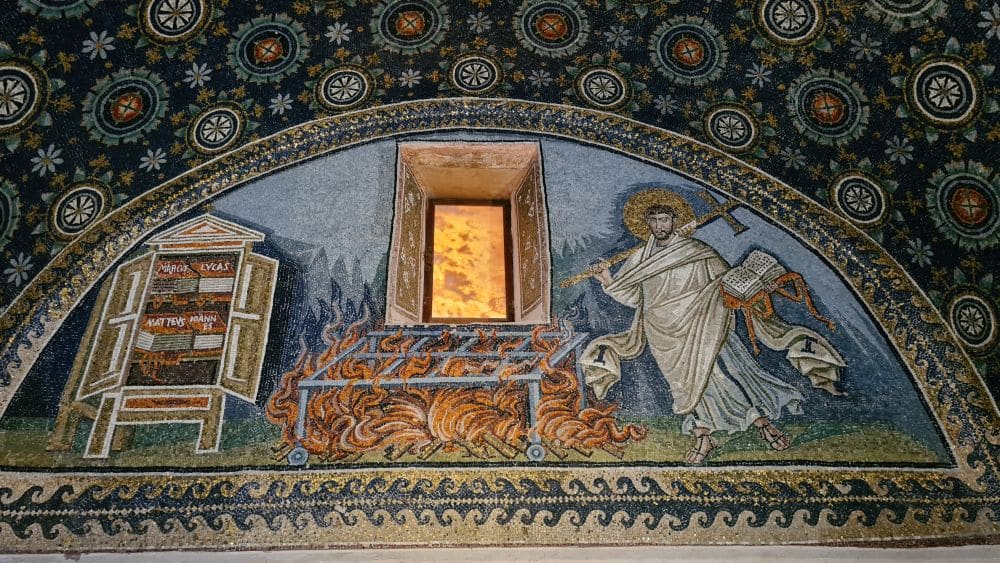
The mausoleum is a small brick building dating to between 425 and 450 AD. Outside, it seems modest and simple, but the walls and ceilings inside are covered with colorful mosaic images. They refer to the Resurrection and eternal life through symbols like doves drinking from a spring, which represents faith in baptism and eternal life, or the image of Jesus welcoming believers, who are depicted as sheep.
The Basilica of San Vitale
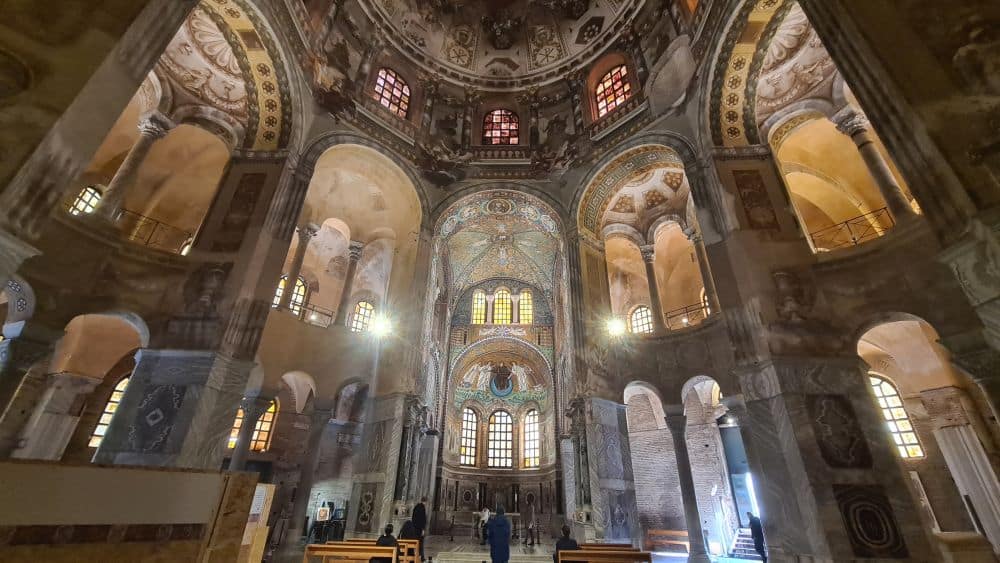
Dating to about 547 AD, this octagonal brick church with a dome in its center contains two levels. The upper one was the women’s gallery, a tradition in the oldest Christian churches, possibly carried over from Judaism. Architecturally, it contains both Roman and Byzantine elements.
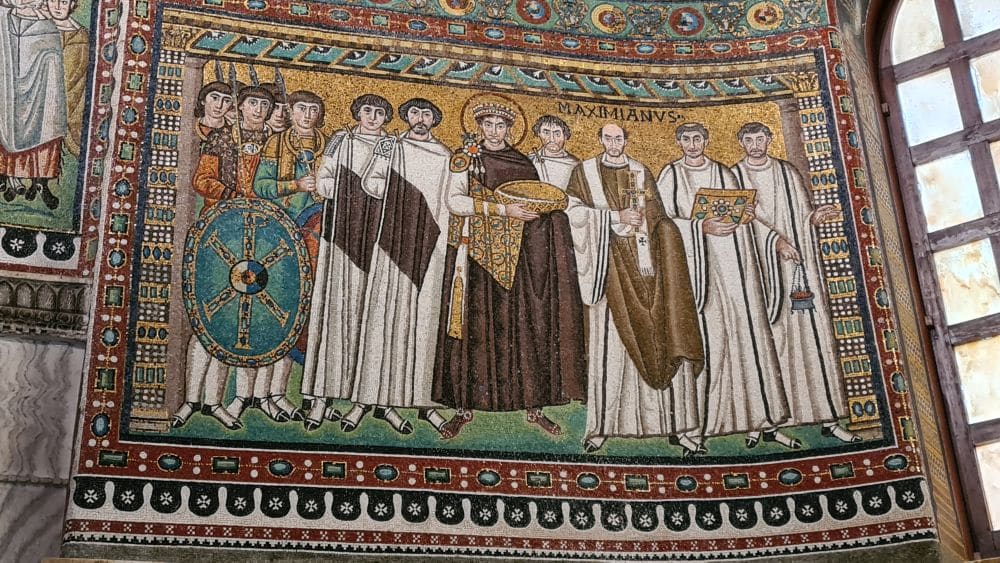
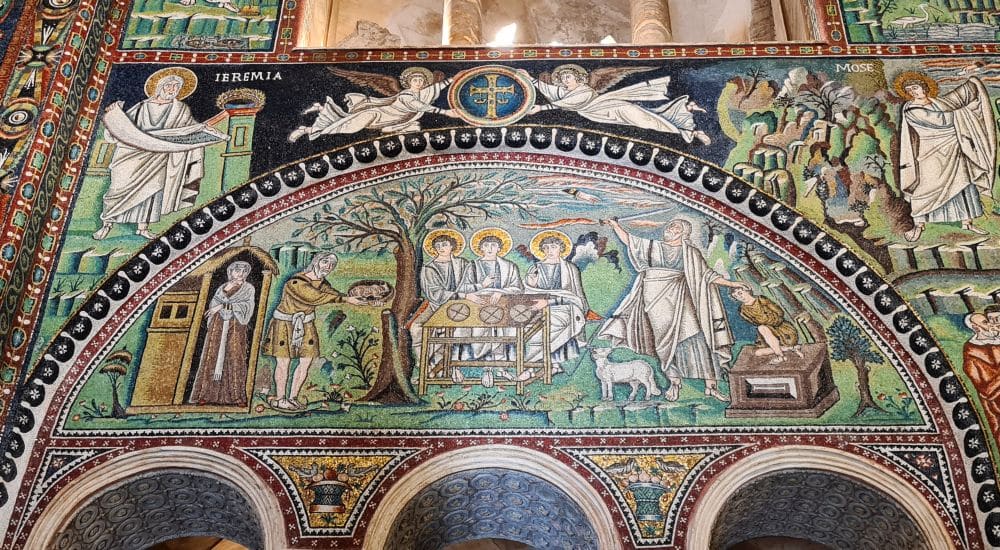
The mosaics inside the church are, like at the Galla Placidia mausoleum, vivid and expressive. The most striking are the large image of Abraham as he is about to sacrifice his son Isaac, stopped by the hand of God; and the one of the Abel and Melchizedec, both of them making offerings to God. Another shows Jesus dressed like a Byzantine emperor, and there are also images of the apostles, St. Vitale and various other saints. One large image shows a halo-wearing Emperor Justinian I, with soldiers and clergymen, while another shows his wife, Empress Theodora, also with a halo and surrounded by her courtiers.
The Neonian Baptistry
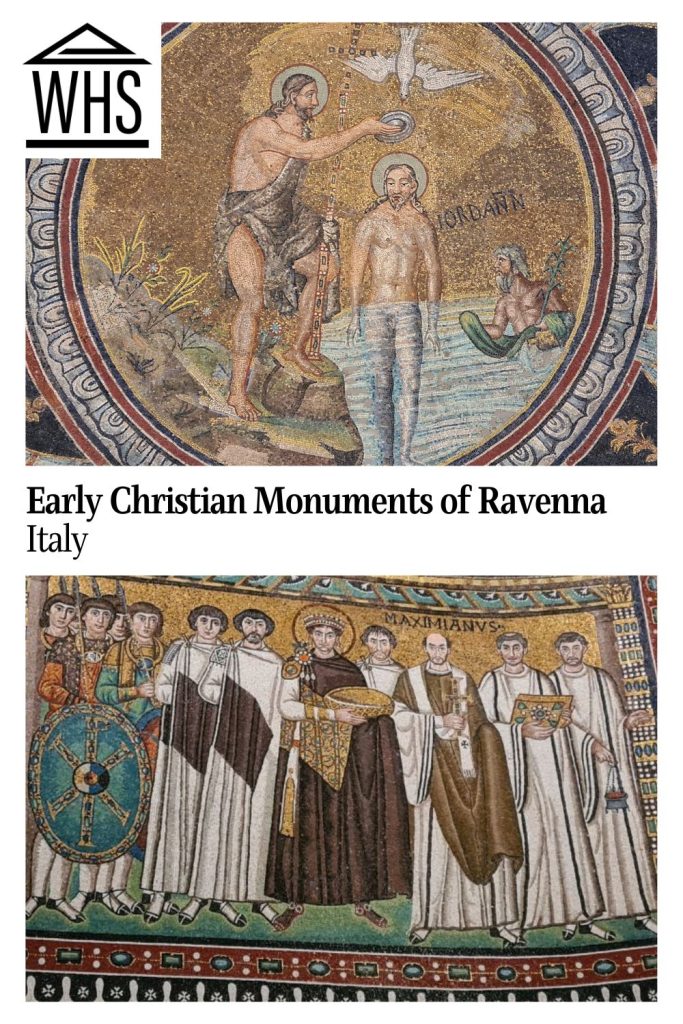
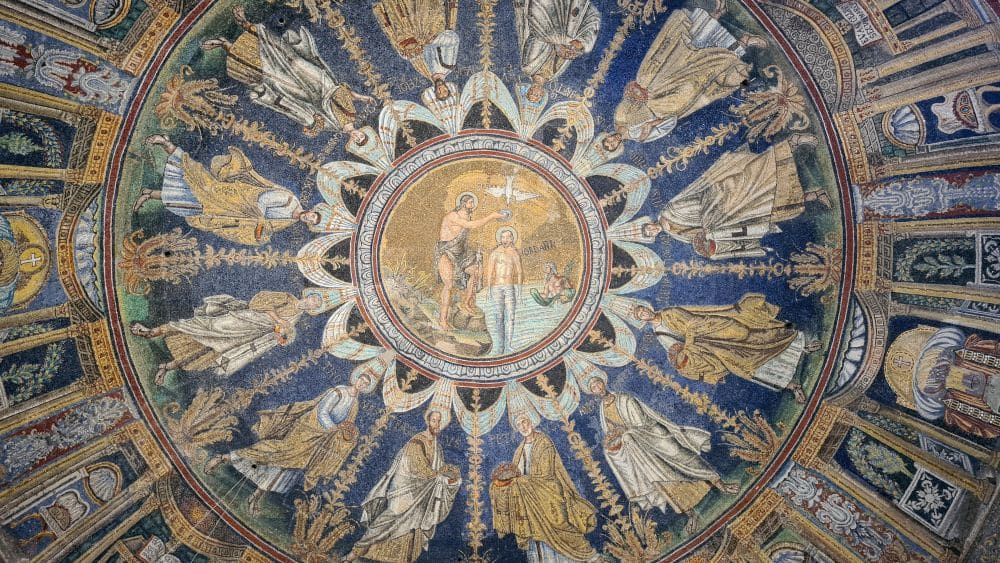
This simple octagonal brick building is likely the oldest of the group, dating to the end of the 4th or the early 5th century. The ceiling mosaic centers on a depiction of John the Baptist baptizing Jesus in the River Jordan and, interestingly, includes the figure of Zeus to represent the spirit of the river.
There are more mosaics on the eight arches around the central baptismal pool, and bas-relief images of saints circle the room above the arches and between a circle of eight windows. In a single room I had so much to look at that my neck started hurting from looking up for so long.
The Archiepiscopal Chapel
Also known as the Archbishop’s Chapel or Saint Andrew’s Chapel, this monument dates to sometime between 494 and 519 AD. It is now part of the Archiepiscopal Museum, and consists of two small rooms: a rectangular hall and a small chapel shaped like a Greek cross. It served as a private chapel for the bishops of Ravenna.
On the ceilings of both rooms are some wonderful mosaics, most of which have been restored “with completion,” i.e. based on early descriptions and traces that remained. The symbol at the ceiling’s center shows an I and an X, forming a chrismos, representing Jesus. Around that are four angels with busts of the apostles circling them.
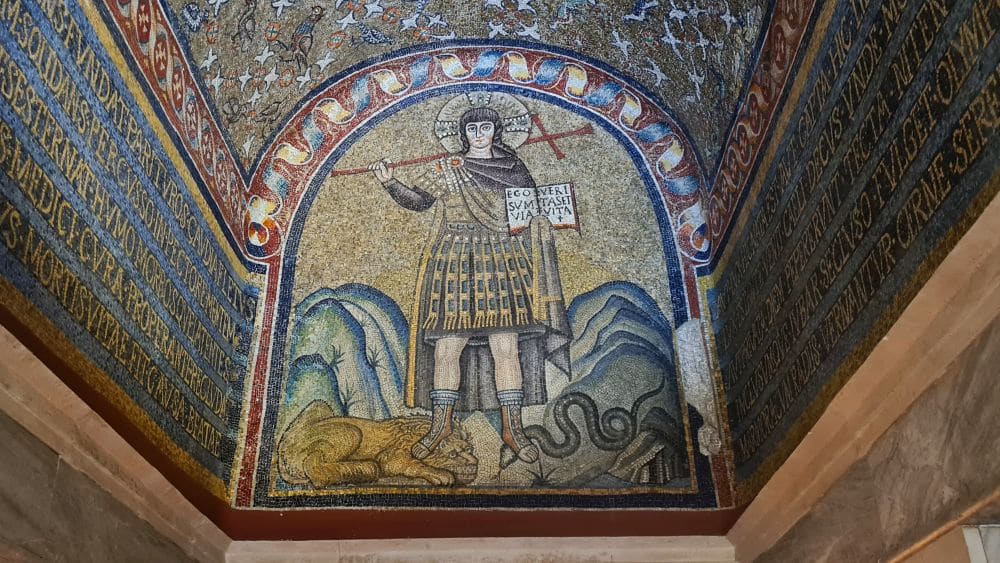
The best part of this set of mosaics, though, is in the vestibule, above the entrance. It’s a beautiful representation of a young Jesus – no beard – with one foot on a lion and one on a snake. These represent the forces of evil.
Basilica of Sant’Apollinare in Classe
This church outside of Ravenna dates to 549 AD and stands on Saint Apollinare’s burial site. The original church was large, but the design was simple. The entrance was added later, as was the 9th-century bell tower.
Inside, the side walls were once covered in mosaics, but today only the mosaics around the apse and the arch above it remain. The frescos date to the 18th century and are not in great shape.
The mosaics that remain today are in Byzantine style and emphasize mainstream (Nicene) belief in a divine Jesus, shown at the very top center, flanked by a winged man, a lion, a calf, and an eagle, which represent Matthew, Mark, Luke and John. In the half-dome top of the apse is a cross in the center, with the hand of God above it as well as pictures of Elijah and Moses. The three sheep under them symbolize the Transfiguration.
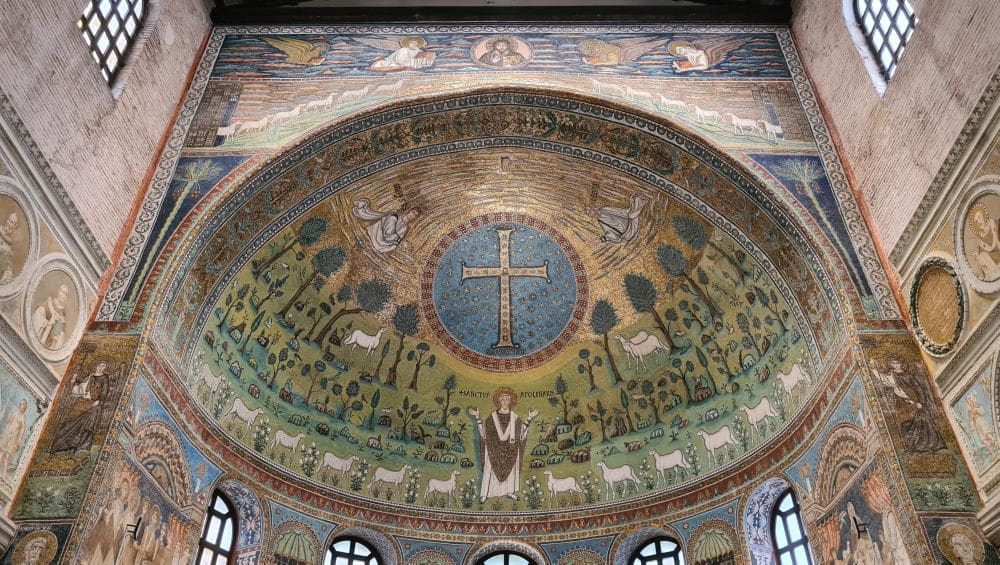
Below that, but central to the entire composition, is an image of Saint Apollinaris with a row of 12 lambs, representing the Christian faithful.
Around the large open space inside the church, you’ll also notice various huge stone sarcophagi dating from the 5th to the 8th century. The bas-relief images on each one trace how styles changed over the years.
Basilica of Sant’Apollinare Nuovo
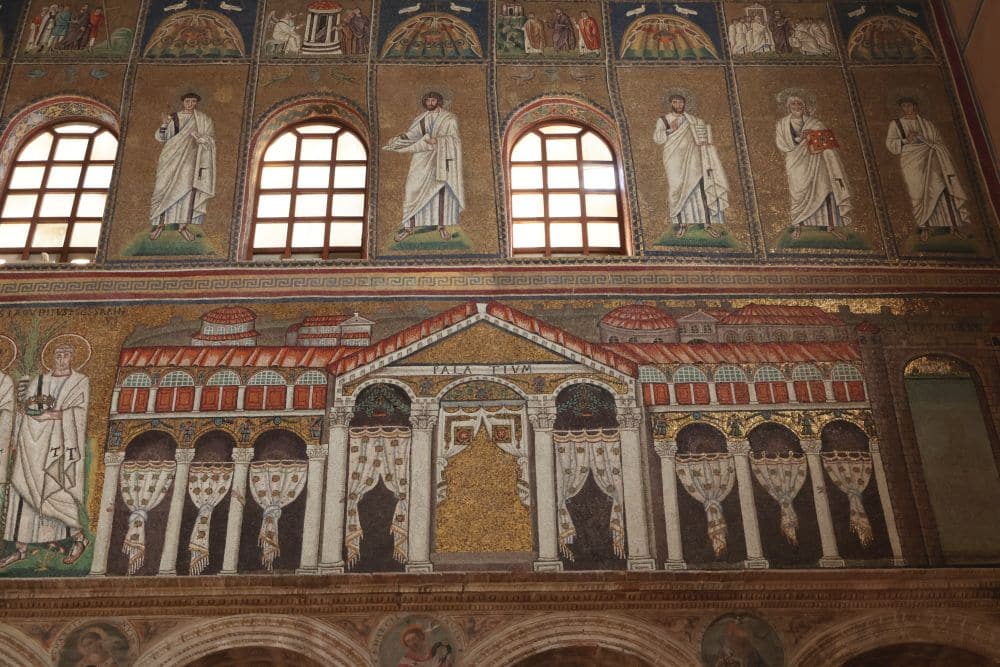
Commissioned by Emperor Theodoric in the late 400s or early 500s, this was originally an Arian church. It’s remarkably large and light, considering how its age. While most of the mosaics date to when the church was built, the two processions – Martyrs and Virgins – along the sides of the center aisle were added after Justinian’s edict.
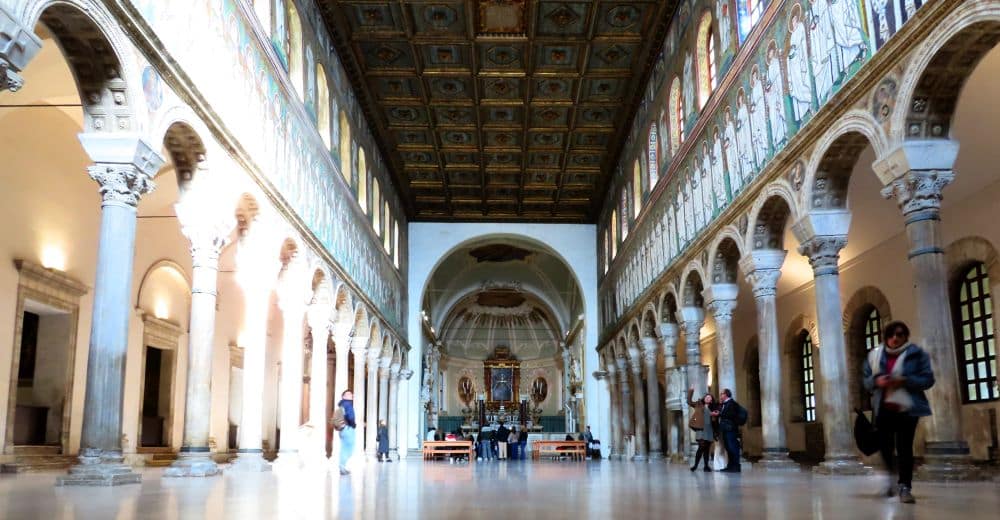
This allows some comparison. The earlier mosaics above the processions right under the ceiling show stories from biblical accounts of Jesus’s life, miracles and parables. Unfortunately, it’s hard to see the them from the floor. On one side, they show Jesus with a beard, and on the other side as a young man without a beard. This was important in Arian belief because it emphasized his human aging process.
The row below these, also from Theodoric’s time, shows various saints, in a Greek-Roman style. They show some individuality in their faces, hair and stance.
The two processions, on the other hand, show more Byzantine influence. They look very similar to each other, especially the row of women. The women are moving from Classe toward the Madonna and child, led by the three Magi. The men, led by St. Martin, move from Theodoric’s palace to an image of Jesus on the throne. This was a clear message of moving away from Arianism and toward the mainstream church.
As for its outward appearance, the portico along the front was added in the 16th century, and the tower was added in the 10th century.
Arian Baptistry
The Arian Baptistry, built by Theodoric in the late fifth or early sixth century, was part of his effort to provide facilities for Arian worship. Like the Neonian Baptistry, it’s an octagonal brick building. The mosaics or other decorations that once covered the walls and small apses are gone, but its domed ceiling contains a gorgeous Byzantine-style mosaic showing the baptism of Jesus by John the Baptist.
Again, like in the Neonian Baptistry, another figure is present in the baptism scene. This may be a Christianized version of Zeus or a river god, symbolizing the Jordan River. Above the young Jesus’s head is a dove, representing the holy spirit, spraying water on Jesus. John the Baptist wears skins to represent his harsh life in the desert.
Around this scene are the apostles, all looking much the same, and all walking toward a throne that represents Jesus’s power.
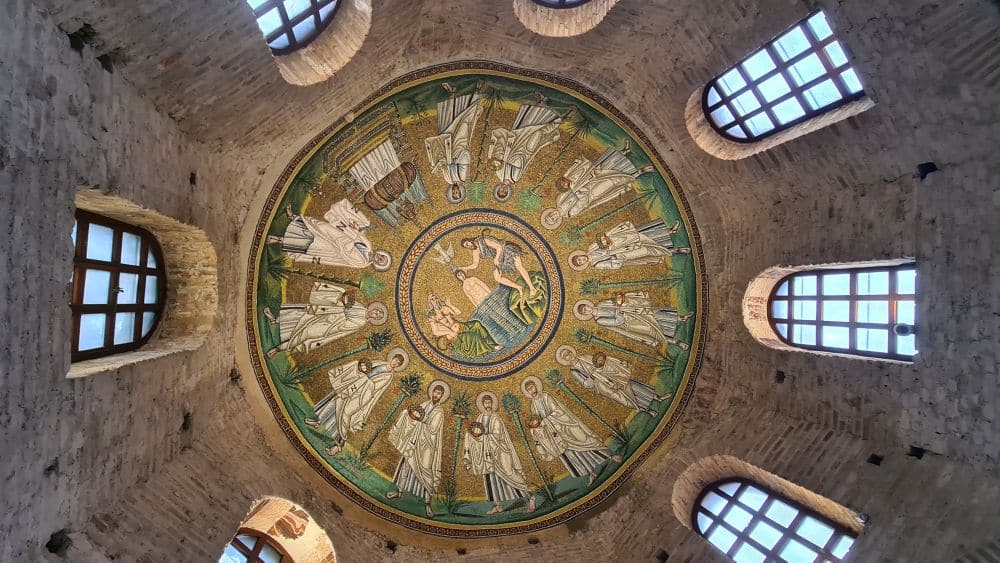
Even though this baptistry was intended for Arians – along with the Spiritu Santo church next door, now much changed – it isn’t much different from the mainstream Catholic Neonian Baptistry. There’s no clear statement about Jesus as being human or subordinate to God, except perhaps in his portrayal as quite young and beardless. Perhaps the message was clearer on the missing wall mosaics.
The Mausoleum of Theodoric
Theodoric the Great, who added Ravenna to his empire after conquering it in 493 AD, ruled until 526. An Arian Christian, he tolerated the mainstream Christians, but felt that the Arian believers needed separate places of worship. He was responsible for building the Basilica of Sant’Apollinare Nuovo, the Arian Baptistry, and this tomb for himself. He built a number of other churches as well, but none of them have survived.
This mausoleum is the only monument on the list that was made of stone rather than brick. Dating to 520 AD, it consists of two ten-sided levels. Inside, the lower level is shaped like a Greek cross, while the upper level is round. Remarkably, the roof is a single stone 10.76 m (35.3 ft) across and weighing 230,000 kg (507,000 lbs). There are mosaics inside, but there are a few remnants of carved details on the exterior.
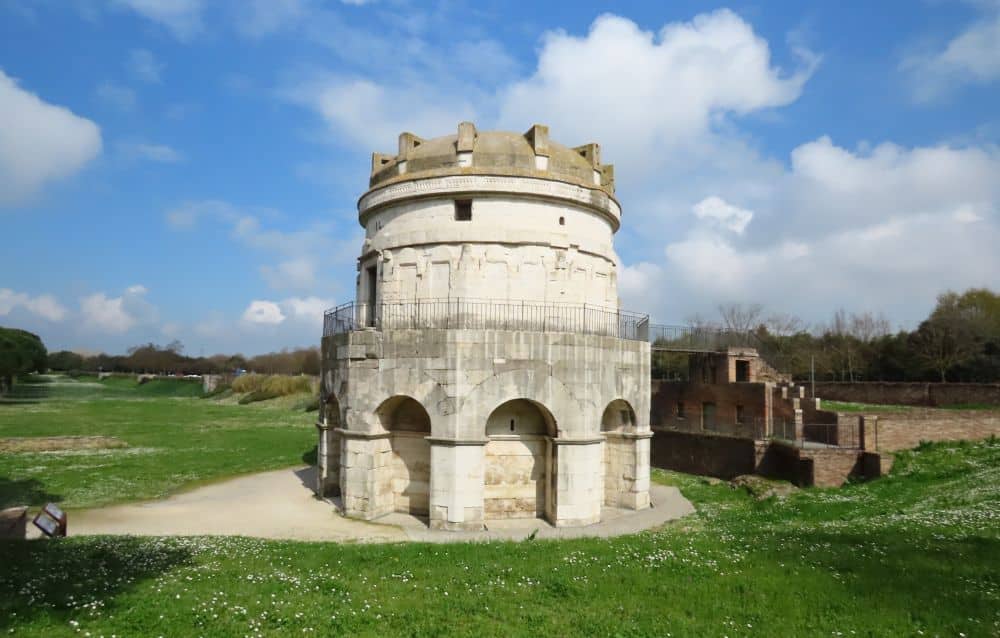
After the Justinian Edict, Theodoric’s bones were scattered or perhaps buried elsewhere, and the mausoleum was used as a chapel.
It’s part of this UNESCO property because it’s in Gothic style, rather than Roman or Byzantine like the other elements in the group, and because of Theodoric’s importance during this period.
Are the Early Christian Monuments of Ravenna worth visiting?
Certainly if you’re in Ravenna, you should stop into at least one or two of these monuments. If you like mosaics, it’s worth a special trip from wherever else you’re visiting in Italy. They’re really quite special.
What sorts of travelers would like these monuments in Ravenna?
Anyone interested in early Christian history, art and/or iconography would love the mosaics here. And Ravenna is a pleasant place, with attractive city squares, great food, and lots of shopping opportunities.
Tips for visiting Ravenna
It took us a day and a half to see all eight monuments. Having said that, it’s probably not worth seeing them all. In particular, we found the Mausoleum of Theodoric rather underwhelming, so if you have to choose, skip that. And the Basilica of Sant’Apollinare in Classe is both harder to get to and somewhat less awe-inspiring than the others. Use the map below to plan your itinerary.
I think the best, if you have to choose, are the Mausoleum of Galla Placidia, the Basilica of San Vitale, and the Neonian Baptistry. But if you like mosaic artwork, see more. The Archiepiscopal Chapel is tiny and beautiful. To see it, you’ll have to pay entrance to the Archiepiscopal Museum, which is inside the former Archiepiscopal Palace. In the museum you’ll see various decorative elements taken from the Ravenna Cathedral when it was renovated in the 16th century.
Speaking of the Ravenna Cathedral, it dates to the same period as the monuments in this UNESCO group, but looks Baroque these days because of that renovation in the 16th century and additional renovations in neo-classical style in the 18th century.
If you visit the cathedral, notice the two huge 5th-century sarcophagi. You’ll find them in the Sanctuary of the Madonna del Sudore chapel inside the cathedral. Apparently they contain the remains of an archbishop and of Saint Barbiano, who was Galla Placidio’s confessor. They have similar early-Christian imagery in bas-relief form that you’ll see in the mosaics in the UNESCO monuments.
Also in Ravenna Cathedral is a pulpit from the original cathedral on the site. It holds bas-relief images as well, mostly of animals and birds.
Take a 2-3-hour guided walking tour that includes three of the sites with a guide. Or consider a private tour that includes four of the monuments, led by an art historian.
These sites all charge admission fees. If you’re going to see more than one, it’s worth checking the various combination tickets available.
All of these locations seem to be at least partly wheelchair accessible, with ramps in place as needed.
If you’re going to be in Ravenna anyway, it won’t be hard to get to Bologna, with its UNESCO porticos, or Urbino, a charming Renaissance city on a hill. You also might enjoy seeing the tiny independent state of San Marino on its rocky perch.
Where is Ravenna?
Ravenna is in northern Italy near the east coast, south of Venice and north of San Marino. It is well-connected to anywhere in Italy by train.
If you’re driving, keep an eye out for the center of the city zone with limited traffic (ZTL) and don’t enter it. You’ll end up with a fine. You can find parking outside of the zone and walk in. You can usually park in white-edged parking spaces for free. You’ll need to pay for any blue-edged space and you should not park in any yellow-edged space.
We stayed in a very pleasant little studio apartment walking distance from the sights, with free on-street parking. There are plenty of other accommodations to choose from in or near the city center.
For more information about the Early Christian Monuments of Ravenna, their opening hours and admission fees, see these websites:
- Mausoleum of Galla Placidia
- Basilica of San Vitale
- Neonian Baptistry
- The Archiepiscopal Chapel in the Archiepiscopal Museum
- Basilica of Sant’Apollinare in Classe
- Basilica of Sant’Apollinare Nuovo
- The Arian Baptistry
- The Mausoleum of Theodoric
Have you been to the Early Christian Monuments of Ravenna? If so, do you have any additional information or advice about this UNESCO World Heritage site? Please add your comments below!
- About the author
- Posts by this author

Rachel Heller blogs at Rachel’s Ruminations, a website focusing on historical and cultural sights/sites for independent travelers. She is also the owner of this World Heritage Travel website.