
Grotte Chauvet-Pont d’Arc, Ardèche
By Carol Cram
What is Grotte Chauvet-Pont d’Arc?
Listed by UNESCO as “Decorated Cave of Pont d’Arc, known as Grotte Chauvet-Pont d’Arc, Ardèche,” Chauvet Cave contains the oldest known figurative art on earth. Between 37,000 and 28,000 years ago, during the Aurignacian period, artists painted over 1000 images of animals: horses, mammoths, woolly rhinoceroses, cave lions, bison, cave bears, and more. Also included are hand stencils, charcoal markings, and one enigmatic half-human, half-bison figure that has kept archaeologists arguing for decades.
Disclosure: This article contains affiliate links. Making a purchase through an affiliate link will mean a small commission for this website. This will not affect your price. Privacy policy.
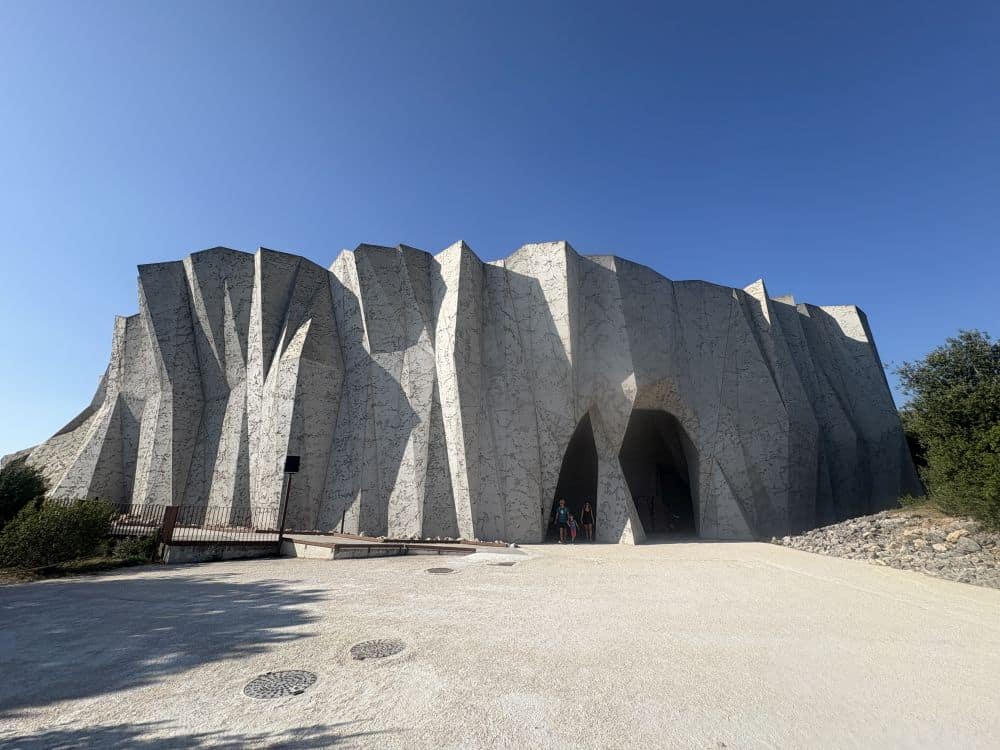
The cave, and its replica, are located in the Ardèche region of southern France, not far from the town of Pont d’Arc. I say “replica” because the original cave has been closed to the public since its discovery in 1994. The art inside is too precious and too fragile to withstand crowds of people breathing near it.
The replica cave is called Grotte Chauvet 2, and I visited this astonishing full-scale facsimile of the real cave on a hot summer day in 2025. It is located about five kilometers from the original site, near the iconic natural arch of Pont d’Arc.
Grotte Chauvet 2 opened in 2015 after technicians spent approximately 700 hours laser-scanning the original cave to ensure the reproduction was as accurate as possible. The replica is nearly the size of a football field.
Why is Grotte Chauvet-Pont d’Arc a UNESCO World Heritage Site?
The cave received UNESCO World Heritage status in 2014. The UNESCO listing describes the images as being “of exceptional aesthetic quality.” It says that they “demonstrate a range of techniques including the skillful use of shading, combinations of paint and engraving, anatomical precision, three-dimensionality and movement.” Some of the animal species represented were dangerous to these prehistoric humans. Yet they were able to observe them and accurately depict them.
Because a rock fall about 20,000 years ago sealed off the cave until its rediscovery in 1994, the level of preservation of the artwork is exceptional. The cave’s climate remained stable and there were no natural events or human incursions to affect their condition. It “illustrates like no other cave of the Early Upper Palaeolithic period, the frequentation of caves for cultural and ritual practices,” according to UNESCO.
Chauvet is extraordinary both because of its age and the incredible sophistication of the art adorning the walls of the cave. The Paleolithic artists – our ancestors – knew what they were doing. They scraped the cave walls clean before painting to make the images stand out. They used perspective and the natural
contours of the rock with its bulges and natural fissures to bring the images to life.
What can you expect on a visit to Grotte Chauvet 2?
I came to Grotte Chauvet 2 as someone who had already visited other prehistoric painted caves. I’ve seen UNESCO-listed Lascaux (in its own replica form, since the original is closed) and Altamira Cave in Spain (also UNESCO-listed), along with several smaller caves in the Dordogne region of France and Andalusia in Spain. The site has been on my to-visit list ever since I saw the Werner Herzog documentary Cave of Forgotten Dreams in 2010.
The documentary was recently restored for re-release in iMax theaters. Here is the film’s trailer, which gives a few glimpses of the artworks inside the cave.
As both a novelist and a travel blogger who loves art, I have a particular interest in prehistoric art. So does my husband, Gregg Simpson, a visual artist. Gregg has done entire art series inspired by cave paintings, so our visit to the Chauvet Cave was particularly meaningful for us.
What struck me immediately at Grotte Chauvet 2 was the scale. While the Lascaux cave is quite intimate, Grotte Chauvet 2 is vast. With its low lighting and cool air (a welcome relief from a sweltering August day), the feeling I got upon first entering the cave was of being transported from the modern to the ancient world.
Grotte Chauvet 2 is the most well-organized cave experience I’ve ever had. Instead of following a human guide as is done at Altamira, visitors are provided with a motion-activated audio guide available in ten languages. Inside the cave, you walk along winding paths dotted with a series of numbers. When you stand near a number printed on the pathway, a commentary automatically plays to describe the paintings you’re looking at.
You can stand for as long as you want in any area. The timed entry system ensures that there are never more than a comfortable number of visitors in the cave. I never felt rushed and because of how the pathways are organized, I always had a full and clear view of the paintings. Photography is not allowed, which makes for a much deeper experience. Instead of snapping pictures of every panel, I really looked at the paintings while listening to the commentary. I saw how the paintings use the cave walls to provide depth and dimension. A bulge becomes the hindquarters of a bison; the front legs of a lion disappear into a dark crevice.
Each painting tells a story beyond our understanding. We don’t know why the paintings were done or what the artists were thinking while painting deep in a cave lit only by torchlight. I was overwhelmed by a feeling of oneness with these unknown artists. Tens of thousands of years ago, these people, who were biologically identical to modern humans, endured harsh, short lives endangered by many of the animals depicted on the cave walls.
While much is written about how the paintings may have been part of hunting rituals, I like to imagine that the artists themselves were also motivated by a desire to depict their world for its own sake, just like artists do to this day. Gregg, in particular, felt a strong kinship with these ancient artists who dipped a brush into pigment and applied it to a surface just like he does every day. The urge to create, the need to create, is what makes us human.
Is Grotte Chauvet-Pont d’Arc (i.e. Grotte Chauvet 2) worth visiting?
Without hesitation: yes, and it’s worth making a special trip. For us, our visit to Grotte Chauvet 2 was the main reason we chose to spend three days in the Ardèche during an August heat wave. The site itself is lovely to walk around with lots to see in addition to the cave.
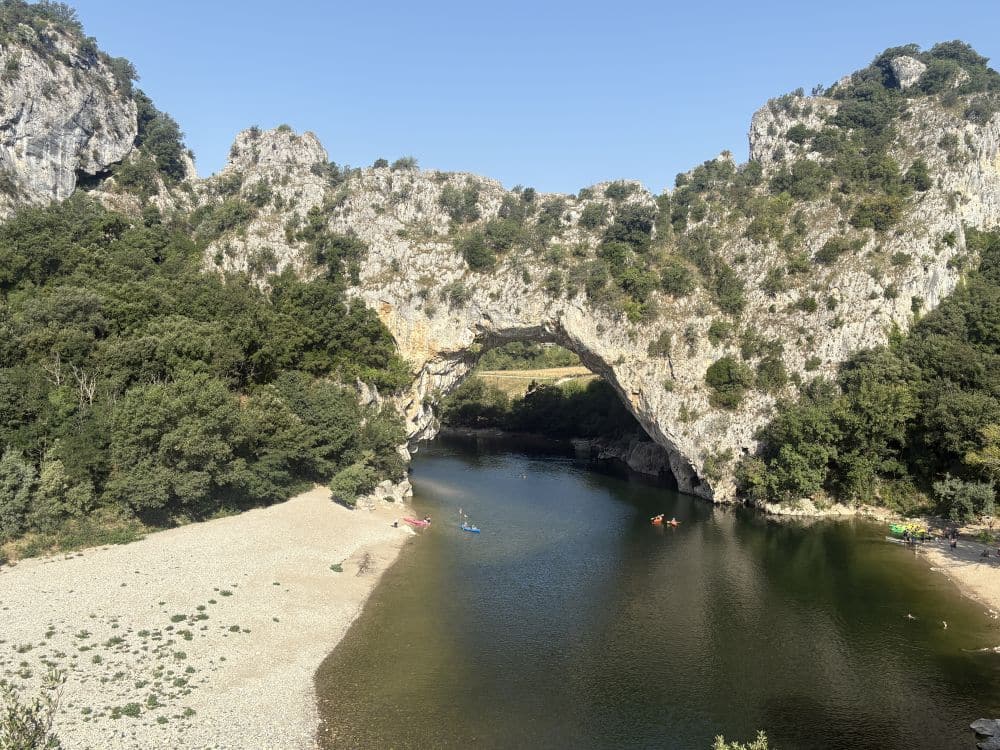
I would not treat a visit to this area as a quick detour. Build it into a dedicated stay in the Ardèche region, ideally at least two nights, so you can also experience the gorge itself. It is spectacular in its own right, with the natural stone arch of Pont d’Arc visible from the river and the surrounding cliffs rising dramatically above you.
Allow at least two to three hours for Grotte Chauvet 2. This includes the Aurignacian Gallery, a large exhibition space that is a must-visit either before or after your cave visit. In the Aurignacian Gallery, you’ll gain a deeper understanding of the people who created the art in the cave and view life-size prehistoric animals and scenes of everyday life from the era. Here are a few of the critters you’ll meet: bison, mammoth, deer, and rhino. Plenty of multimedia stations feature interviews with scientists and provide additional ways to extend your knowledge.
After steeping yourself in the glories of Grotte Chauvet 2, check out the extensive gift shop. Here you can purchase a book featuring full-color reproductions of the cave paintings. It’s a must if you want a keepsake since you can’t take photos in the cave. You can also buy an impressive variety of prehistoric swag, including stuffed prehistoric animals, fridge magnets, and sweatshirts. And yes, I bought a stuffed rhinoceros.
What sorts of travelers would like this replica of Grotte Chauvet-Pont d’Arc?
Anyone with an interest in art history, archaeology, or human prehistory will find a visit to Grotte Chauvet 2 deeply rewarding. But even if that’s not an interest, a visit to Grotte Chauvet 2 earns its place on a trip to the Ardèche area.
The experience is so thoughtfully designed, and the art so undeniably powerful that even visitors with little knowledge of or interest in prehistoric culture will leave impressed. Children over about the age of six will also enjoy the visit. The cave itself is uncrowded. There’s lots to look at, and the exhibition spaces feature lots of exhibits geared to children.
Tips for visiting Grotte Chauvet 2
You must book in advance to secure your timed-entry spot. Tickets often sell out, especially in summer. Don’t assume you can walk up on the day. That said, we had tickets for a 5:00 pm entry and arrived at 3:00 pm. We asked at the desk if we could move our entrance time up and they cheerfully re-issued tickets for the 4:00 entry. But I wouldn’t count on that! Book through the official Grotte Chauvet 2 website.
In the summer, get tickets for a morning visit if you can. The outdoor walkways to the cave will
be cooler and less crowded.
Take a light wrap even if you’re visiting in summer. The replica cave maintains a cool, stable
temperature to mimic the original’s conditions which can feel surprisingly chilly on a hot day.
Also, wear comfortable, closed-toe shoes. The paths inside can occasionally be uneven.
Before you visit Grotte Chauvet 2, watch Werner Herzog’s documentary Cave of Forgotten Dreams. Both Gregg and I saw this not long after its release in 2010, which is one of the reasons we were so keen to visit. The documentary was filmed inside the actual Chauvet Cave and beautifully prepares you for the visit.
Grotte Chauvet 2 combines well with a morning spent at the Pont d’Arc viewpoint, a swim in the Ardèche River, or a kayaking excursion through the gorge.
The Ardèche Gorge area is full enough to occupy two or three days comfortably. Grotte Chauvet 2 is the cultural centerpiece of any itinerary here.
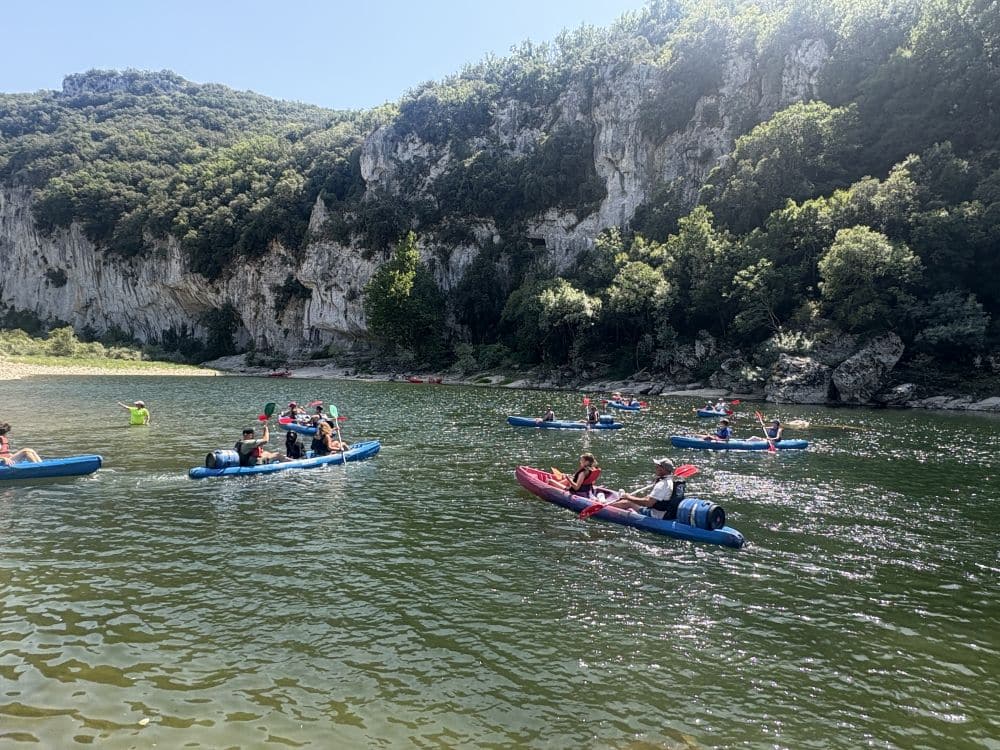
Find accommodations in Vallon-Pont-d’Arc, near Grotte Chauvet 2.
You’ll find other UNESCO sites nearby in Orange, Avignon, Arles, the Massif Central and Nîmes, as well as the Pont du Gard aqueduct.
Where is Grotte Chauvet 2?
Grotte Chauvet 2 is located in the Ardèche region at Route de Bourg-Saint-Andéol, 07150 Vallon-Pont-d’Arc, France.
If you’re driving, head for Vallon-Pont-d’Arc in the Ardèche department of southern France. From Lyon, it’s approximately two hours by car. From Montpellier, the trip will take about one and a half hours; from Avignon, roughly ninety minutes. Plenty of parking is available on site. Pick up a rental car from the airport when you arrive.
Getting to Vallon-Pont-d’Arc by public transport is possible but requires some patience. From Montélimar (the nearest large town with a TGV rail connection), you can take a bus toward Vallon-Pont-d’Arc. The journey takes around 60-90 minutes depending on the service. Check current schedules through the Ardèche regional transport website, as services are more frequent in summer.
For more information about Grotte Chauvet 2, including opening hours and admission fees, see its official website.
Have you been to Grotte Chauvet-Pont d’Arc? If so, do you have any additional information or advice about this UNESCO World Heritage site? Please add your comments below!