
SG̱ang Gwaay

By Carol Cram
What is SG̱ang Gwaay?
Listed by UNESCO simply as “SG̱ang Gwaay,” this small island at the remote southern tip of the Haida Gwaii archipelago in British Columbia, Canada, holds the remains of a 19th-century Haida village. The village contains the world’s finest collection of Haida mortuary and memorial poles, still standing where their carvers placed them.
Disclosure: This article contains affiliate links. Making a purchase through an affiliate link will mean a small commission for this website. This will not affect your price. Privacy policy.
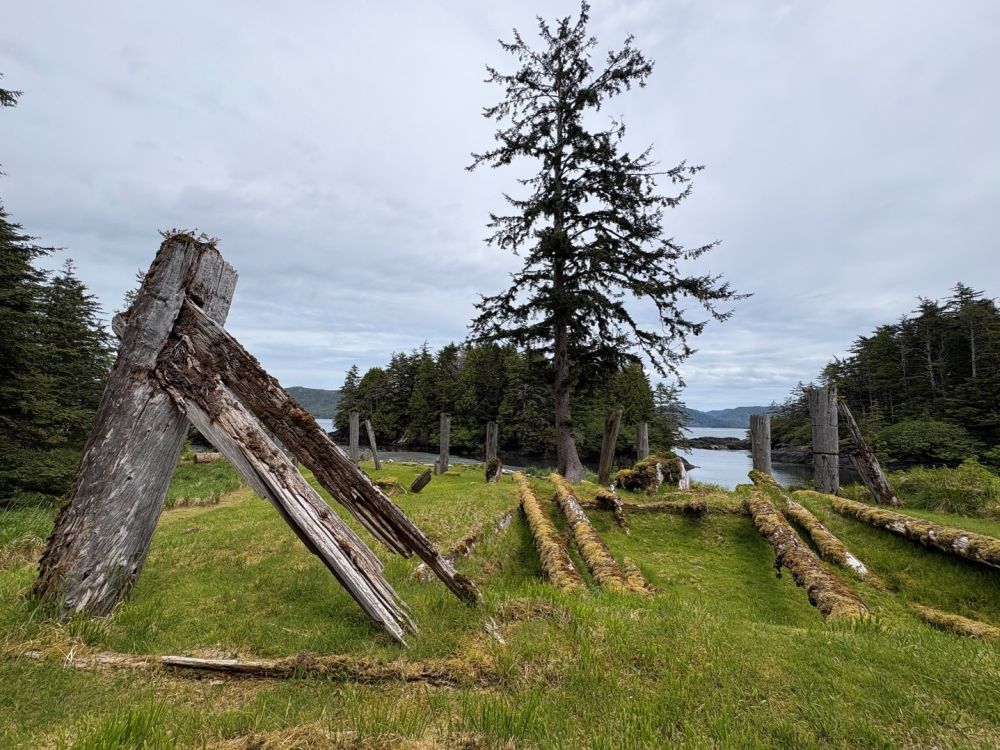
The village, SG̱ang Gwaay Llnagaay, known historically as Ninstints and once home to around 300 people, was abandoned by the end of the 19th century after smallpox epidemics devastated the Haida population. What remains is extraordinary: rows of weathered cedar poles facing the sea, along with the outlines and massive corner posts of the longhouses that once sheltered a thriving community.
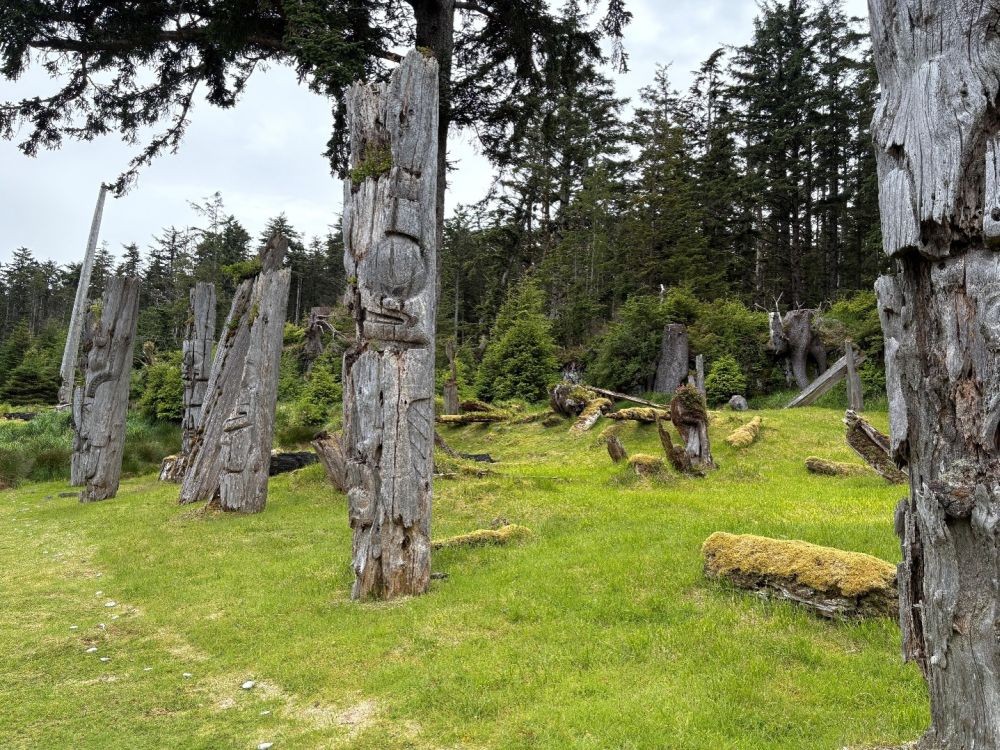
SG̱ang Gwaay (formerly called Anthony Island) lies within Gwaii Haanas National Park Reserve, National Marine Conservation Area Reserve, and Haida Heritage Site, an area co-managed by the Council of the Haida Nation and Parks Canada. There are no roads, no ferries, and no shortcuts. You reach SG̱ang Gwaay by boat, kayak, or chartered floatplane, and every visitor needs a permit.
I visited SG̱ang Gwaay on the second day of a four-day boat tour through Gwaii Haanas. I can say without hesitation that few places I’ve traveled (and I’ve been traveling for five decades) have moved me more.
Why is SG̱ang Gwaay a UNESCO World Heritage Site?
SG̱ang Gwaay was inscribed on the UNESCO World Heritage List in 1981, making it one of Canada’s earliest World Heritage Sites. The UNESCO listing describes the village as a unique illustration of Haida art and way of life, and notes that the site “commemorates the living culture of the Haida people and their relationship to the land and sea.”
The site was once a thriving village inhabited by the Kunghit Haida. Archaeological evidence shows that Haida Gwaii has been inhabited for at least 10,000 years, with the village site dating back to at least 360 CE.
The poles at SG̱ang Gwaay are not being preserved in the museum sense of the word. In keeping with Haida tradition, the intention is for a pole to stand for its natural lifetime. Then it returns to the earth, taking the spirit of the place with it. The Haida Gwaii Watchmen who care for the site do some careful maintenance. They clear vegetation and stabilize where appropriate, but the poles are slowly, deliberately, falling.
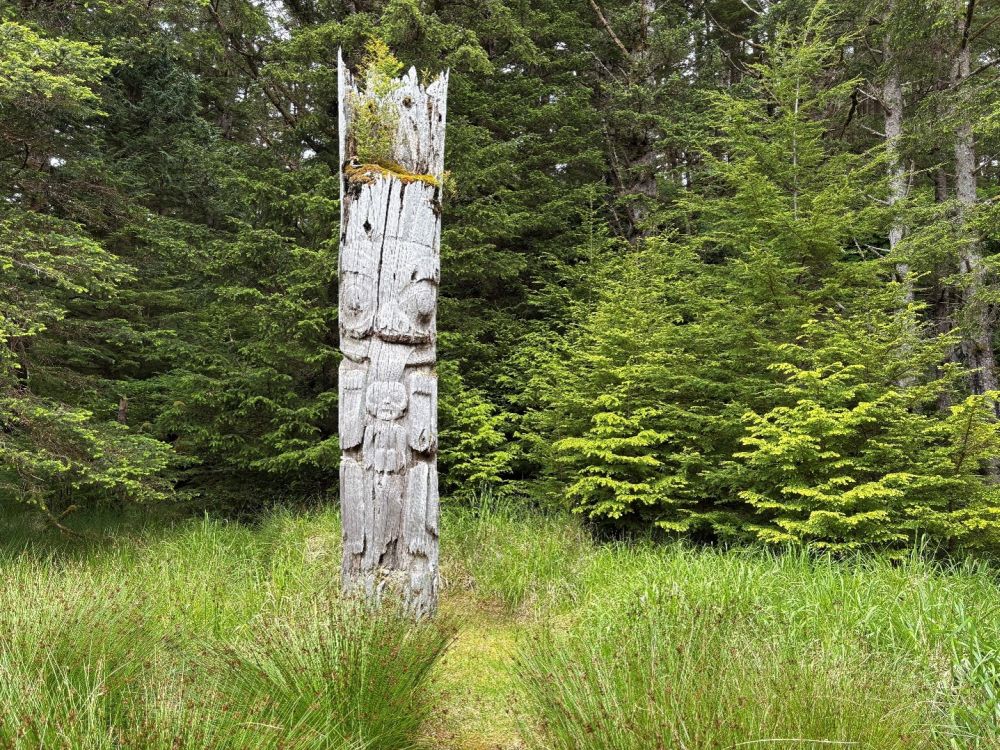
In the 19th and early 20th centuries, collectors carted off the vast majority of Haida poles and artifacts to museums around the world. They were apparently quite happy to take the objects the Haida made while the people who made them were being destroyed.
Standing in front of poles that remain exactly where The Haida first raised them, knowing they will one day lie down in the moss, is a profoundly different experience from viewing a pole in a climate-controlled gallery.
What can you expect on a visit to SG̱ang Gwaay?
Getting there is half the story. I traveled with Moresby Explorers, a tour company based in Sandspit on Haida Gwaii, on their four-day Zodiac tour through the length of Gwaii Haanas. Before boarding, each guest is issued gum boots, enormous waterproof overalls, and a floater jacket. Wedging myself into a narrow Zodiac seat while cased in semi-rigid rubber required more flexibility than I currently possess. By Day 4, I’d improved.
The Zodiac ride south takes you past snow-capped peaks, misty inlets, and waters busy with whales, sea lions, puffins, and eagles. I wore seven layers on my torso and needed every one of them, despite visiting in June.
Haida Gwaii Watchmen host all visitors to SG̱ang Gwaay. They are members of the Haida Nation who live at the site during the visitor season and welcome a maximum of twelve people at a time. The Watchmen program revives a centuries-old tradition: Haida villages once posted watchmen to scan the sea for approaching danger. Today’s Watchmen share the stories, songs, and history of the village with the visitors who make the journey.
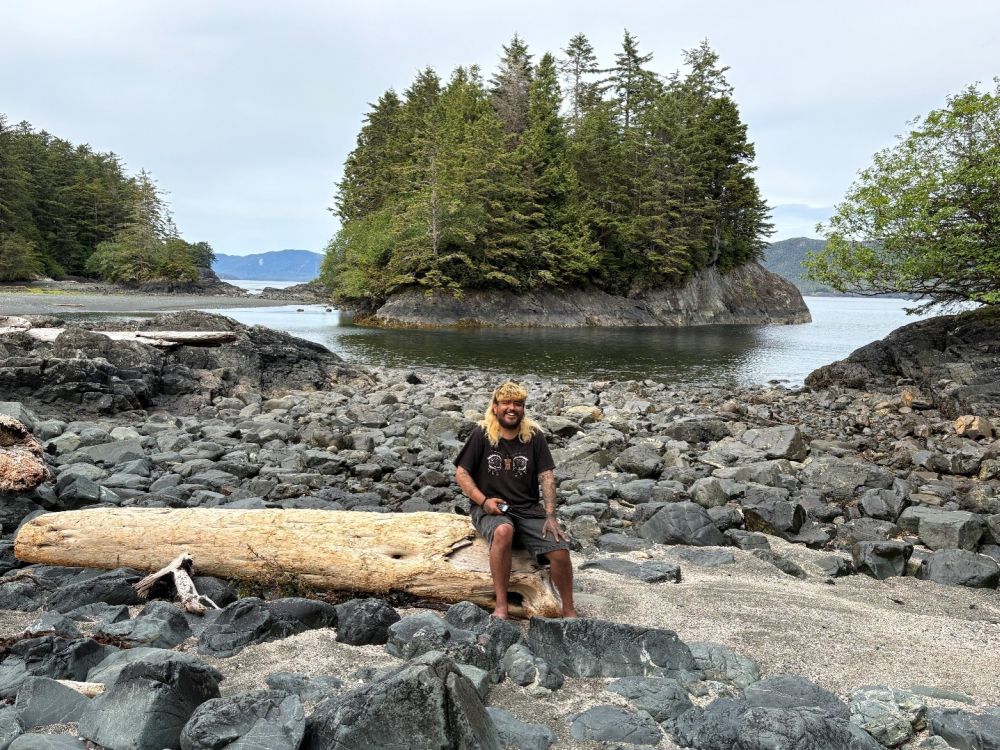
Our Watchman guide was Gavin, an energetic and passionate young man who led us barefoot along forest paths and boardwalks to our first view of the village. The moment stays with me.
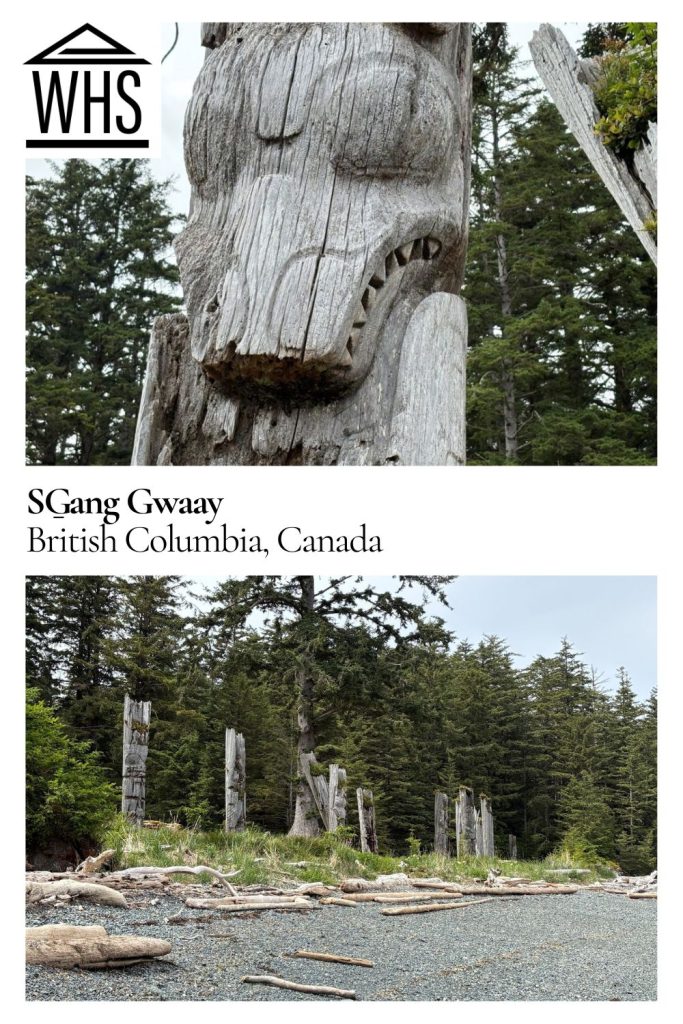
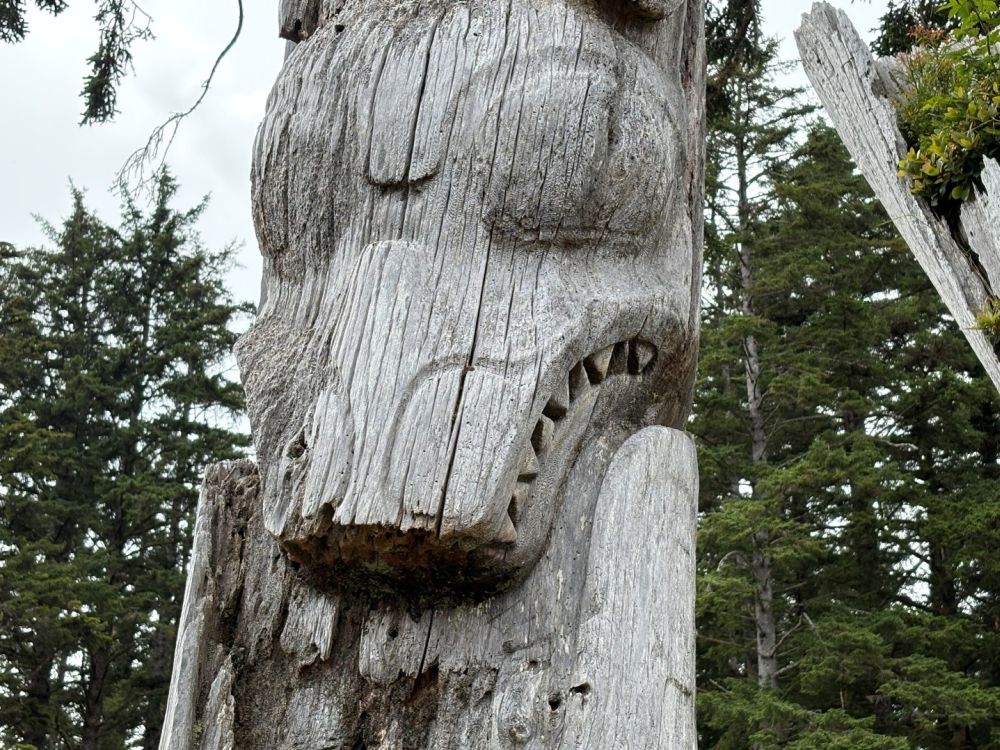
Grey, weathered poles lean at odd angles above the beach, all facing the ocean. On some, you can still trace the original carvings of eagles, ravens, bears, and killer whales. On others, a century and a half of rain and wind have softened the figures into ambiguity. Somehow this makes them more haunting rather than less.
Gavin walked us from pole to pole, describing each one and encouraging us to really look. Master carvers made these poles, working at the height of a sophisticated artistic tradition. Even in their weathered state, the quality of the work is remarkable.
Behind the poles lie the remains of the longhouses, their huge cedar beams now cradled in moss.
The site is immaculately cared for, with trails lined in white clamshells to keep visitors from straying onto fragile ground.
We were blessed with unseasonably glorious weather, sunshine and calm water in a place normally shrouded in grey mist and driving rain. After visiting SG̱ang Gwaay, our tour guide was able to take us on the Zodiac around the southern tip of the archipelago at Cape St. James, something she’d never done before because the sea is never calm enough. We even saw puffins.
As she told us often during the four-day trip, the gorgeous weather was very much not the norm. If you go, make sure you pack for heavy rains. Consider sunshine a bonus.
Is SG̱ang Gwaay worth visiting?
Emphatically yes, with one honest caveat: this is not a stop, it’s an expedition.
Unlike most World Heritage Sites, you cannot drive up, buy a ticket, and wander in. Reaching SG̱ang Gwaay requires a multi-day commitment: a flight to Haida Gwaii, then a guided boat tour, a kayak expedition, or a floatplane charter, plus a mandatory Parks Canada orientation before you enter Gwaii Haanas. The trip is a significant investment of time and money.
That’s precisely what makes it extraordinary. Only a few thousand people visit Gwaii Haanas each year, a rounding error compared to the crowds at most World Heritage Sites. There is no cell service anywhere in the protected area, which I initially found alarming and quickly came to love. For four days, nothing stood between my thoughts and the landscape.
What sorts of travelers would like SG̱ang Gwaay?
SG̱ang Gwaay will reward travelers drawn to Indigenous art and history, wilderness lovers, photographers, and anyone who believes the best places are the ones that make you work a little. If your idea of a perfect travel day includes hours on a Zodiac in waterproof overalls, beach picnics, and standing in reverent silence in front of 19th-century carvings, you’ll be in heaven.
A few honest notes. You need reasonable mobility to get in and out of a Zodiac and to walk forest trails, though our tour group ranged from mid-thirties to almost eighty and everyone managed. The weather can be cold, wet, and changeable even in July. Travelers who require constant connectivity, private bathrooms, and a firm schedule should probably choose a different World Heritage Site. Gwaii Haanas runs on weather and tides, not itineraries.
For everyone else, surrendering your phone, your schedule, and your assumptions about how a day will unfold turns out to be the whole point.
Tips for visiting SG̱ang Gwaay
Book well in advance. Access to Gwaii Haanas is controlled through permits, tour capacity is small, and the season is short (roughly May through September). Moresby Explorers offers one-day, two-day, and four-day tours. I recommend the four-day tour, which visits most of the five Watchmen sites and is the only tour that may include SG̱ang Gwaay, weather and time permitting.
Only a few companies have permits to take visitors to the area. See the list of tour operators on the official Parks Canada website. There are tours ranging from a single day to two weeks.
Manage expectations. Access to the Watchmen sites, including SG̱ang Gwaay, is first come, first served with a strict limit of twelve visitors at a time. You can’t reserve a spot ahead, and the Watchmen are under no obligation to accept visitors on any given day. Your tour operator or captain will radio ahead to check availability.
Complete the mandatory orientation. All visitors to Gwaii Haanas must complete a Parks Canada orientation before entering the protected area. Tour operators build this into their trips.
Dress in layers. Then add more layers. Seven worked for me on the water. Rain gear is essential regardless of the forecast. If you’re prone to seasickness, come prepared.
Visit the Haida Heritage Centre first. The Haida Heritage Centre at Kay Llnagaay in Skidegate, on Graham Island, provides invaluable context on Haida art, history, and the pole-carving tradition. Seeing it before SG̱ang Gwaay is like reading the program before the performance.
Stay within the clamshell-lined paths. Artifacts remain throughout the village site, many hidden beneath the moss. The Watchmen will remind you, but it bears repeating.
Sign the Haida Gwaii Pledge. Visitors to Haida Gwaii are invited to sign a pledge to travel respectfully on Haida lands and waters. Do it.
Read about the other World Heritage Sites in Canada.
Where is SG̱ang Gwaay?
SG̱ang Gwaay sits at the far southern end of the Haida Gwaii archipelago, off the northwest coast of British Columbia. It’s about 100 kilometers (62 miles) from the southern tip of the Alaska Panhandle.
To get there, fly from Vancouver to Sandspit on Moresby Island (a two-hour direct flight). I stayed at the Seaport B&B in Sandspit, conveniently owned by Moresby Explorers and located next door to their office, before and after my tour. Alternatively, fly via floatplane from Prince Rupert to the airport near Masset on Graham Island and connect via road and ferry to Moresby Island.
The other option is to take a BC Ferry from Prince Rupert to Skidegate on Graham Island. The crossing takes 8 hours.
From Sandspit, licensed operators run boat tours south through Gwaii Haanas to SG̱ang Gwaay.
If you have extra days, rent a car and explore Graham Island, including the Haida Heritage Centre in Skidegate, a short ferry ride from Sandspit.
Here are some accommodation options in Sandspit or on Graham Island.
For official information on permits, orientation, and trip planning, visit the Parks Canada Gwaii Haanas page.
Have you been to SG̱ang Gwaay? If so, do you have any additional information or advice about this UNESCO World Heritage site? Please add your comments below!