
Archaeological Site of Aigai (modern name Vergina)
By Teja
What is the Archaeological Site of Aigai?
The Archaeological Site of Aigai is the site of the ancient first capital of the kingdom of Macedonia. It was the seat of the Temenid dynasty, which united the Hellenic world under Alexander the Great. He then expanded Greek influence into Africa and Asia.
Re-discovered in the 19th century in the present-day town of Vergina, the archaeological site comprises the ancient city of Aigai and a necropolis, as well as a Bronze Age settlement and burial tumuli. Of these, the most important remains are the royal tombs in the necropolis, and the monumental palace.
Disclosure: This article contains affiliate links. Making a purchase through an affiliate link will mean a small commission for this website. This will not affect your price. Privacy policy.
The excavated city includes Aigai’s monumental palace (340 BC), which was, UNESCO states, “the biggest and one of the most impressive buildings of classical Greece.” There is also a theatre, sanctuaries dedicated to Eukleia and the Mother of the Gods, city walls, and over 500 royal tumuli (tomb mounds) dating to the 11th-2nd century BC. Some tombs are particularly significant, including the tombs of Phillip II (father of Alexander the Great); Euridice (the mother of Philip II); and Phillip II’s grandson, Alexander IV.
Why is the Archaeological Site of Aigai a UNESCO World Heritage site?
The ruins of Aigai, according to UNESCO, provide “important information about the culture, history and society of the ancient Macedonians, the Greek border tribe that preserved age-old traditions, and carried Greek culture to the outer limits of the ancient world” during the reign of the Temenid kings Philip II and Alexander III (i.e. Alexander the Great).
The cemetery and the ruined city “contain original and unique historical, artistic and aesthetic achievements of the late classical art of extraordinarily high quality and historical importance.” Together, they illustrate “a significant development in European civilization, at the transition from the classical city state to the imperial structure of the Hellenistic and Roman periods.”
What can you expect on a visit to the Archaeological Site of Aigai?
A full visit to the Archaeological Site of Aigai actually encompasses several sites at three locations: the Royal Tombs, the Polycentric Museum, and the ruins of the Macedonian palace. Most tours focus on the Royal Tombs, but the ticket usually includes entry to the Polycentric Museum as well, which is at a different location.
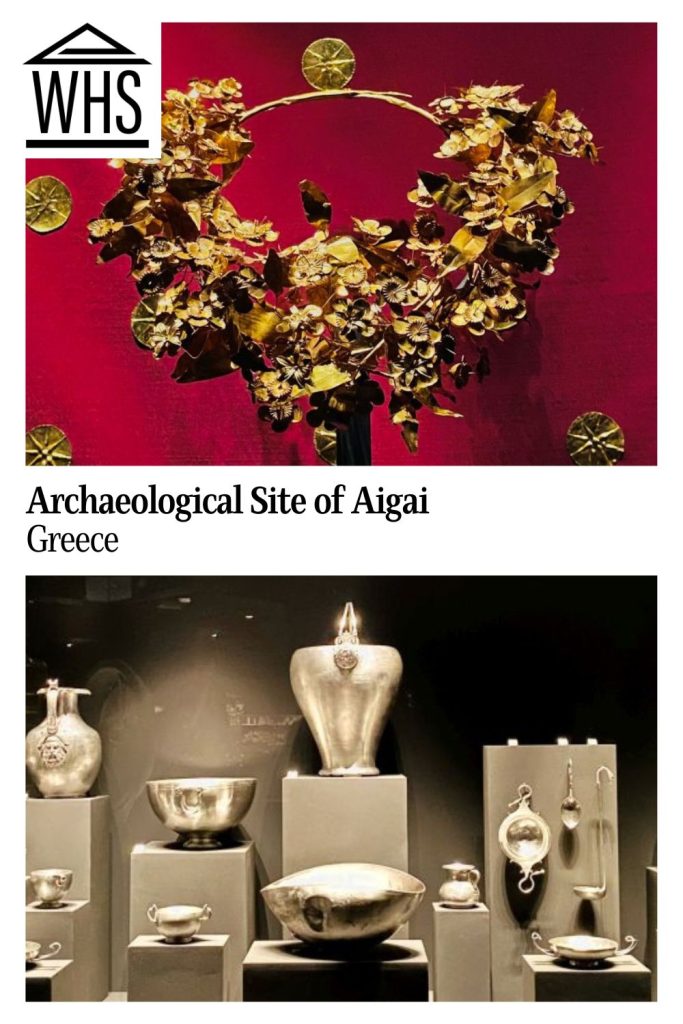
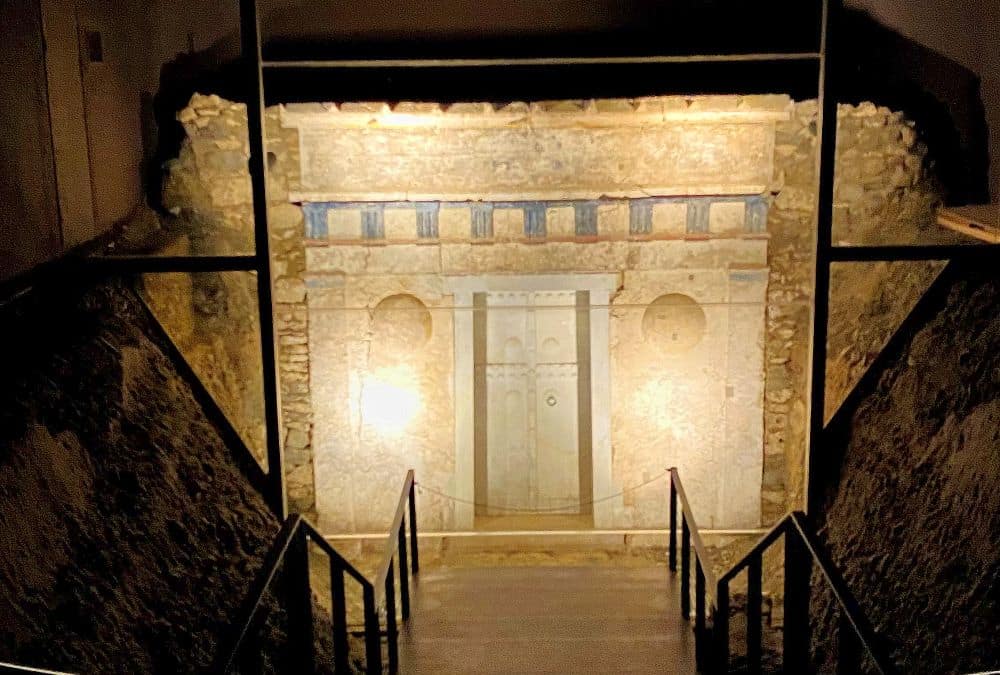
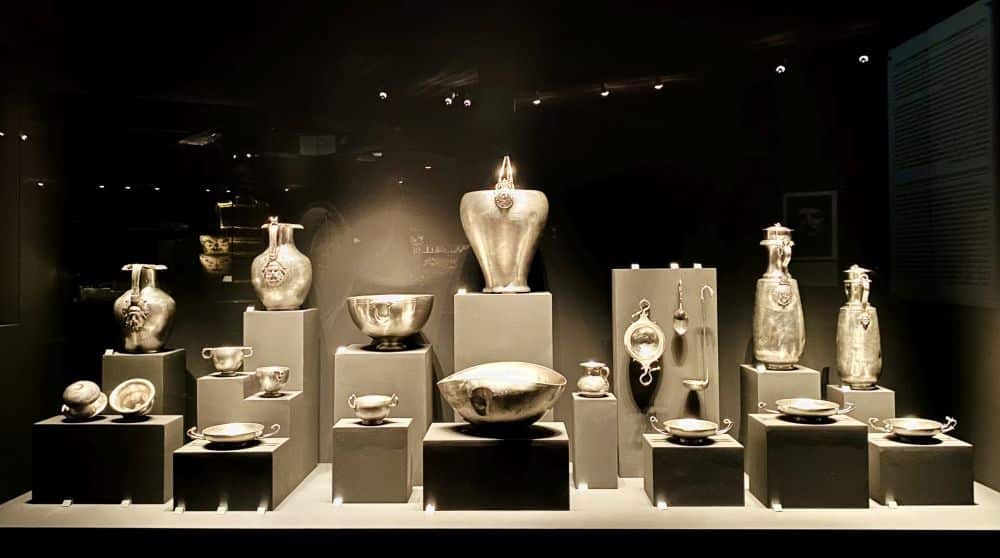
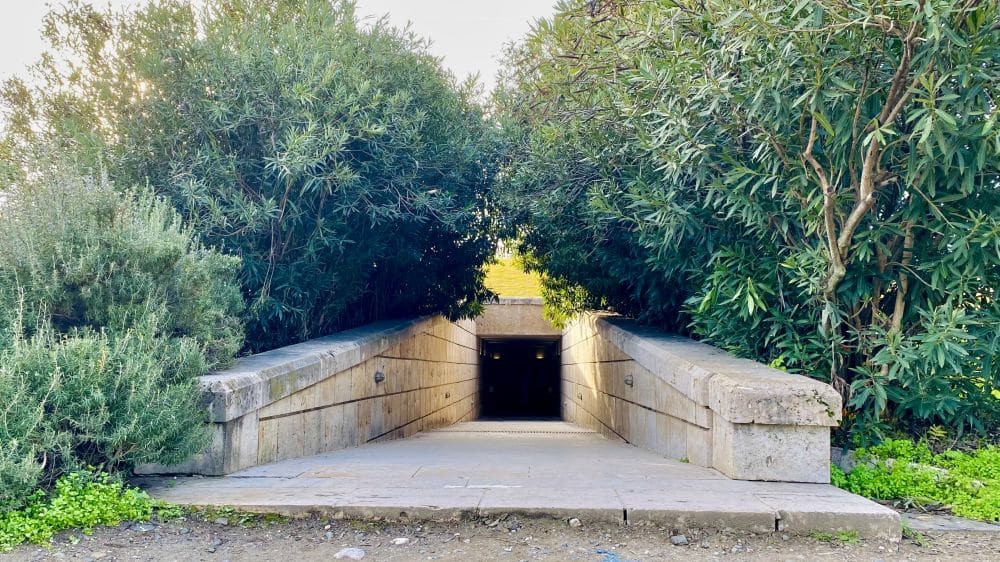
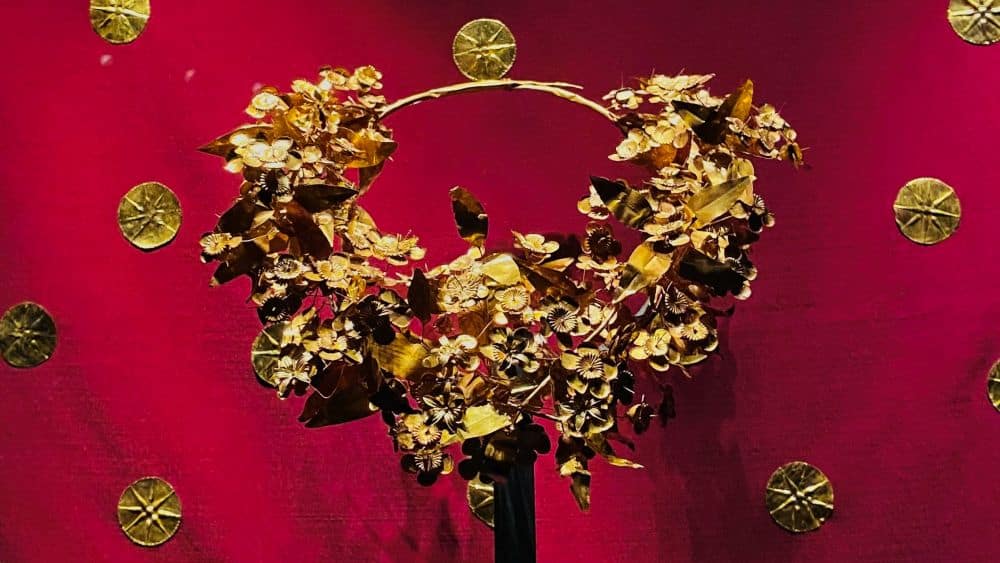
It is easy to see why the Royal Tombs is the centrepiece. Most ancient tombs have been looted, but the tomb of Philip II somehow escaped it. Thus its discovery revealed the lavish burial goods that his son Alexander the Great had ordered for him, completely intact. Visiting the Royal Tombs takes you to a museum displaying these incredible treasures, as well as the burial goods of another intact tomb, thought to belong to Philip’s grandson. The museum also provides context on the Macedonian worldview of the afterlife. You can see the sealed tombs from inside the museum.
It is also possible to visit the palace ruins. This complex is about 1km away from the Museum of the Royal Tombs, and only accessible by walking. The ruins comprise several important sites: the ancient palace of Aigai, the adjacent theatre where Philip II was dramatically assassinated, and the key religious buildings of Aigai. However, in 2025 the ruins were still in the process of restoration and excavation, and were not quite ready for visitors.
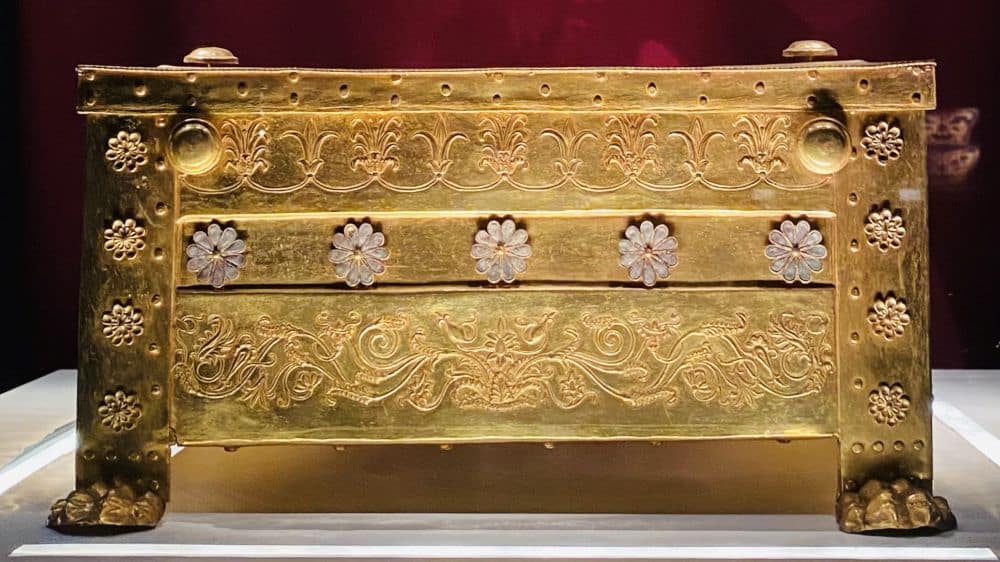
Both the above locations are part of the Polycentric Museum concept for the ancient site of Aigai. The multi-site concept is a means to provide visitors an experience for the whole UNESCO site, in consideration of the layout of the original settlement. It also protects certain of its monuments. The third location for visitors is the Central Building, which houses a collection of excavated items from across the ancient site of Aigai. It serves as the gateway to Macedonian culture and history, and the extent of the Hellenic world of Alexander the Great’s empire.
Is the Archaeological Site of Aigai worth visiting?
Aigai is one of Europe’s most important archaeological sites. If you’re travelling in mainland Greece, the Royal Tombs are worth going to northern Greece to see. Tours from Thessaloniki usually take a day, and normally include another site along the way, such as Pella.
Travellers with an interest in Greek culture, history, and the legend of Alexander the Great, would best appreciate Aigai. For these, the Royal Tombs are worth travelling to Greece for. The other two locations in Aigai are worth adding to a visit to the Royal Tombs (after Pella), but may not be worth travelling to for themselves.
Tips for visiting the Archaeological Site of Aigai
There are several related Macedonian points of interest in the region of Aigai. For most tourists, a visit to the Aigai Royal Tombs would suffice. However, if you want to see all the sites related to the Temenid dynasty, you need to take multiple tours or rent a car.
Most tours to the Archaeological Site of Aigai depart from Thessaloniki. Tours usually focus on the Royal Tombs, though some may also include the Polycentric Museum. However, a common tour variation is the combination of the Aigai Royal Tombs with Pella. Pella was the new capital of Macedonia that King Philip II founded. The Pella ruins is an easy detour along the route to Aigai, and has an excellent museum attached.
Take this group tour to the Royal Tombs and Pella from Thessaloniki.
If you’re going on your own, get the e-ticket for the Polycentric museum and tombs ahead of time. It includes an audio tour.
Note that in the winter, the mosaics in the ruins of Pella are covered to protect them. Visit Pella before the winter season to see the in situ mosaics. Alternatively, there are other mosaics that have been moved into the Pella Archaeological Museum, which can be viewed year-round.
Take a look at accommodations options in Thessaloniki or Vergina.
If you’re on a self-drive trip, you can also visit the Cultural Centre of Aristotle’s School in Mieza. This museum is attached to the Nymphaeum of Mieza, where Aristotle set up his school to educate Alexander the Great and his famous companions.
Regardless of whether you’re just going to the Royal Tombs or driving to all of the ancient Macedonian sites, visit the Archaeological Museum in Thessaloniki beforehand. It gives a very good overview and historical context of Macedonia and its two most famous kings.
The region also has significant early Christian and Byzantine sites, especially in Thessaloniki. The city’s 15 Byzantine monuments – mostly churches and monasteries – together form a UNESCO site. Christian travellers may want to opt for a tour that includes Veria too, which was among the earliest places where the Apostle Paul preached.
This group tour includes Veria, the Royal Tombs, and Pella.
This private tour goes to Veria, the Royal Tombs, and the Polycentric Museum.
If your trip involves self-driving on the Greek mainland, consider a stop of a couple of days in Meteora to see its dramatic UNESCO-listed monasteries poised atop high rocks.
Where is the Archaeological Site of Aigai?
The locations associated with the Archaeological Site of Aigai are around the small town of Vergina, about an hour’s drive from the nearest city, Thessaloniki. Free parking is available at the Royal Tombs and the Polycentric Museum. The palace ruins are about a 1km walk from the Royal Tombs.
There are no bus routes between Thessaloniki and Vergina. However, you can take a train or a bus from Thessaloniki to the town of Veria, which is 8km (5mi) away from Vergina. By intercity train, it takes about an hour. By bus, Veria is a stop about 1.5 hours into the Thessaloniki-Corfu Green Buses service.
From Veria, you can take a bus to Vergina. However, it is a little tricky because there isn’t a dedicated tourist bus. You have to take a KTEL bus (Greece’s bus company) that passes through Vergina. KTEL is run regionally rather than centrally, and they each have separate websites. Unfortunately, the KTEL Imathias website is not very user-friendly. It is difficult to find the routes that pass through Vergina and the approximate times. Additionally, routes and schedules may vary by season. If you plan to go to Vergina by bus from Veria, enquire beforehand or ask locally.
For more information about how to visit the Archaeological Site of Aigai, its admission fees and opening hours, see the official website.
Have you been to Aigai? If so, do you have any additional information or advice about this UNESCO World Heritage site? Please add your comments below!
- About the author
- Posts by this author
Text and photos provided by Teja of Teja on the Horizon. Teja is an environmental scientist and a sustainable travel storyteller on a voyage for homes in a thousand strange places. Teja writes to inspire insightful travel.